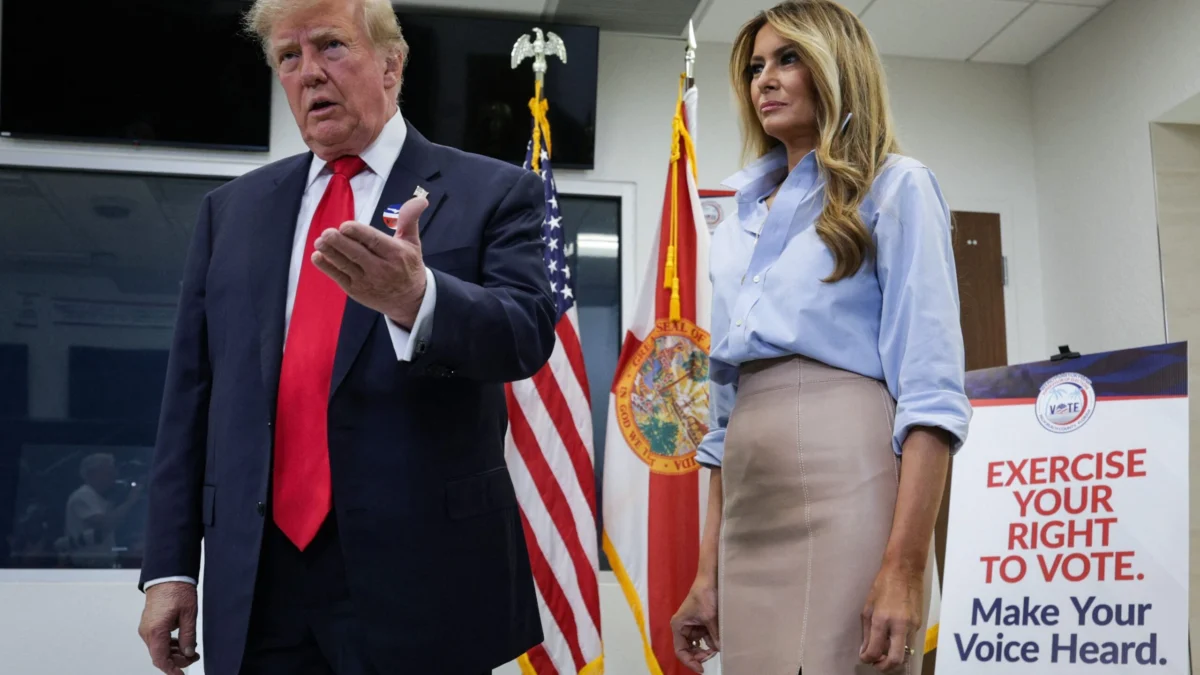
As the United States hurtles toward the midterm elections, the political atmosphere in Washington and across the country has reached a boiling point. President Donald Trump, currently navigating a complex landscape of legal, diplomatic, and domestic policy challenges, has officially cast his vote in Florida, signaling the start of the final push for his party.
The midterms represent a critical juncture for the Trump administration. With control of both chambers of Congress hanging in the balance, the President has mobilized unprecedented financial resources to secure a Republican majority. However, as recent polling suggests, the path to victory remains fraught with obstacles, ranging from economic headwinds to international friction.
The Core Facts: A Presidential Stance
On Friday, President Donald Trump, accompanied by First Lady Melania Trump, arrived at a polling station in West Palm Beach, Florida, to cast his vote in person. His appearance at the local ballot center, located near his Mar-a-Lago estate, was highly symbolic. Following the act of voting, the President displayed his "voted" sticker, a visual rebuttal to persistent criticisms regarding his past skepticism of mail-in ballots.

For months, the President has campaigned on a platform of tightening election integrity, specifically targeting mail-in voting protocols. His critics have frequently pointed to a perceived hypocrisy, noting that the President himself has utilized alternative voting methods in the past. By voting in person, Trump sought to align his public actions with his legislative agenda, which aims to curb mail-in voting—a move his opponents argue is designed to suppress voter turnout among Democratic demographics, who traditionally favor postal ballots.
Chronology of Escalating Tensions
The weeks leading up to the midterms have been defined by a series of high-profile controversies and strategic maneuvers:
- Mid-October: The Department of Justice (DOJ) confirms it is examining allegations against long-time Trump confidant Corey Lewandowski. The investigation centers on claims of personal enrichment during his tenure at the Department of Homeland Security.
- Late October: Tensions with Canada escalate after the US Embassy in Ottawa issues an information sheet accusing Canadian officials, including Prime Minister Mark Carney, of attempting to influence US domestic politics.
- Late October: President Trump classifies the import of wind energy components as a threat to national security, initiating a 180-day review period for potential trade barriers.
- Present Day: The Supreme Court intervenes in a dispute regarding the medical care of transgender inmates, blocking the administration’s attempt to cut funding for gender-affirming procedures.
Supporting Data: The Cost of Influence
The financial scale of the current election cycle is unprecedented. Reports indicate that political action committees (PACs) associated with the President have funneled approximately $277 million into the midterm campaigns.

Key expenditures include:
- $200 million allocated to the "No Going Back" PAC.
- $25 million directed to the "Safety & Affordability" PAC.
- $80 million in independent funding provided by billionaire Michael Bloomberg to support Democratic candidates, aiming to flip critical seats in the House of Representatives.
These figures illustrate a scorched-earth financial strategy. As GOP strategists note, this is the highest level of spending by an incumbent president for midterm elections in modern US history, reflecting the administration’s acute anxiety over the potential loss of congressional control.
Official Responses and Diplomatic Friction
The international community has taken note of the volatility in Washington. The Canadian government, caught in the crossfire, has issued strict internal directives to its diplomatic corps. According to reports, Canadian officials are now prohibited from attending events with US congressional candidates without explicit authorization to avoid accusations of foreign interference.

Prime Minister Mark Carney dismissed the US allegations as "unfounded," expressing profound disappointment in the rhetoric employed by US Ambassador to Canada, Pete Hoekstra. The dispute is further complicated by threats from the Trump administration to integrate Canada into the US as a 51st state, a rhetoric that has deeply unsettled Ottawa.
Simultaneously, the administration’s foreign policy is facing scrutiny at home. CDU foreign policy expert Norbert Röttgen (Germany) has warned that if the President faces a setback in the midterms, he may pivot to a more aggressive foreign policy to distract from domestic political failures. "He will likely put everything on his political legacy—ending wars—regardless of the impact on allies," Röttgen stated.
Implications: A Nation at a Crossroads
The implications of these midterms extend far beyond the legislative agenda.
The Judiciary and Social Policy
The Supreme Court’s decision to temporarily halt the administration’s cuts to medical care for transgender inmates highlights the ongoing friction between the executive branch and the judiciary. This legal battle is a microcosm of the broader cultural conflict defining the election. The administration’s focus on border security, specifically the continuation of the wall in Texas, remains a primary campaign pillar, despite staunch opposition from environmental groups and local ranchers.
Economic Policy and Energy
The designation of wind energy imports as a national security risk has sent shockwaves through the renewable energy sector. By linking environmental policy to trade security, the President is attempting to reframe the debate around energy independence. However, with housing starts declining by 5.2% in September, economic anxiety remains the primary concern for the average American voter.
The Media Landscape
Perhaps the most concerning development for civil society is the reported plan to potentially restrict press access to the White House. The reported directive, which aimed to replace the traditional press briefing room with a limited pool, suggests a hardening stance toward the Fourth Estate. While the resignation of former Press Secretary Karoline Leavitt stalled these plans, the sentiment remains a point of contention among journalists and free-press advocates.

The Road to November 3rd
As the final ballots are prepared, the focus shifts to the battleground states. In Texas, the Senate race between Republican Ken Paxton and Democrat James Talarico has become a bellwether for the country. The fact that Neil Bush, brother of former President George W. Bush, has publicly endorsed a Democratic candidate speaks volumes about the shifting alliances within the Republican party.
Furthermore, the administrative errors in California, where 7,800 voters received duplicate ballots, provide fodder for both sides of the aisle. While officials have labeled the incident a standard logistical failure by a third-party printer, the incident highlights the fragility of the electoral process in a hyper-polarized environment.
Conclusion: The Verdict of the Voter
The President’s personal investment of over $300 million—with plans to hit $400 million by election day—is a testament to his belief that this election is a referendum on his governance. With approval ratings hovering at 31%, the lowest in his presidency, the results of the midterms will undoubtedly reshape the trajectory of the American political landscape for years to come.

Whether the administration succeeds in its mission to retain control of Congress or faces a legislative stalemate, the events of these final weeks have demonstrated one thing clearly: the stakes could not be higher. As citizens head to the polls, they are not merely voting for candidates; they are casting a vote on the future direction of the American experiment.
Key Statistics Summary:
- Projected Election Spend: $400 million+ (Trump-aligned groups).
- Democratic Support: $80 million (Bloomberg contribution).
- Approval Rating: 31% (Reuters/Ipsos).
- Visa Revocations: 300,000+ (during the current term).
- Housing Market: 5.2% decline in new construction starts.
This report is based on current electoral developments and ongoing federal investigations. Further updates will be provided as additional data becomes available.