For over a decade, Bosch eBike Systems has been the undisputed heavyweight champion of the electric bicycle industry. Its mid-drive motors—the Performance Line, the Cargo Line, and the CX series—have set the gold standard for power, reliability, and integration. However, there has always been a noticeable gap in the German giant’s portfolio: the absence of a hub motor.
That gap is now closed. With the official unveiling of the "Hub Line," Bosch is pivoting to capture the growing segment of urban commuters, weight-conscious cyclists, and those who demand an e-bike that looks and handles like a traditional bicycle.
The Strategic Shift: Why Bosch Needed a Hub Motor
For years, Bosch focused exclusively on the mid-drive configuration, arguing that placing the motor at the bottom bracket provides the most natural riding dynamics and optimal weight distribution. While this remains true for heavy-duty cargo bikes and mountain bikes, the market has shifted.
A new generation of riders, particularly in dense urban environments, is looking for "stealth" e-bikes. These users want bikes that are light enough to carry up a flight of stairs and aesthetically indistinguishable from non-electric bicycles. Until now, these riders were forced to look at competitors like Mahle, Fazua, or direct-to-consumer brands like Cowboy and VanMoof. By launching the Hub Line, Bosch is finally addressing this "minimalist" market segment with the weight of its massive service network behind it.
Technical Specifications: The Core of the Hub Line
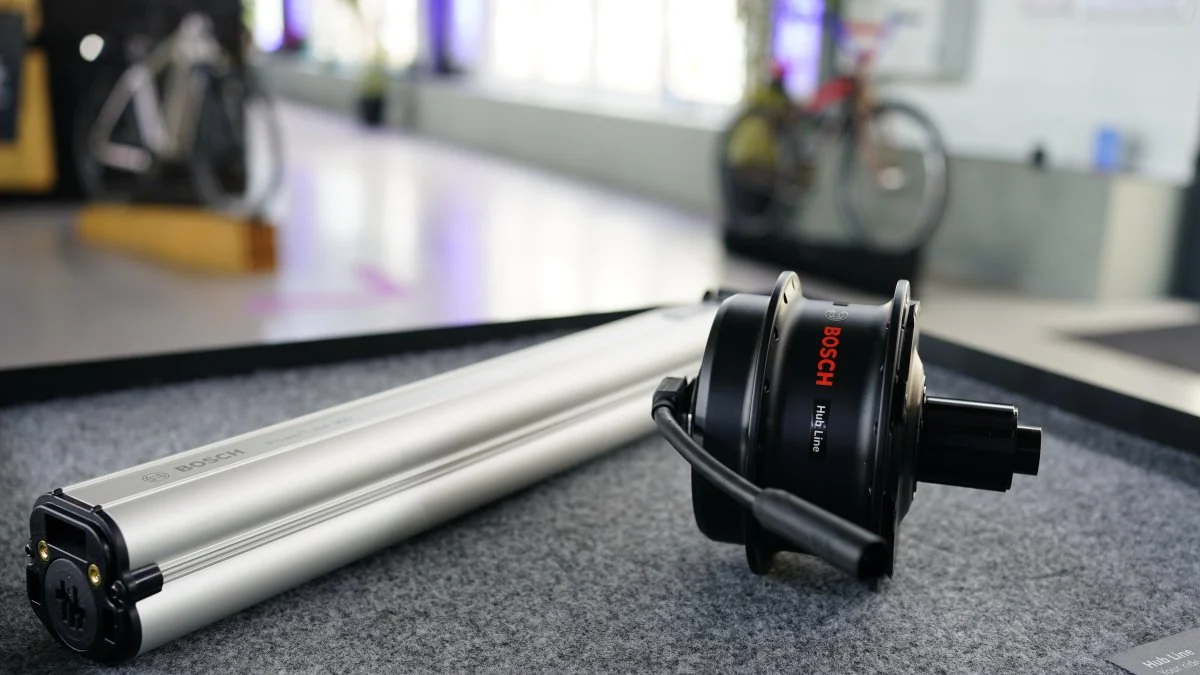
At the heart of the new system is the Hub Line motor itself. Weighing in at just 2.3 kilograms and measuring a compact 100 millimeters in diameter, the unit is remarkably unobtrusive.
Key Performance Metrics
- Peak Power: 400 Watts
- Nominal Continuous Power: 250 Watts
- Torque: 45 Nm
While 45 Nm of torque might seem modest compared to the 85 Nm found in Bosch’s Performance Line CX, it is perfectly positioned within the competitive landscape of urban e-bikes. For comparison, premium "smart" bikes from Ampler and Cowboy typically utilize motors with similar torque figures. By focusing on a power-to-weight ratio rather than raw, tire-shredding torque, Bosch has created a motor that prioritizes agility and efficiency over raw climbing force.

The PowerTube 360
To complement the motor, Bosch has introduced the PowerTube 360, a slimline battery measuring only 68 millimeters in width. With a capacity of 360 Wh, it offers an estimated range of up to 80 kilometers in the lowest support mode. Bosch has left the integration design up to the individual manufacturers, allowing for either permanently integrated batteries for a sleek, clean look, or removable designs for apartment dwellers who need to charge away from their bikes.
Chronology: From Concept to Consumer
The development of the Hub Line represents a multi-year effort to miniaturize Bosch’s technology without sacrificing the reliability that defines the brand.
- Initial Development Phase: Bosch began identifying the need for a rear-hub system as consumer trends shifted toward lightweight, "acoustic-looking" e-bikes.
- Collaboration Phase: Rather than developing the system in total isolation, Bosch worked closely with key industry partners—including Canyon, Gazelle, Moustache, and Nicolai—to ensure the motor fit into a variety of frame geometries.
- Testing and Refinement: Throughout the testing phase, the focus was on the "invisible" integration. The goal was to ensure the motor was not just a bolt-on component, but a central feature of the bike’s industrial design.
- Launch: The product was officially unveiled to the press, accompanied by the announcement of the first wave of bikes, including the flagship Canyon Roadlite:ON CF.
The "Invisible" Integration: Design Flexibility
One of the most significant advantages of the Hub Line is its impact on frame design. Unlike mid-drive motors, which require specific frame reinforcements and complex mounting interfaces at the bottom bracket, the Hub Line is housed entirely within the rear wheel.
This gives bicycle manufacturers unprecedented freedom. Because the motor does not interfere with the drivetrain, designers can easily pair the system with a traditional chain, a high-end derailleur system, or, perhaps most attractively, a belt drive. Through a partnership with Universal Transmissions, manufacturers can even integrate the "UTgear H2," a two-speed hub gear that allows for the combination of a clean, maintenance-free belt drive with the versatility of a multi-speed system.
The Canyon Roadlite:ON CF: A Case Study in Performance
We had the opportunity to take the new Canyon Roadlite:ON CF for a test ride, and the results were illuminating.
The Ride Experience
The bike is an exercise in minimalism. In its standard trim—complete with a belt drive, kickstand, and integrated lighting—it tips the scales at approximately 15 kilograms. If you strip away the optional fenders, that weight drops to an impressive 13.9 kilograms. To put that into perspective, there are many non-electric hybrid bikes on the market that weigh significantly more.

The support modes—Eco, Tour, and Sport—provide a natural, intuitive assist. The automatic mode, in particular, is a highlight; it reads the rider’s input and adjusts the power delivery seamlessly. While the motor produces a faint, high-frequency hum, it is far from intrusive.
On flat terrain, the bike is incredibly fast. Once you surpass the 25 km/h assistance limit, the motor decouples completely. There is virtually no drag, meaning the bike feels like a high-end, lightweight fitness bike. It is a joy to ride even without the motor engaged, which is the ultimate test of a good e-bike design.
Implications for the Market: The Bosch Service Advantage
The most profound impact of the Hub Line is not necessarily the motor’s raw power, but the service infrastructure it brings to the table.
For years, owners of "direct-to-consumer" smart bikes have struggled with long wait times for repairs, proprietary parts that are difficult to source, and a lack of certified service centers. Bosch, by contrast, possesses the largest network of specialized e-bike dealers in the world. By adopting the Hub Line, a bicycle brand instantly gains access to this massive support system.
If your Bosch-powered bike breaks down in a foreign city or a small town, the likelihood of finding a shop that can plug in a diagnostic tool and order a replacement part is exponentially higher than with a niche manufacturer. This creates a compelling "peace of mind" value proposition that will be hard for competitors to ignore.
Official Perspective: Claus Fleischer’s Vision
During the presentation, Claus Fleischer, the General Manager of Bosch eBike Systems, emphasized the philosophy behind the project. "The goal was to create an experience where the technology disappears," Fleischer noted. "The rider should feel the benefit of the power without being reminded of the machinery behind it."

This focus on the "invisible" experience is central to Bosch’s strategy moving forward. By making the motor smaller and the controller interface more discreet—with options ranging from minimalist LED indicators to clean 2.4-inch monochrome displays—Bosch is catering to a new demographic of riders who value aesthetics as much as performance.
Future Outlook: A New Standard?
The arrival of the Hub Line is a watershed moment for the e-bike industry. It signals that the market for lightweight, agile city bikes has matured enough to warrant a dedicated investment from the industry leader.
While mid-drive motors will continue to dominate the mountain and cargo bike segments, the Hub Line is poised to take a significant share of the urban commute market. As battery technology continues to shrink and connectivity via the Bosch app becomes more integrated, we can expect to see the Hub Line evolve into an even more powerful, efficient, and intelligent system.
For the consumer, the choice has never been better. With the Canyon Roadlite:ON CF retailing at approximately 3,000 euros, the barrier to entry for a premium, lightweight, and service-supported e-bike has been significantly lowered. As more manufacturers integrate the Hub Line into their 2025 and 2026 lineups, the "stealth e-bike" is set to move from a niche curiosity to the mainstream standard.
In conclusion, Bosch has successfully managed to take its legendary reliability and transplant it into a form factor that satisfies the modern urbanite. The Hub Line is not just a new product; it is a new chapter for the world’s largest e-bike drive manufacturer.