DÜSSELDORF – They are impossible to ignore: gargantuan, rotund, and unapologetically vibrant. Known as the "Nanas," the iconic female figures created by French-Swiss artist Niki de Saint Phalle have long served as cultural landmarks, most famously at the Leibnizufer in Hanover. However, a sweeping new retrospective titled Dream Machine, which opened today at the Kunstpalast in Düsseldorf, invites the public to look past the colorful exterior to uncover the profound, often harrowing, history that fueled one of the 20th century’s most complex artistic legacies. Running through February 7, 2027, the exhibition offers an unflinching look at an artist who used joy as a weapon against trauma and patriarchy.
The Evolution of an Icon: From "Knödel" to Cultural Treasure
The term "Nana," borrowed from French slang, denotes a sassy, self-confident, and overtly erotic woman. When Saint Phalle first unveiled these larger-than-life sculptures in the 1960s, the reception was far from the celebratory adoration they receive today.
When the three Nanas—Sophie, Charlotte, and Caroline—were installed in Hanover in 1974, they ignited a firestorm of public protest. Critics of the era, deeply entrenched in traditionalist views of aesthetics, disparaged the works as "misshapen dumplings" (unförmige Knödel) and "disgusting abominations." For Saint Phalle, this vitriol was not a failure but a triumph. She sought to shatter the "ideal" of the slender, passive female body, replacing it with a celebratory, expansive, and messy form of femininity.
Today, that narrative has shifted entirely. Hanover proudly counts Saint Phalle as its only female honorary citizen, and the Nanas are regarded as symbols of the city’s progressive spirit. Yet, the exhibition in Düsseldorf meticulously documents that this journey from social pariah to icon was built on a foundation of radical resistance.
Chronology of a Creative Rebellion
To understand the trajectory of Niki de Saint Phalle, one must look at the timeline of her evolution, which serves as the backbone of the Dream Machine exhibition.
- 1930: Born in Neuilly-sur-Seine, France, into an aristocratic family. Raised in New York, she was subjected to a rigid, patriarchal Catholic upbringing that demanded submissiveness.
- The 1950s: Following a nervous breakdown and psychiatric hospitalization—including the use of electroshock therapy—Saint Phalle turned to painting as a form of self-preservation. She famously described art as her "salvation and necessity."
- 1961: The birth of the "Tirs" (Shooting Paintings). Saint Phalle began affixing bags of paint to plaster relief assemblages, using a rifle to rupture them. The resulting drips of pigment represented the bleeding of her inner trauma.
- 1966: The creation of Hon – en katedral (She – a cathedral) in Stockholm, in collaboration with Jean Tinguely. This 29-meter-long, reclining Nana was a landmark moment in installation art. Visitors entered the sculpture through the vagina to find a cinema, a planetarium, and a milk bar in the breast.
- 1974: The installation of the Hanover Nanas, marking the transition from her darker, explosive period into a more public, sculptural phase of "subversive joy."
The "Shooting Paintings": Art as Catharsis
A central pillar of the Dream Machine exhibition is the examination of Saint Phalle’s "Shooting Paintings." These works represent the pivot point in her career, where she transformed raw, unbridled rage into a performative act of creation.
"Using a rifle is traditionally a male-dominated act," explains Heike van den Valentyn, the curator of the Kunstpalast exhibition. "By taking that tool of violence and repurposing it, she didn’t just destroy; she created something entirely new. She was reclaiming her agency."
The curators argue that the violence inflicted upon these canvases was a direct response to the childhood sexual abuse she suffered at the hands of her father—a trauma she only publicly disclosed in her 1994 autobiography. By shooting the paintings, she was not just attacking an object; she was dismantling the silence that had been forced upon her for decades.
The Subversive Power of Joy
As the retrospective demonstrates, Saint Phalle eventually moved away from the literal violence of the shooting paintings, but she did not abandon the intent behind them. Instead, she pivoted toward "the subversive power of joy."
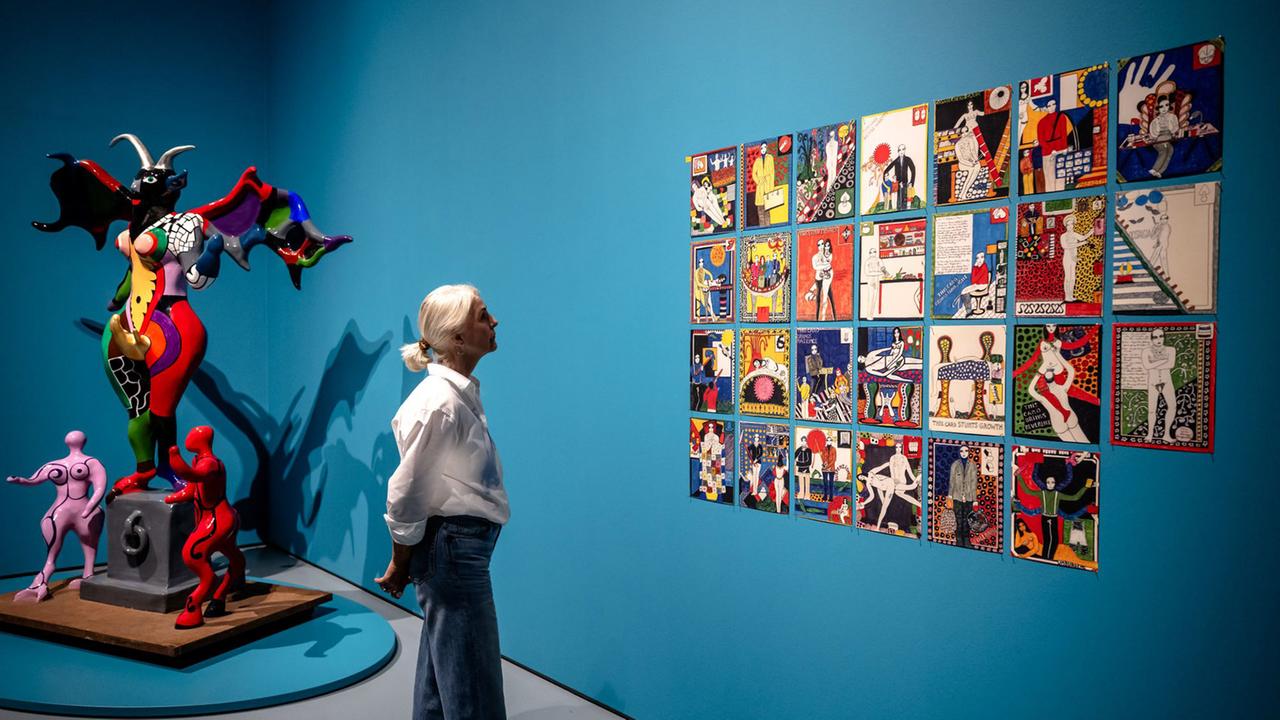
She realized that a positive, colorful, and monumental aesthetic could be just as provocative as a bullet. By creating figures that demanded space and exuded unapologetic pleasure, she challenged the art world’s preoccupation with masculine, minimalist, or conceptual rigor.
"She wanted to change the power dynamics and bring female-centric topics—pregnancy, birth, and the ambivalence of motherhood—to the forefront," says van den Valentyn. "In the 1960s, her work was often dismissed as ‘decorative’ or ‘naive’ because it was colorful and joyful. Today, we recognize the immense political weight behind those choices. Her work is not just relevant; it is urgent."
Institutional Perspectives: Why Now?
The Kunstpalast exhibition is being hailed by critics as a necessary re-evaluation of post-war feminist art. In the current cultural climate, where discussions surrounding bodily autonomy, trauma, and representation are at the forefront of social discourse, Saint Phalle’s work resonates with a new generation.
"She wanted people to not just look at her art, but to touch it, to enter it, to interact with it," says van den Valentyn. "She had a special place in her heart for children, believing that if you engage them early with these ideas of self-empowerment and bodily positivity, you break the cycle of generational trauma."
The exhibition highlights that the issues Saint Phalle grappled with—the policing of female bodies, the suppression of female rage, and the struggle for creative autonomy—remain unresolved. By displaying the "Nana-balloons" and various interactive elements, the exhibition invites visitors to step into the artist’s world, emphasizing that her work was never meant to be static.
Implications for Modern Feminism
The parallel drawn between Saint Phalle and other giants of the era, such as the late Yayoi Kusama, is a point of significant discussion in the show. Both artists utilized repetitive patterns, intense colors, and monumental scales to navigate their internal landscapes. Where Kusama retreated into a self-constructed universe to manage her mental health, Saint Phalle projected her recovery outward, inviting the world to participate in her healing.
The implications for the art world are clear: history is finally catching up to Saint Phalle. For decades, her work was relegated to the sphere of "public art" or "whimsical sculpture," largely because of its accessibility. By contextualizing her playful Nanas alongside her darker, performative pieces, the Dream Machine exhibition forces a reconciliation of her entire identity.
She was a survivor who refused to be defined by her victimization. She was a mother who explored the complexities of maternal identity. And, perhaps most importantly, she was a woman who claimed her right to be loud, colorful, and impossible to overlook.
As the doors of the Kunstpalast remain open until 2027, the exhibition serves as a reminder that the "Nanas" are not merely statues—they are monuments to a woman who turned her wounds into a landscape of liberation. For those who visit, the message is clear: Saint Phalle’s revolution was not just about changing how the world looked at women; it was about changing how women looked at themselves.