For nearly a century, the history of animation has been dominated by the towering legacy of Walt Disney. In the collective cultural consciousness, the 1937 release of Snow White and the Seven Dwarfs stands as the monolith—the "first" full-length animated feature film. Yet, this narrative ignores a monumental milestone achieved eleven years earlier in a humble garage in Potsdam, Germany.
In 1926, a visionary German silhouette artist named Lotte Reiniger unveiled The Adventures of Prince Achmed (Die Abenteuer des Prinzen Achmed). A breathtaking work of shadow play and intricate paper-cutting, it is the oldest surviving animated feature film in history. While Disney would later revolutionize the industry with color and cel animation, Reiniger had already mastered the art of long-form narrative storytelling through light and shadow, crafting a cinematic achievement that remains as technically brilliant and aesthetically haunting today as it was in the twilight of the Weimar Republic.
The Genesis of a Visionary: Chronology of an Artist
Lotte Reiniger’s path to cinematic history began not in a studio, but behind the scenes of the theater. Born in Berlin in 1899, Reiniger displayed a prodigious talent for the art of Scherenschnitte—the traditional German craft of intricate paper-cutting—from a young age.
The Influence of Paul Wegener
Her transition to film was catalyzed by the legendary German actor and director Paul Wegener, best known for his iconic role in The Golem. Wegener, recognizing the artistic potential in Reiniger’s delicate silhouettes, became her mentor. In 1919, he invited her to animate the movement of rats for his film The Pied Piper of Hamelin. This was the spark that ignited Reiniger’s lifelong obsession with bringing static cut-outs to life through the frame-by-frame precision of film.
The Berlin Experimental Years
Between 1919 and 1923, Reiniger honed her craft at the Berlin Institute for Cultural Research. It was here that she perfected her signature technique: a glass-topped light table where she placed her jointed cardboard figures. By manipulating these figures by millimeters and capturing each movement on 35mm film, she created a fluid, dreamlike motion. During this period, she met her husband and collaborator, Carl Koch, who would become the indispensable technical partner in her creative journey.
The Making of Prince Achmed (1923–1926)
The production of The Adventures of Prince Achmed was a gargantuan undertaking. In 1923, the Jewish banker Louis Hagen, fascinated by Reiniger’s talent, provided the financial backing for her to produce a full-length film. Working in a makeshift studio above the garage of Hagen’s villa, Reiniger’s team spent three years meticulously crafting the work. They shot approximately 250,000 frames to produce a 66-minute film, with roughly 96,000 frames making the final cut.
Technical Innovation: The Precursor to the Multiplane Camera
Beyond the artistic merit of Prince Achmed, the production contributed a vital technological advancement to the medium of animation. To achieve a sense of depth in her two-dimensional shadow world, Reiniger and Koch developed a system of layered glass plates. This allowed them to move backgrounds and foregrounds independently, creating a parallax effect that simulated three-dimensional space.
This apparatus is widely recognized by film historians as the precursor to the "Multiplane Camera," which Walt Disney’s studio would famously patent and utilize to grand effect in the late 1930s. Reiniger’s innovation demonstrated that animation was not merely a novelty for short comedy skits, but a medium capable of complex visual depth and sophisticated cinematography.
Aesthetic Brilliance: The Art of the Shadow
The Adventures of Prince Achmed draws its narrative structure from the tales of One Thousand and One Nights. Reiniger, with her keen eye for detail, utilized the aesthetics of the period—the intricate geometry of Islamic architecture, the pointed arches, and the flowing calligraphic lines—to translate the essence of the Middle Eastern folktales into her silhouettes.
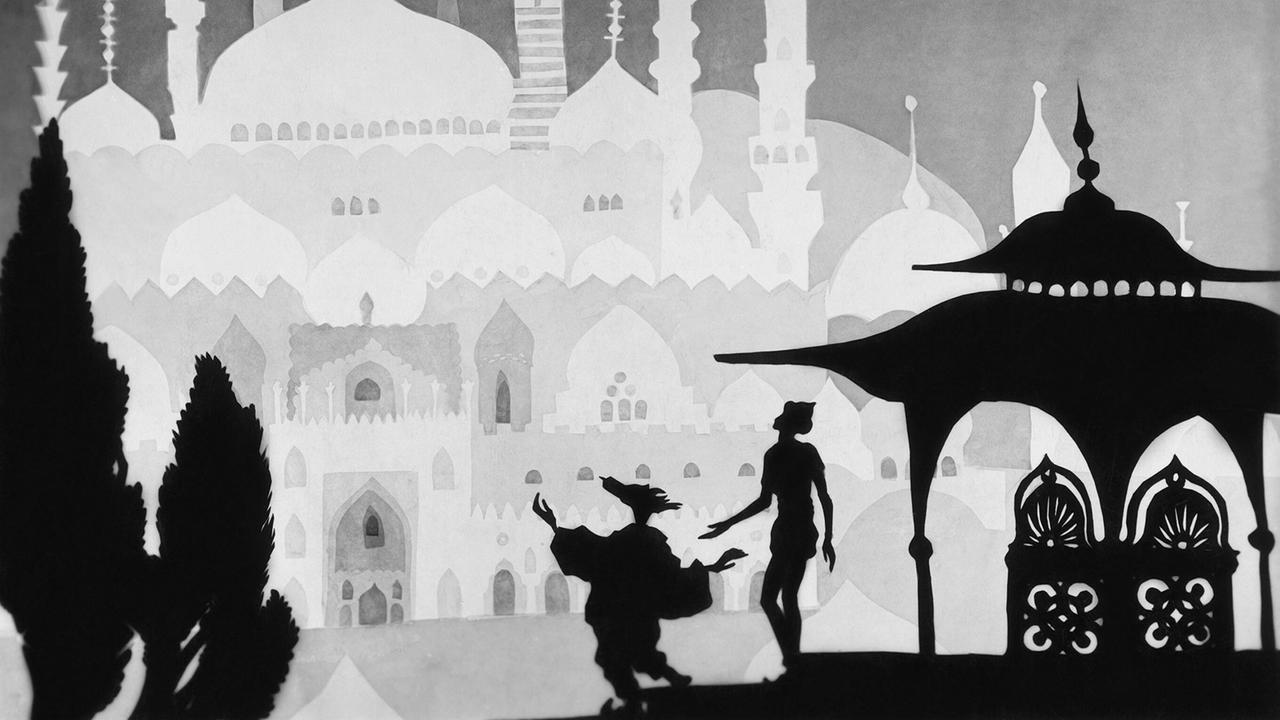
The film follows the titular Prince Achmed, who is tricked by a wicked sorcerer into mounting a flying horse that carries him into the sky. His journey takes him through a series of fantastical encounters, including the beautiful Peri Banu, the magical island of Wak-Wak, and the iconic figure of Aladin and his lamp.
Evamarie Blattner, a curator at the Stadtmuseum Tübingen, which houses the Lotte Reiniger estate, highlights why this work remains a benchmark: "How she managed to cut these figures with such profound empathy and craftsmanship is a skill that she mastered like no one else. The silhouettes possess a delicacy that cel animation, which can sometimes feel rigid or overly literal, never quite captures."
Implications and Global Recognition
For decades, the name Lotte Reiniger was relegated to the fringes of film history, often treated as a footnote compared to the booming commercial success of American studios. However, the 21st century has seen a significant reassessment of her work.
The Institutional Shift
Museums and archives worldwide have begun to prioritize the preservation of Reiniger’s work. The Stadtmuseum Tübingen has become a global hub for researchers and fans alike. The increasing number of inquiries from the United States, Australia, and Asia confirms that Reiniger’s visual language—transcending linguistic and cultural barriers—resonates across borders.
Awards and Posthumous Accolades
In 2024, the animation industry finally bestowed a long-overdue honor upon the pioneer. Reiniger was awarded a prestigious Annie Award (the "Oscars of Animation"). While this recognition arrived posthumously, it signaled a formal acknowledgement by the global animation community that the foundations of the industry were built, in part, by a woman working in a garage in Potsdam with nothing but paper, scissors, and a dream.
A Universal Language
The endurance of Prince Achmed lies in its primal, almost hypnotic appeal. In an era dominated by hyper-realistic CGI, the simplicity of a black silhouette against a shimmering, multi-layered background feels increasingly sophisticated. "What I admire about Lotte Reiniger," says Blattner, "is that people of all ages, across all continents, can understand her stories. Whether in Europe, the Arab world, or Asia, her films speak the same language of wonder."
Conclusion: The Shadow That Never Faded
The legacy of The Adventures of Prince Achmed is not just that it was the first of its kind; it is that it remains a masterpiece of visual storytelling. While the world may have focused on the colorful evolution of animation led by Disney, the silent, elegant silhouettes of Lotte Reiniger provided the initial blueprint for the medium’s potential.
She proved that the magic of film does not require immense budgets or the most advanced technology of the day. It requires a singular vision, an immense capacity for labor, and the ability to find beauty in the shadows. As we look back on a hundred years of animated cinema, it is clear that Lotte Reiniger did not just animate paper—she animated the imagination itself, ensuring that her Prince Achmed would continue his flight across our screens, and our collective memory, for generations to come.