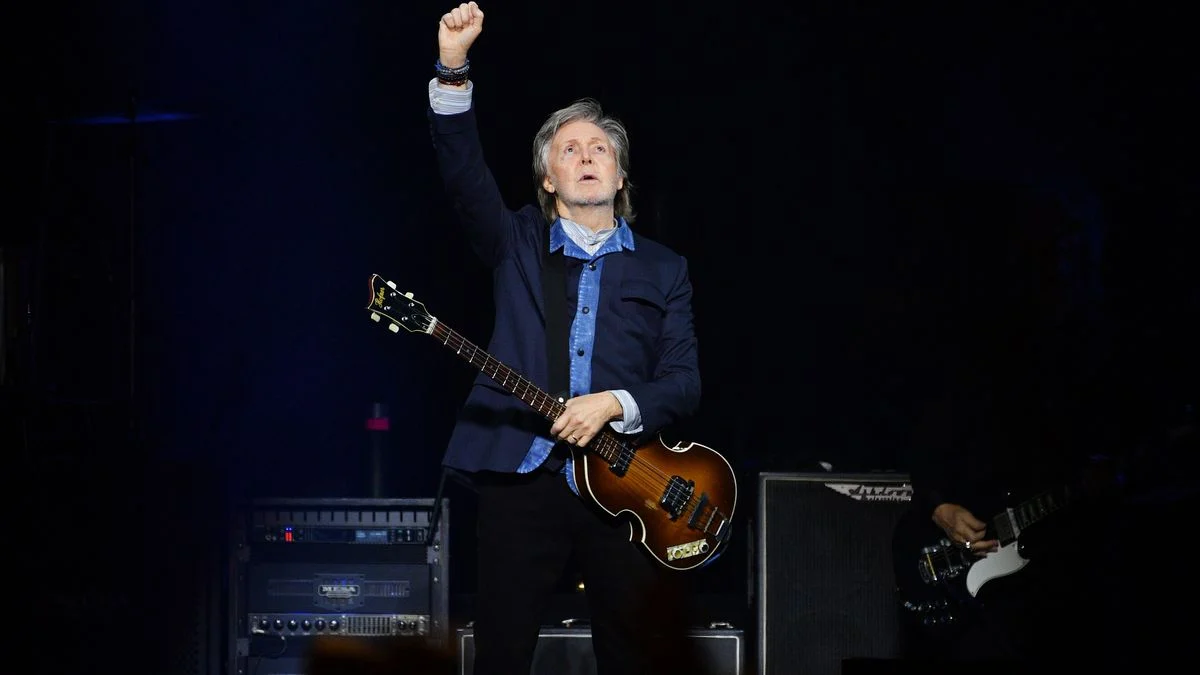
In a world where memories are often considered ephemeral—slipping away like sand through an hourglass—Beatles legend Sir Paul McCartney has sparked a fascinating debate regarding the limits of human cognition. At 84, the music icon recently revealed in a candid interview that he believes he possesses a vivid, sensory-driven memory of his own birth. The claim, shared during an appearance on the podcast Good Hang with Amy Poehler, has invited both curiosity and skepticism, bridging the gap between musical legacy and the enigmatic nature of human memory.
The Main Facts: A Glimpse into the Neonatal Void
The revelation occurred during a lighthearted exchange with host Amy Poehler. When prompted to share the earliest memory of his life, McCartney did not point to a childhood toy or a scene from his early days in Liverpool. Instead, he reached back to June 18, 1942, at the Walton Hospital in Liverpool—a sprawling, austere Victorian structure.
"I have this feeling that I can remember being born," McCartney confessed. He described the setting with striking, almost clinical detail: "I remember, somehow, white tiles—very hygienic white tiles. And chrome-glinting instruments and a clanking sound, because I was a forceps delivery. They had to pull me out."
The singer-songwriter acknowledged the inherent fragility of such a claim, tempering his statement with the humble admission: "I don’t know if it’s true." However, the descriptive power of his account—focusing on the sensory experience of cold, sterile hospital surfaces and the mechanical nature of a complicated birth—has provided a compelling narrative that has captivated fans and neuroscientists alike.
Chronology: The Life of a Legend
To understand the context of this claim, one must look at the timeline of McCartney’s life, which has been synonymous with 20th-century cultural history.
- June 18, 1942: Paul McCartney is born at Walton Hospital, Liverpool, to Mary and James McCartney.
- The 1960s: McCartney achieves global fame as a member of The Beatles, fundamentally altering the landscape of modern music.
- 1969: McCartney marries Linda Eastman. He adopts her daughter, Heather, and together they have three children: Mary, Stella, and James.
- 1998: Tragedy strikes as Linda McCartney passes away after a battle with breast cancer.
- 2002: McCartney marries Heather Mills, with whom he has a daughter, Beatrice, born in 2003.
- 2024: McCartney, now 84, reflects on the foundations of his life during the Good Hang podcast.
The anecdote about his birth was brought to light through the involvement of his daughter, Stella McCartney. A renowned fashion designer in her own right, Stella encouraged Poehler to ask her father about his earliest memories. Stella shared her own recollection of being in an incubator, suggesting that the McCartney family often leans into the exploration of their own origins.
Supporting Data: Can We Really Remember Our Birth?
The scientific community remains largely skeptical of "birth memories." Psychologists generally subscribe to the theory of "childhood amnesia," which posits that humans are unable to retain memories from the first few years of life. This is attributed to the fact that the hippocampus—the region of the brain responsible for memory formation—and the prefrontal cortex are not fully developed in infants.
However, the "McCartney Claim" sits in a gray area of anecdotal evidence. Experts suggest that what McCartney describes may be a "reconstructed memory." Over the course of a lifetime, individuals often hear stories from their parents or relatives about their birth. If those stories are vivid enough, the brain may internalize them, creating a false narrative that feels like a firsthand memory.
Yet, the specificity of McCartney’s sensory descriptions—the "clanking" of chrome instruments and the "hygienic white tiles"—suggests a level of sensory engagement that goes beyond a mere story told by a parent. It is possible that McCartney, a man whose life has been dedicated to artistic expression and emotional recall, possesses a heightened capacity for "sensory memory" that allows him to synthesize early life narratives into visceral mental images.
Official Responses and Family Dynamics
The response to McCartney’s claim has been one of fascination rather than dismissal. In the digital age, where celebrity personas are often carefully curated, this moment of vulnerability felt authentic. Stella McCartney’s role as the "instigator" of this discussion highlights the close-knit nature of the McCartney family.
By encouraging the question, Stella allowed for a rare look into the private internal world of her father. The family’s transparency regarding their origins—from the tragic loss of Linda to the birth of Beatrice—has always been a cornerstone of their public image. While no official medical record can verify the accuracy of his birth memory, the psychological value of the recollection remains intact for the family. It serves as a bridge between the clinical reality of 1942 Liverpool and the life of the man who would eventually change the world.
Implications: The Nature of Identity and Memory
What are the implications of believing in a memory that science says shouldn’t exist? For Paul McCartney, the memory of his birth serves as a foundational myth of his own existence. Whether the memory is a physiological reality or a cognitive construct is perhaps secondary to the meaning he derives from it.
1. The Power of Narrative
McCartney’s account illustrates how humans construct identities through stories. By framing his entry into the world as a struggle—a "forceps delivery" where he had to be "pulled out"—he unconsciously mirrors the trajectory of his own life: one marked by persistent effort, resilience, and the drive to break through barriers.
2. The Persistence of Sensory Detail
The focus on "white tiles" and "chrome" reflects the aesthetic sensibilities of a man who has spent decades curating sound and image. It suggests that even in the most subconscious layers of the mind, the brain archives information in sensory "snapshots."
3. The Limits of Scientific Dogma
Science is a map, not the territory. While "childhood amnesia" is a robust psychological principle, the individual experience of consciousness remains deeply subjective. McCartney’s testimony reminds us that the human mind is capable of creating its own internal truths, which may defy conventional neurological expectations.
Conclusion: A Legacy Beyond the Music
As Paul McCartney continues to tour and create at the age of 84, his legacy is firmly cemented in the annals of music history. However, his willingness to share such a private and enigmatic memory adds a new layer to the public’s understanding of the man behind the melodies.
Whether or not the "white tiles" of Walton Hospital truly existed in his infant consciousness is a question that may never be definitively answered. Yet, the fact that he holds this memory—or chooses to believe in it—speaks to the enduring nature of the human spirit. It reminds us that we are all, in a sense, the sum of our stories, and that the earliest chapters of those stories are often the ones we hold most tightly, even when they seem to defy the laws of memory itself.
In the end, McCartney’s reflection on his birth is not just a footnote in a podcast; it is a profound meditation on the journey from the cradle to the stage. It serves as a gentle reminder that even for the most famous figures, the mystery of where we began remains the most compelling performance of all. As he continues to influence generations of musicians and fans, McCartney invites us to look back at our own lives—not just at the big moments, but at the very first, hidden flickers of awareness that define the human condition.