By Editorial Staff Updated: October 8, 2026 | 17:32 CET
Executive Summary: A City in Reflection and Conflict
On Wednesday, October 7, 2026, the city of Berlin served as the backdrop for somber commemorations marking the third anniversary of the Hamas-led terror attacks on Israel. On that fateful day in 2023, militants launched a multi-front assault that resulted in the deaths of over 1,200 people and the abduction of approximately 250 hostages. As the world marked three years since the onset of the ensuing conflict—which has devastated the Gaza Strip, displaced millions, and triggered broader regional instability—the German capital grappled with its own internal divisions regarding the war and rising domestic antisemitism.
While thousands gathered in peaceful solidarity, the day was also marred by aggressive pro-Palestinian demonstrations that resulted in clashes with law enforcement, underscoring the deep polarization currently defining the sociopolitical landscape in Germany.
Chronology of the Day’s Events
The day began with a series of quiet, reflective observances before shifting toward the large-scale public demonstrations that defined the evening.
Morning: The Jewish community, joined by local political leaders, held intimate ceremonies at the Chabad Synagogue. These gatherings focused on the personal loss and the spiritual resilience of the community.
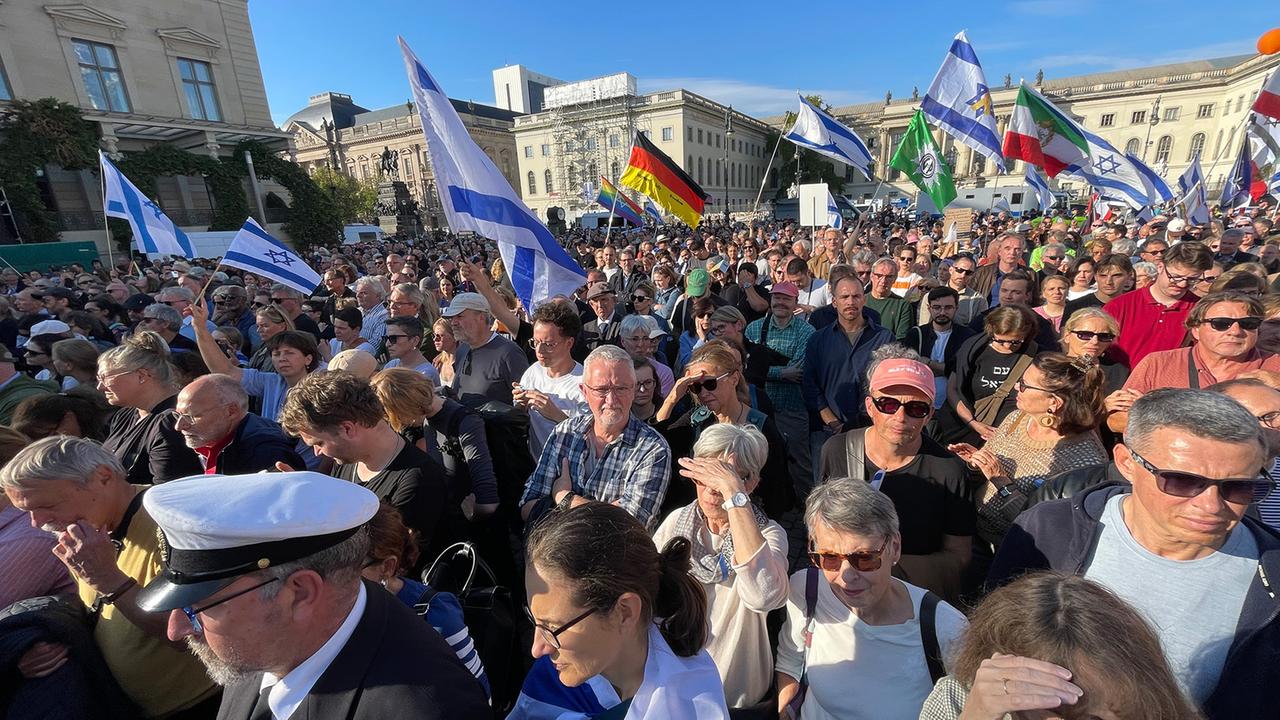
Midday: A major commemorative rally took place at Berlin’s Bebelplatz. The choice of venue was symbolic; this was the site of the infamous Nazi book burnings in 1933. Approximately 1,700 participants gathered to mourn the victims, with German Federal Interior Minister Alexander Dobrindt and Israeli Ambassador Ron Prosor in attendance.
Afternoon: Throughout the city, various vigils and installations were erected. Notably, a display featuring photographs of the victims was inaugurated at the Brandenburg Gate.
Evening: As dusk fell, the Brandenburg Gate was illuminated with the Israeli flag, a gesture of state-level solidarity. Simultaneously, a cross-denominational service at the Kaiser-Wilhelm-Gedächtniskirche in Charlottenburg brought together religious and political leaders, including Brandenburg’s Minister-President Dietmar Woidke.
Night: The atmosphere grew volatile in the Kreuzberg district, where a pro-Palestinian protest turned violent, forcing police to intervene and eventually terminate the demonstration.
Supporting Data and Security Operations
The Berlin Police Department executed a massive security operation, deploying over 1,100 officers to manage the competing demonstrations and memorial events. The sheer scale of the deployment reflected the high state of alert in the capital.
Security Statistics:
Total Police Personnel: 1,100+
Criminal Investigations: 46 active cases opened as of Thursday.
Nature of Charges: These include the use of symbols of unconstitutional organizations, physical assault on law enforcement officers, defamation, and bodily harm.
Protest Attendance: While the Bebelplatz memorial saw 1,700 participants, the “Down with Colonialism” march in Kreuzberg drew approximately 850 individuals, far exceeding the initially permitted 150.
The police reported that while most memorial events remained peaceful, the Kreuzberg demonstration devolved into chaos. Officers were subjected to physical attacks, including being pelted with unknown liquids and facing aggressive, antisemitic rhetoric.
Official Responses: The Stance of the German State
The central message from German leadership was one of unwavering support for Israel’s right to exist and a stern warning against the "poison" of antisemitism.
Minister Alexander Dobrindt’s Address
In his keynote speech at Bebelplatz, Minister Dobrindt delivered a resolute address. He emphasized that the fight against antisemitism is not merely a political policy but the "duty of every German." Addressing the rise in hate speech, he stated:
"Those who question the right of existence of Israel are not part of Germany and must not become part of it. Antisemitism is a vile poison that threatens to infect parts of our society."
Dobrindt’s words resonated with the historical weight of the venue, linking the current fight against modern hatred to the lessons learned from the dark chapters of the 20th century.
Diplomatic and Regional Engagement
While the capital held vigils, Berlin’s Governing Mayor, Kai Wegner, was in Israel. His visit was intended to strengthen the burgeoning municipal partnership between Berlin and Tel Aviv, demonstrating that the city’s commitment extends beyond symbolic gestures to concrete bilateral cooperation.
Implications: The Domestic Societal Challenge
The events of October 7, 2026, highlight an alarming trend in Germany: the solidification of the "Israel-Palestine" conflict as a domestic battleground.
Rising Antisemitism
The increase in antisemitic incidents in Germany since 2023 is no longer a fringe concern but a central domestic issue. The prevalence of Iranian flags alongside slogans calling for the "total liberation" of Palestine at the Kreuzberg protest points to the influence of radical ideological currents that have gained traction within certain sectors of the population.
The Polarization of Public Space
The divide between the pro-Israel memorials and the pro-Palestinian demonstrations highlights a widening chasm. The slogans heard on the streets—ranging from "Glory to the resistance" to the explicit hostility toward Israel—demonstrate that the rhetoric surrounding the Middle East conflict has become increasingly radicalized. The presence of such sentiments on the streets of Berlin presents a significant challenge for German domestic policy.
The state now finds itself balancing the constitutional right to freedom of assembly with the imperative to protect Jewish citizens from harassment and hate speech. The fact that police were forced to dissolve a demonstration due to the use of criminal, antisemitic slogans is a stark reminder that the boundaries of civil discourse are under constant pressure.
Looking Forward
As the third anniversary passes, the city remains in a state of reflection. The juxtaposition of the somber, candlelight vigils at the Kaiser-Wilhelm-Gedächtniskirche and the chaotic scenes in the streets of Kreuzberg captures the complexity of Germany’s current situation.
For the political establishment, the path forward is clear but difficult: they must continue to offer a safe harbor for the Jewish community while managing a demographic and social landscape that is increasingly fractured by foreign policy issues. The events of this week have served as a barometer for the health of German democracy, testing its ability to maintain order, uphold its historical responsibilities, and integrate diverse perspectives without sacrificing its core values of human rights and tolerance.
As the conflict in the Middle East shows little sign of reaching a definitive resolution, the echoes of the October 7 tragedy will likely continue to reverberate through the streets of Berlin, challenging the city’s identity and its commitment to the promise of "never again."
Notes on Methodology: This report summarizes accounts from the Berlin Police, statements from the Federal Ministry of the Interior, and on-the-ground reporting from the rbb24 Abendschau broadcasts. Data regarding attendance and criminal charges are based on preliminary police reports released on October 8, 2026.