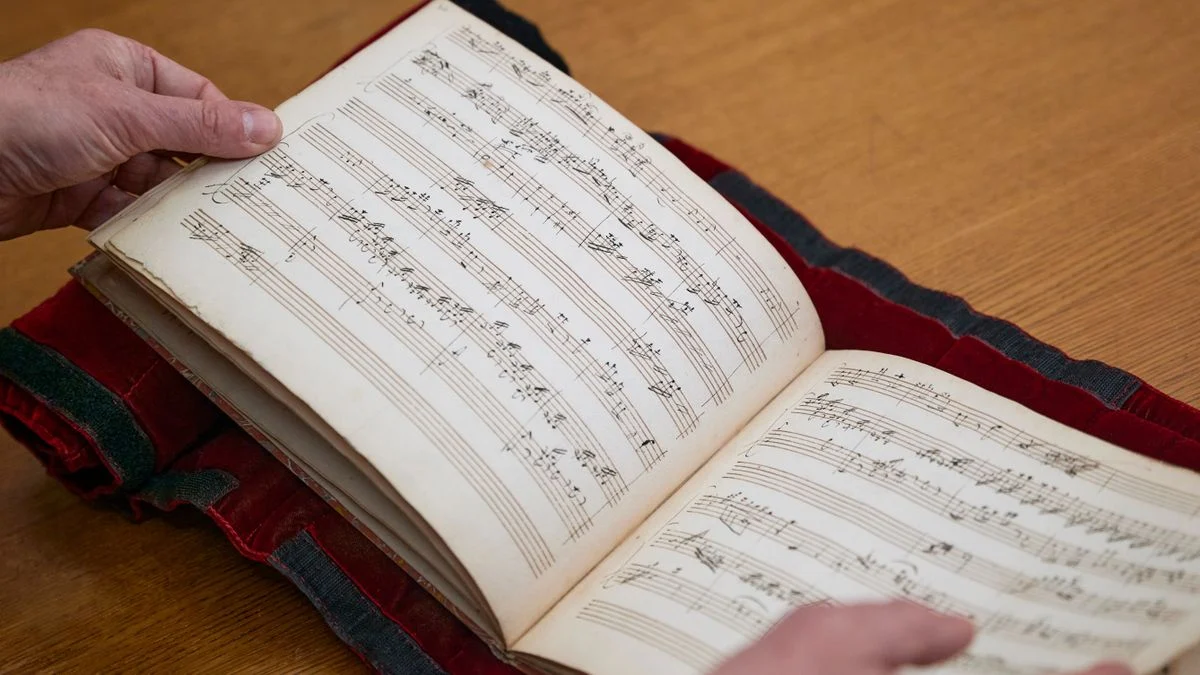
In the hallowed, dimly lit archives of the Bibliothèque nationale de France (BnF), a discovery has been made that promises to rewrite the pedagogical history of one of the world’s most celebrated composers. An anonymous, untitled music notebook, long gathering dust in the library’s vast collection, has been definitively identified as an authentic manuscript by Wolfgang Amadeus Mozart.
Gilles Pécout, Director of the BnF, has hailed the finding as one of the most significant musical discoveries of the past several decades. What began as a routine cataloging task has culminated in the retrieval of a rare, intimate look at Mozart not just as a genius of composition, but as a teacher in the bustling, often frustrating environment of 18th-century Paris.
A Detective Story: Identifying the Master’s Hand
The identification of the manuscript is a testament to the meticulous expertise of musicologist François-Pierre Goy. Specializing in anonymous manuscripts, Goy began scrutinizing the marble-paper-bound notebook after spending extensive time analyzing other known educational materials produced by Mozart.
As he pored over the folios, subtle hallmarks emerged. Goy noted the characteristic "rounded, slightly forward-leaning treble clefs" and bass clefs that deviated significantly from the conventions of French notation of the era. These stylistic signatures, combined with a rigorous analysis of the paper stock used in the 18th century, provided a compelling case for the Austrian composer’s hand. The International Mozarteum Foundation in Salzburg, the world’s leading authority on the composer, later verified these findings, confirming the authenticity of the work.
Chronology: The Paris Summer of 1778
The content of the manuscript provides a vivid snapshot of Mozart’s final stay in Paris between May and July 1778. At the time, a young Mozart was navigating the social and artistic demands of the French capital, seeking patronage and teaching the scions of the aristocracy.
The notebook contains a series of composition exercises and seven distinct pieces written for flute and harp. Historical records and the nature of the exercises suggest these were instructional lessons provided by Mozart to Marie-Louise-Philippine de Guînes, a talented harpist from a prominent noble family.
The chronology of the manuscript is etched into its very pages. The handwriting transitions from joint efforts between teacher and student to almost exclusively Mozart’s own hand toward the end. The final exercise remains unfinished, and the last six pages are blank—a silent testament to an abrupt conclusion. This silence matches the historical record: the lessons ceased on July 26, 1778, the day of Mademoiselle de Guînes’s wedding. Following the French Revolution, the manuscript was seized from the Duke of Guînes, eventually making its way into the state’s collection, where it remained misidentified for over two centuries.
The Pedagogical Evolution: A Teacher’s Growing Disillusionment
The implications of this manuscript extend far beyond the notes on the page. Ulrich Leisinger, the scientific director of the Mozarteum Foundation in Salzburg, provided critical insight into the relationship between the composer and his pupil.
According to Leisinger, the manuscript reveals a dynamic that shifted rapidly over the course of three months. Initially, it appears that Mozart was eager to foster the creative potential of his student. However, as the weeks progressed, his approach became increasingly corrective.
"Mozart wanted to teach her to compose, but he clearly overestimated her abilities for a time," Leisinger remarked in an interview with the Austrian broadcaster ORF. "The manuscript shows beautifully that her contribution to the notebook diminishes over time. He evidently trusted her less and less, and the original input from her side became negligible. By the end, it is almost entirely Mozart’s own hand on the paper."
This discovery offers a rare, unflinching look at the daily professional life of Mozart. It depicts a man who was not only a virtuoso but also a pragmatic teacher, struggling to translate his own effortless genius into a language that his aristocratic pupils could comprehend.
Implications for Musicology and History
The discovery of this manuscript is not merely an addition to the Mozart catalog; it is a catalyst for a deeper understanding of the "Parisian Mozart." While much has been written about his operas and symphonies, his role as a private tutor to the nobility remains a significantly under-documented aspect of his biography.
The notebook serves as a primary source for the 18th-century French court culture, providing a bridge between the artistic output of the Enlightenment and the societal upheaval of the subsequent revolution. The fact that the manuscript was once the property of the Duke of Guînes before being confiscated suggests that these musical lessons were part of the private, elevated lifestyle that would eventually be swept away by the winds of 1789.
For modern musicologists, the seven pieces—which account for roughly 20 minutes of performance time—offer a unique case study in how Mozart simplified his complex musical thoughts for instructional purposes.
Bringing the Music to Life
The significance of the discovery will be celebrated with a public performance. The pieces, restored and analyzed for their historical context, are scheduled to be performed during the traditional Fête de la Musique on June 21 at the National Library in Paris.
The concert serves as a symbolic homecoming for a work that has been silent for nearly 250 years. For those unable to attend the live event, the French radio station France Musique will air a special broadcast on Monday at 3:00 PM, dedicated to the theme "Mozart in Paris." This program will feature expert commentary on the discovery and a recording of the newly recovered compositions.
Historical Context: The Life of Wolfgang Amadeus Mozart
Wolfgang Amadeus Mozart remains one of the most towering figures in Western classical music. Born in Salzburg in 1756, he was a child prodigy whose work spanned every genre of his time. Despite his short life—he died in Vienna in 1791 at the age of 35—he left behind an oeuvre that defined the Classical period.
The 1778 trip to Paris was intended to be a career-defining moment for the young composer, though it was fraught with personal and professional difficulties, including the death of his mother during the journey. This newly discovered manuscript adds a layer of humanity to this period, showing Mozart not just as a struggling musician, but as a man deeply engaged in the practical, often tedious, work of musical education.
As scholars continue to study the manuscript, further revelations are expected. In an era where the digital age often feels as though it has uncovered every corner of history, the discovery of a "lost" Mozart work in a major national archive serves as a humbling reminder: the past still holds secrets, waiting for the right eye to notice the curve of a clef or the texture of a piece of paper. The archives of the world, it seems, still have much to tell us.