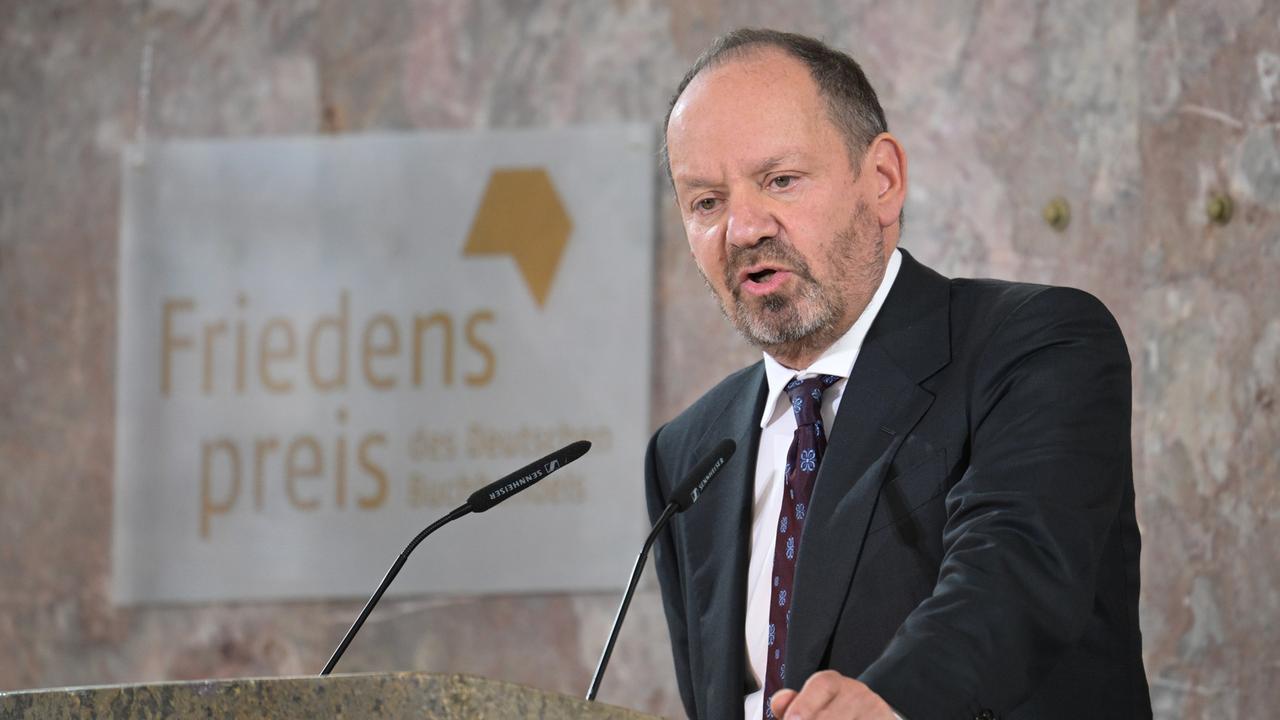
Frankfurt am Main, Germany – October 11, 2026 – In a powerful and deeply personal address delivered from the historic Paulskirche in Frankfurt, the distinguished French-British jurist and writer Philippe Sands was awarded the Peace Prize of the German Book Trade. Sands used the prestigious platform not only to express gratitude but also to deliver a poignant and unyielding appeal for the universal application of international law, pointedly criticizing Germany’s perceived silence regarding Israel’s actions in Gaza. His speech, steeped in family history and legal philosophy, resonated through the hallowed hall, sparking both applause and notable silence among the assembled dignitaries, including German President Frank-Walter Steinmeier.
The Peace Prize, one of Germany’s most significant cultural accolades, has historically honored individuals who have made outstanding contributions to peace, humanity, and international understanding through their work in literature, science, and art. Sands, a leading expert in international law and a celebrated author whose works often intertwine personal narrative with legal history, was recognized for his unwavering commitment to justice and his eloquent advocacy for human rights.
The ceremony, held annually during the Frankfurt Book Fair, is a landmark event in the German cultural calendar, drawing prominent figures from politics, culture, and society. The Paulskirche itself, a symbol of German democracy and the site of the first freely elected German parliament in 1848, provided a fitting backdrop for Sands’ address, which sought to challenge national narratives in the service of universal principles.
The Paulskirche Address: Silence is Not the Way
Sands’ acceptance speech centered on a profound credo: "Peace needs justice. Justice needs rules. Rules need law." He then added, with deliberate emphasis, "Law and rules apply universally, not selectively." This unambiguous statement served as the cornerstone of his critique directed at Germany.
He acknowledged Germany’s unparalleled efforts in confronting the atrocities of its past, recognizing the nation’s commendable commitment to denouncing and actively opposing many historical brutalities. However, Sands then drew a stark contrast: "Regarding Israel, the Gaza Strip, and the West Bank, Germany’s silence remains loud to this day." He vehemently asserted that criticism of Israel’s actions is neither antisemitic nor anti-Israel, but rather a necessary adherence to truth. "International crimes were committed on October 7th on the territory of Israel and subsequently on the territory of Palestine, in the Gaza Strip and the West Bank," Sands declared, drawing a direct link between the initial attacks and the subsequent response.
This direct challenge to Germany’s foreign policy, particularly its steadfast support for Israel, was met with a complex reaction. While some in the audience applauded his call for universal justice, the discernible lack of applause from certain quarters, notably from President Steinmeier, underscored the controversial nature of Sands’ remarks within the German political landscape.
A Legacy Forged in Trauma and Law
Philippe Sands’ unwavering commitment to international law and human rights is deeply rooted in his personal history, a narrative he has eloquently woven into his acclaimed literary works such as "East West Street: On the Origins of Genocide and Crimes Against Humanity" and "The Ratline: The Extermination Camp Escape Route of a Nazi SS Officer."
Personal Roots of Universal Law
Born in London in 1960, Sands grew up in a Jewish family profoundly marked by the Holocaust. Many of his relatives perished in the Shoah, a trauma that cast a long shadow over his upbringing. The family’s silence surrounding these unspeakable losses profoundly affected him, instilling a deep-seated desire to understand and confront historical injustices. This personal burden of unspoken trauma became a powerful catalyst for his later work, compelling him to give voice to those silenced by history and to seek accountability for crimes against humanity.
His journey to Lviv (formerly Lemberg), in present-day Ukraine, to trace his family’s roots became a pivotal point. It was there that he unearthed not only the stories of his ancestors but also the intertwined biographies of two seminal figures in international law: Hersch Lauterpacht and Raphael Lemkin. Both men, having witnessed unimaginable atrocities, independently developed the legal concepts that would forever change the landscape of international justice after 1945.
The Genesis of International Justice: Lauterpacht and Lemkin
Hersch Lauterpacht, a fellow Lviv native, became a key figure in the development of the concept of "crimes against humanity." His work emphasized the protection of individuals, arguing that states could no longer claim absolute sovereignty when committing atrocities against their own populations. Lauterpacht’s philosophy underpinned the very notion that individuals, not just states, possess rights under international law, and that certain acts are so heinous they offend the conscience of all mankind.
Raphael Lemkin, a Polish-Jewish lawyer also from the region, tirelessly campaigned for the recognition of "genocide" as a distinct international crime. He coined the term, combining the ancient Greek word genos (race, tribe) with the Latin suffix -cide (killing), to describe the systematic destruction of a national, ethnic, racial, or religious group. Lemkin’s relentless advocacy led to the adoption of the UN Convention on the Prevention and Punishment of the Crime of Genocide in 1948, a landmark achievement that codified the international community’s commitment to preventing such horrors.
Sands’ meticulous research into their lives, their intellectual struggles, and their profound contributions revealed how personal experiences of suffering and displacement fueled their legal innovations. Their work, born from the crucible of the Holocaust, laid the foundational principles for holding individuals accountable for mass atrocities, thereby shaping the very framework of modern international criminal law.
The Core Message: Universal Law, Not Selective Application
Sands’ central argument was a fervent plea for the consistent and impartial application of international law. He posited that the principles forged in the aftermath of World War II, particularly those relating to genocide and crimes against humanity, must apply to all, regardless of political alliances or historical sensitivities.
Germany’s ‘Loud Silence’ on Gaza
His criticism of Germany’s "loud silence" regarding Israel’s actions in Gaza struck a particularly sensitive chord. Sands acknowledged Germany’s unique historical responsibility and its steadfast commitment to Israel’s security, often referred to as its "Staatsräson" (reason of state). However, he argued that this special relationship should not exempt Israel from scrutiny under international law, nor should it preclude Germany from speaking out against potential violations. He maintained that to remain silent when international law is allegedly breached, even by a friend or ally, undermines the very universality and credibility of the legal framework.
Sands’ assertion that "Völkerstraftaten were committed… subsequently on the territory of Palestine, in the Gaza Strip and the West Bank," directly challenges the prevailing narrative in Germany, where criticism of Israel’s military actions is often met with accusations of antisemitism or a questioning of Germany’s historical responsibility. By explicitly stating that criticizing Israel’s actions is neither antisemitic nor anti-Israel, but rather a pursuit of truth, Sands aimed to carve out a legitimate space for critical discourse.
Redefining ‘Staatsräson’
He proposed a redefinition of "genuine Staatsräson for Germany," suggesting that it must involve "breaking the silence about international crimes" – irrespective of who commits them, and "even if it’s friends, especially if it’s friends." This provocative reinterpretation suggests that true loyalty to democratic values and international justice demands a willingness to hold all parties accountable, even those with whom one shares deep historical bonds. Sands implied that Germany’s historical experience, which led to the development of international legal frameworks to prevent future atrocities, should compel it to be a global advocate for these principles, rather than allowing political expediency to dictate their application.
The Nexus of Law, Literature, and Truth-Telling
Sands articulated a powerful synergy between his work as a human rights lawyer at the International Criminal Court in The Hague and his literary endeavors. He sees both disciplines as essential tools in the fight against silence and for the pursuit of justice.
Confronting Prejudice and Double Standards
"This is precisely where law and literature come together," Sands explained, "by telling stories, by prompting reflection, by speaking truth to power, by countering prejudice and double standards, by unearthing things some would prefer to keep hidden." For Sands, literature provides the narrative depth and emotional resonance that legal texts often lack, allowing complex historical events and human suffering to be understood on a more profound level. It allows him to explore the ambiguities of human experience, the motivations of perpetrators and victims alike, and the long-lasting consequences of injustice.
He passionately argued that those who denounce international crimes "should not be silenced, excluded, or punished." This statement was a direct plea for freedom of expression, particularly for artists, journalists, and writers who often face pressure or censorship when addressing sensitive geopolitical issues. "Authors and journalists, singers and poets, filmmakers and others must be able to tell their stories," he insisted, underscoring the vital role of creative expression in fostering public debate and holding power accountable.
Music as a Medium for Repentance and Justice
Adding another layer of profound meaning to his address, Sands revealed his specific musical choices for the ceremony: Johann Sebastian Bach’s "Erbarme dich, mein Gott" (Have mercy, my God) from the St. Matthew Passion and Leonard Cohen’s "Anthem." He explained that these pieces carry powerful messages of repentance, grace, and justice, serving as a universal language to convey the profound moral and ethical dimensions of his message. Bach’s lamentation speaks to human suffering and the yearning for compassion, while Cohen’s anthem, with its famous line "There is a crack in everything / That’s how the light gets in," offers a message of hope and resilience, suggesting that even in brokenness, there is potential for redemption and enlightenment.
Reactions and Reverberations in Frankfurt
The impact of Sands’ speech was immediate and multifaceted, provoking both strong affirmation and subtle dissent among the distinguished guests.
A Divided Audience
While his general call for justice and the rule of law was met with broad approval, his direct criticism of Germany’s stance on Gaza created a palpable tension. The visible lack of applause from President Steinmeier during this specific segment was a telling indicator of the discomfort Sands’ words generated in official German circles. This reaction highlights the delicate balance Germany attempts to strike between its historical commitment to Israel’s security and its broader obligations under international law, a balance Sands clearly believes has tilted too far towards political expediency.
Laudatory Voices and Shared Principles
Despite the controversial elements, the overall reception of Sands and his work remained overwhelmingly positive, reflecting the deep respect for his intellectual contributions and moral courage.
In her laudation, Austrian historian Mirjam Zadoff, Director of the NS Documentation Centre in Munich, lauded Sands’ clear moral compass. "No axis of good or evil divides the world of the jurist and author Philippe Sands in two," she stated, praising his nuanced approach to complex historical and ethical questions. Zadoff highlighted Sands’ unique ability as a writer to "sometimes smuggle almost unbearable stories into our protected and comfortable lives," thereby forcing introspection and challenging complacency.
Sebastian Guggolz, head of the German Publishers and Booksellers Association (Börsenverein des deutschen Buchhandels), echoed these sentiments, commending Sands’ literary prowess. Guggolz described the narrative form as "a liberation for the jurist," unleashing Sands’ storytelling joy and revealing his masterful sensitivity for ambiguous situations. He praised Sands’ ability to portray individuals – whether perpetrators or victims – who are entangled in injustice and must grapple with its repercussions. From Guggolz’s hand, Sands formally accepted the Peace Prize certificate, a tangible symbol of recognition for his profound contributions.
Echoes of History: Fritz Bauer and the Enduring Fight Against Injustice
The opening remarks by Frankfurt’s Mayor Mike Josef (SPD) added another layer of historical resonance to the ceremony, drawing a direct line between contemporary challenges and Germany’s post-war reckoning.
Learning from the Past, Shaping the Future
Josef welcomed the guests, who included, alongside President Steinmeier, Federal Minister of Justice Stefanie Hubig (SPD), Bundestag Vice President Omid Nouripour (Greens), and Hesse’s Minister of Arts Timon Gremmels (SPD). He invoked the memory of Fritz Bauer, the former Hessian Chief Public Prosecutor who initiated the groundbreaking Frankfurt Auschwitz Trials in 1963. Bauer’s relentless pursuit of justice against former Nazi perpetrators, despite significant political and societal resistance, became a crucial chapter in Germany’s confrontation with its past.
Mayor Josef quoted Bauer, who had famously stated that if these trials were to have any meaning, it was the "indispensable realization that adaptation to an unjust state is injustice." Learning from history in the spirit of Bauer and Peace Prize laureate Philippe Sands, Josef asserted, also means ensuring that "right-wing extremists must never again hold government responsibility." This strong statement served as a reminder of Germany’s vigilance against the resurgence of extremist ideologies, linking Sands’ call for universal justice to the ongoing defense of democratic values within Germany itself.
Implications for German Discourse and International Law
Philippe Sands’ acceptance speech for the Peace Prize of the German Book Trade is more than just an award ceremony; it is a significant cultural and political event that is likely to have lasting implications for German public discourse and the broader conversation about international law.
Challenging the Boundaries of Criticism
Sands’ direct challenge to Germany’s "Staatsräson" regarding Israel will undoubtedly fuel ongoing debates within Germany about the boundaries of permissible criticism of Israeli policies. It forces a critical examination of whether Germany’s historical responsibility, while paramount, inadvertently leads to a selective application of international legal principles. His argument that "criticism of Israel’s actions is neither antisemitic nor anti-Israel" aims to create a crucial distinction between legitimate political critique and malicious prejudice, a distinction that is often blurred in heated discussions.
The fact that such a critique was delivered from the Paulskirche, a site imbued with the spirit of democratic debate and the pursuit of justice, adds considerable weight to Sands’ words. It places the debate squarely within the context of Germany’s own democratic evolution and its commitment to universal human rights.
The Enduring Power of the Peace Prize
The Peace Prize of the German Book Trade, by honoring figures like Philippe Sands, consistently positions itself as a platform for critical thought and moral conscience. It encourages difficult conversations and challenges prevailing orthodoxies, even when those challenges come with uncomfortable truths for the host nation. Sands’ speech, delivered with intellectual rigor and deeply felt conviction, underscores the prize’s mission to foster understanding and peace through the unwavering pursuit of justice and adherence to universal legal principles. It is a powerful reminder that silence, especially in the face of alleged injustice, can be a form of complicity, and that the path to lasting peace must always be paved with justice and accountability, universally applied.