France is currently gripped by a wave of student-led protests that have evolved from localized school grievances into a full-scale national crisis. What began as a series of isolated demonstrations at a lycée in Grenoble has rapidly expanded, igniting a firestorm across the country’s educational landscape. As hundreds of thousands of students, supported by university faculties and concerned parents, take to the streets, the French government finds itself trapped between a mounting social movement and its own increasingly criticized reliance on heavy-handed police tactics.
The Genesis of the Movement
The origins of this upheaval can be traced back to mid-September, when students at a high school in Grenoble first voiced their discontent regarding deteriorating learning conditions. For several days, these initial sparks went largely unnoticed by mainstream media and national political circles. However, the movement gained significant momentum when students in Créteil, a bustling suburb southeast of Paris, began organizing more visible demonstrations.
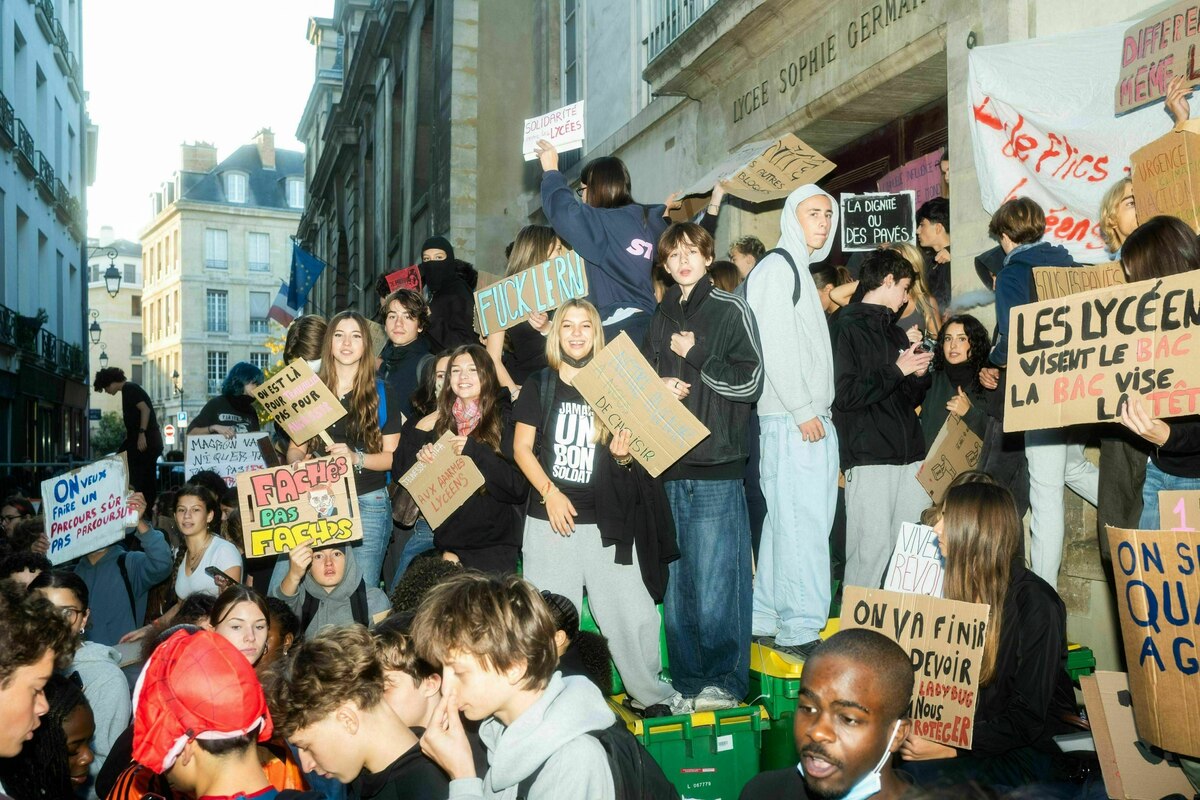
By the end of September, the sentiment had metastasized, crossing regional borders to affect at least one-third of France’s 3,700 lycées. Contrary to early accusations from government officials—who attempted to frame the unrest as the result of "far-left agitators" or organized political interference—the movement appears to be largely organic. Utilizing platforms like TikTok and Snapchat, students have bypassed traditional political intermediaries, coordinating real-time actions and sharing footage of police interactions that have gone viral, garnering millions of views and solidifying a sense of collective purpose among the nation’s youth.
A Chronology of Escalation
The progression of the revolt has been alarmingly swift. Following the initial unrest in Grenoble and Créteil, the protests matured into a sophisticated display of civil disobedience. Because French students lack an official legal right to strike, they have adopted the tactic of blockading school entrances. These "human barricades" have frequently served as the focal point for confrontations between students and security forces.
By the second week of October, the movement reached a critical inflection point. Student unions formally aligned with the demonstrators, leading to the occupation of dozens of university faculties. This convergence of high schoolers and university students culminated in a massive day of action where more than a quarter-million people flooded the streets, turning local school grievances into a broader rejection of the current socio-economic status quo.
The Deepening Roots of Discontent
To characterize these protests merely as a reaction to "poor learning conditions" is to ignore the profound political awakening occurring within the French youth. For the 15-to-19-year-olds at the heart of this movement, the classroom is merely the starting point. Their placards and manifestos reveal a generation deeply anxious about the future.

Their concerns are multi-layered:
- Economic Instability: Students highlight the widening gap between the cost of living and the financial support available to families.
- Environmental Existentialism: The climate crisis is a central pillar of their dissent, with students arguing that current government policies are mortgaging their future to preserve the interests of the present.
- The Far-Right Threat: Perhaps most notably, there is a palpable fear regarding the rise of the extreme right. Many students view the current government’s inability to address social inequality as a primary driver of the growing influence of extremist ideologies, which they see as an existential threat to the Republic’s values.
The State’s Heavy Hand: Fueling the Fire
The government’s initial response—a blend of dismissive silence and aggressive policing—has backfired spectacularly. For weeks, the executive branch under President Emmanuel Macron appeared to treat the protests as a nuisance caused by "misbehaving children." By relying on the traditional tactic of using "chaos" caused by fringe groups to justify the suppression of the broader movement, the administration failed to account for the reality that these protesters are largely first-time demonstrators with no appetite for conventional violence.
The statistics of the crackdown are telling. Within ten days, over 6,600 youths were taken into custody—a figure that legal experts and observers describe as unprecedented for student movements of this nature. The deployment of heavy riot control gear, including the use of "Flashbang" grenades (GM2L) and other defensive weapons that were intended only for extreme circumstances, has led to horrific injuries, including a 15-year-old boy who lost a hand. These images have circulated rapidly on social media, turning public opinion further against the authorities and reinforcing the students’ narrative of state brutality.

The Political Fallout
The crisis has sent shockwaves through the Élysée Palace. President Macron, who has largely retreated from domestic policy since his 2022 re-election, now finds his entire legacy overshadowed by this revolt. Reports from within his circle suggest that the President is deeply frustrated by his government’s inability to contain the crisis, which threatens to undermine his legislative agenda.
The political polarization is stark:
- The Far Right: Marine Le Pen has sought to capitalize on the chaos, accusing Macron of being "on the side of those who attack the police." Her demand for "the restoration of order" is a calculated move to appeal to older, conservative voters who are alarmed by the images of burning barricades.
- The Left: The La France Insoumise (LFI) party, led by Jean-Luc Mélenchon, has emerged as the primary political voice for the protesters. With recent polls showing Mélenchon enjoying a 42% approval rating among the 18-24 demographic, the LFI has embraced the movement, providing it with institutional legitimacy while simultaneously facing accusations from the center and right of "instrumentalizing" youthful rage.
Official Responses and the "Democratic Alibi"
In a desperate attempt to regain control of the narrative, Prime Minister Sébastien Lecornu delivered an address on Wednesday evening. The response was two-pronged: he offered a minor concession in the form of a reduction in diesel fuel prices—a classic attempt to appease the broader populace—and a plea to the students to return to their classrooms.

Lecornu promised that the government would review the students’ demands and present a set of proposals within a month. However, the reaction from student organizations was swift and dismissive. Many labeled the offer a "democratic alibi"—a bureaucratic delay tactic designed to dissipate the energy of the streets without actually addressing the structural issues of the French educational system or the broader societal concerns of the youth.
As of this writing, the students remain unpersuaded. The government’s decision to ban the use of certain high-risk grenades against protesters is viewed as a concession, but one that is "too little, too late."
Implications for the Future
The French student revolt of 2024 stands as a watershed moment for the Fifth Republic. It highlights a widening chasm between the governing elite and a generation that no longer feels represented by traditional political channels. The speed at which the movement organized, the refusal to be co-opted by political parties, and the intensity of the response to police violence suggest that this is not merely a temporary disturbance.

The movement has successfully shifted the national conversation from the specific grievances of the lycée to a broader critique of state authority and social justice. Whether or not the government can survive this crisis without major structural concessions remains to be seen. What is clear, however, is that the youth of France have made themselves heard, and they have proven that they are no longer willing to wait for the authorities to "examine their concerns" at their own leisurely pace.
As the streets of Paris and other major cities continue to see protest activity, the government is forced to contend with a new reality: the youth are no longer the subjects of policy—they are now the active agents of change, and they are here to stay.