In kitchens across Germany, a silent and often overlooked threat is on the rise. While public health discourse frequently focuses on Salmonella, the most common cause of bacterial diarrhea in the country is, in fact, Campylobacter. After years of steady decline, infection numbers have reversed course with alarming speed. Between 2023 and 2025, confirmed cases surged by 25%, reaching 50,275. As health authorities scramble to address this trend, a group of British researchers has unveiled a potential technological breakthrough: the use of high-intensity violet light to eradicate the bacteria on poultry before it ever reaches the consumer.
The Magnitude of the Problem: Beyond a "Bad Meal"
Most people associate foodborne illness with the discomfort of a "spoiled stomach." However, a Campylobacter infection is significantly more serious. Symptoms typically include severe abdominal pain, high fever, and bloody diarrhea. While most healthy individuals recover within a week, the infection can be life-threatening for the elderly and immunocompromised. In 2024 alone, nearly 9,200 people in Germany required hospitalization due to the infection, and there were several recorded fatalities.
Beyond the acute phase of illness, the bacteria carry the risk of long-term, debilitating complications. Campylobacter is the most frequent trigger for the Guillain-Barré syndrome, an autoimmune disorder in which the body’s immune system attacks its own nerves, potentially leading to paralysis. Additionally, reactive arthritis can occur as a post-infectious complication. Because many mild cases go unreported, health experts agree that the actual number of infections is significantly higher than official statistics suggest.
A Statistical Chronology: The Reversal of Progress
For nearly two decades, public health efforts to curb bacterial food poisoning were remarkably successful. Between 2001 and 2015, the number of reported Salmonella cases in Germany plummeted from 77,000 to approximately 14,000. This success was driven by rigorous European-wide control programs implemented within poultry flocks, covering everything from breeding stocks to laying hens and broilers.

However, Campylobacter has proved far more elusive. Unlike the targeted, multi-stage intervention programs for Salmonella, there is currently no systematic, pre-slaughter control program for Campylobacter in the stables. Instead, the industry relies on a "limit value" approach at the end of the production chain.
The data highlights a troubling trajectory:
- 2016–2023: A period of optimistic decline, hitting a record low of 40,307 cases in 2023.
- 2024–2025: A sharp, two-year consecutive rise, with 2025 reporting 50,275 cases.
- 2026 Outlook: Data from the first nine months of 2026 suggests that the upward trend shows no sign of slowing, as infection rates have already reached 90% of the previous year’s total by September.
The Supply Chain Dilemma: Limits of Current Regulations
The primary vector for the disease is raw poultry meat. According to the Zoonosis Monitoring program of the Federal Office of Consumer Protection, roughly 41% of conventional chicken meat in German retail is contaminated with Campylobacter. Paradoxically, the contamination rate for organic poultry is even higher, at 46.5%.
Since 2018, the European Union has mandated that slaughterhouses monitor the levels of Campylobacter on the neck skin of carcasses, with a threshold set at 1,000 colony-forming units (CFU) per gram. This threshold was tightened as recently as January 2025. Yet, these regulations are failing to translate into a reduction in human illness. Internal industry controls report that about 7.8% of samples exceed the limit, while official government monitoring puts that figure closer to 19.8%. This discrepancy highlights the complexities of sampling, but the bottom line remains the same: the bacteria are present in high enough concentrations to cause widespread illness.

The Violet Light Revolution: A Non-Chemical Solution
In the United Kingdom, where infection rates are roughly double those in Germany per capita, the economic burden of Campylobacter—including healthcare costs and lost productivity—is estimated at £700 million annually. This urgency led a team at the University of Reading to explore a radical, chemical-free decontamination method: violet light.
The researchers utilized light with a wavelength of 405 nanometers. This is a deep violet color, visible to the human eye, situated just above the ultraviolet (UV) spectrum. The mechanism is fascinatingly simple: the light does not "burn" the bacteria in the way heat does. Instead, it excites specific molecules already present within the bacterial cell. These excited molecules then trigger the production of reactive oxygen species—essentially internal "free radicals"—that destroy the cell from the inside out.
Why This Could Be a Game-Changer:
- Universal Efficacy: The researchers tested 64 different bacterial strains, including those resistant to multiple antibiotics. All 64 were eradicated.
- No Resistance Development: In a longitudinal experiment, the team exposed a single strain to the light for 15 consecutive cycles. The bacteria could not develop resistance, as they cannot build a defense against oxygen compounds generated from their own biological makeup.
- Clean Technology: The process requires no chemical additives, no contact with the food, and utilizes inexpensive, mass-produced LED technology commonly found in currency verification devices and 3D printers.
Implications and Practical Hurdles
Despite the scientific success of the study, the path from laboratory to the slaughterhouse floor is fraught with logistical challenges. The laboratory experiments were conducted on small samples of liquid bacterial suspensions over a 20-minute period.
Applying this to industrial poultry processing is an entirely different matter. Modern slaughter lines process over 10,000 birds per hour, leaving only a fraction of a second for any potential treatment. Furthermore, the physical geometry of a chicken carcass—with its folds of skin, internal cavities, and fat layers—presents a "shadowing" problem where light might not reach every contaminated surface. The effectiveness of the light is also reduced by the opacity of skin and feathers compared to a laboratory buffer solution.
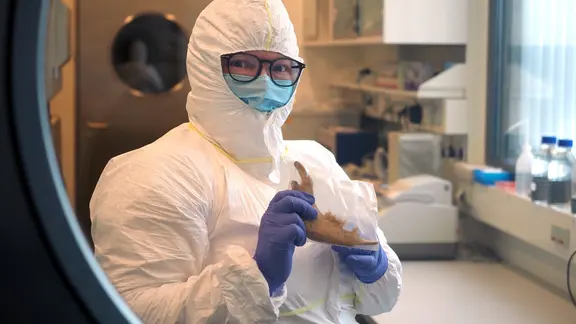
While the researchers are clear that an "off-the-shelf" solution does not yet exist, the discovery provides a vital proof of concept. It demonstrates that there is a fundamental biological vulnerability in Campylobacter that could eventually be exploited to improve food safety on a global scale.
What Consumers Can Do Today
Until technological solutions are perfected and integrated into the supply chain, the responsibility for prevention rests largely in the hands of the consumer. The Federal Institute for Risk Assessment (BfR) provides clear, evidence-based guidance to mitigate the risk of infection in the home kitchen:
- Stop Washing Poultry: One of the most dangerous habits is rinsing raw chicken under the tap. This does not kill the bacteria; rather, it creates an aerosol of contaminated water droplets that spreads Campylobacter across sinks, worktops, and nearby utensils.
- Direct Transfer: Whenever possible, move the raw meat directly from its packaging into the pan using tongs or a fork.
- Hygiene First: Treat every surface that touches raw chicken as contaminated. This includes the packaging, the cutting board, and your own hands.
- Cooking Standards: The only way to ensure the bacteria are killed is by thorough cooking. The meat must reach a core temperature of 70°C for at least two minutes.
- Dispelling Myths: Consumers must recognize that freezing does not kill Campylobacter; it merely slows its growth. Furthermore, because the bacteria do not cause the meat to spoil, it is impossible to detect contamination by sight or smell.
Conclusion: A Multi-Faceted Future
The rise of Campylobacter infections is a clear signal that current regulatory frameworks are insufficient to protect public health. While the prospect of using violet light to disinfect poultry at the industrial level offers a glimpse of a future where foodborne illness is significantly reduced, it is not a silver bullet.
The battle against Campylobacter requires a combination of immediate, vigilant domestic hygiene and a long-term commitment to innovation in food processing technology. As researchers continue to refine the application of light-based decontamination, public awareness remains our strongest line of defense. By understanding the nature of this persistent pathogen, consumers and policymakers alike can work to ensure that the poultry industry finally gets the "green light" on safety that it so desperately needs.