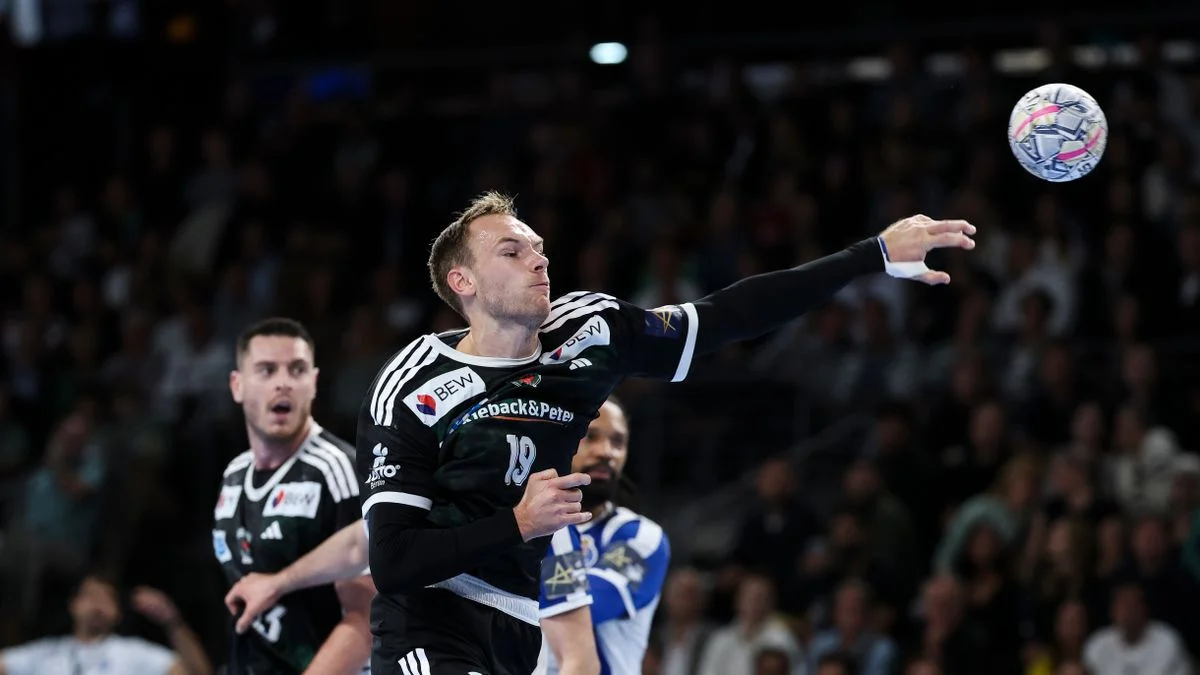
In a performance that will be etched into the annals of European handball history, Füchse Berlin superstar Mathias Gidsel delivered a virtuoso display on Tuesday night, guiding his team to a resounding 40-32 victory over FC Porto in the EHF Champions League. The win, crucial for the German side’s aspirations of advancing to the knockout stages, was overshadowed—or rather, illuminated—by Gidsel’s individual brilliance. With 17 goals, the Danish playmaker did more than just dismantle the Portuguese defense; he equaled a 17-year-old scoring record, cementing his status as the undisputed apex predator of modern handball.
The Chronology of a Masterpiece
The atmosphere at the Max-Schmeling-Halle was electric from the opening whistle, as the Berlin faithful recognized the weight of this Champions League fixture. Füchse Berlin, currently navigating a competitive Group A, needed a statement victory to keep pace with the Hungarian giants Veszprém.
From the first minute, it was clear that Gidsel was operating on a different frequency. While the collective effort of the Füchse defense provided the platform, it was Gidsel’s transition play and clinical efficiency that broke the game open. By the end of the first half, the Porto defense—a side usually characterized by tactical discipline—looked visibly shell-shocked. Gidsel moved through gaps that didn’t appear to exist, utilizing his trademark change of pace and an unorthodox release that left the Porto goalkeepers guessing.
As the second half progressed, the focus shifted from the scoreline to the scoreboard statistics. With every goal, the crowd’s anticipation grew. When Gidsel netted his 17th goal of the evening, the arena erupted. He had matched the legendary performance of Jesús "Chuchi" Martínez de la Cal, who, in November 2009, set the record while playing for Valladolid against Thessaloniki. The final minutes became a coronation, with the Füchse faithful rising as one to salute a player who is currently rewriting the physical and tactical limitations of the sport.
Statistical Dominance: Putting 17 Goals in Context
To understand the magnitude of 17 goals in a single Champions League match, one must look at the nature of modern elite handball. As tactical systems become more rigid and defensive structures more suffocating, individual scoring totals of this nature are becoming increasingly rare.
To put Gidsel’s performance into perspective, the next highest scorer for Füchse Berlin on the night was Aitor Ariño Bengoechea, who contributed a respectable five goals. The fact that Gidsel outperformed his closest teammate by a margin of 12 goals is a statistical anomaly that highlights the absolute dependency the Berlin system currently has on his output.
Furthermore, Gidsel achieved this tally with extraordinary efficiency. His shot selection remained disciplined throughout the match, refusing to force opportunities despite the confidence of his hot hand. He operated not as a selfish volume shooter, but as a central hub around which the entire offensive architecture of the club rotated. This balance—maintaining the highest scoring efficiency while continuing to facilitate for his teammates—is precisely why he is widely considered the best player in the world.
The Architect’s Perspective: Reactions from the Bench and the Court
Following the match, the post-game narrative was defined by a mix of reverence and disbelief. Coach Nicolej Krickau, who has overseen Gidsel’s integration into the Berlin system, was quick to highlight that Gidsel’s contribution extended far beyond the statistical column.
"He was the absolute leader today—not just in terms of goals, but mentally," Krickau noted in his post-match press conference. "He set the tone, pushed us through the difficult stretches, and provided the team with an unparalleled sense of security. When you have a player who can decide a game of this magnitude on his own, it changes the entire defensive setup of the opponent, which creates space for everyone else."
Gidsel himself, typically modest despite his mounting accolades, admitted that this performance carried personal weight. "It was important for me," the 27-year-old Dane said. "I’ve had many good games in my career, but today felt special. There was a rhythm to the match, a certain flow that allowed me to express myself fully. To equal a record like that is an honor, but the primary satisfaction comes from the two points we secured for the club."
Nils Lichtlein, who made his long-awaited home return after a significant injury layoff, provided the most evocative description of his teammate’s performance. "It is simply outstanding," Lichtlein said, still catching his breath after the match. "What he is doing out there is difficult to put into words. It is, perhaps, unique on this planet right now. To watch him work up close is a privilege."
The Tactical Revolution of Mathias Gidsel
Why is Gidsel so difficult to stop? Analysts have spent the better part of the last three seasons attempting to answer this. Unlike the traditional back-court shooters who rely on brute force and height, Gidsel has revolutionized the position through his "non-handball" approach—a concept where he relies on timing, body feints, and an uncanny ability to read the opponent’s center of gravity.
By distancing himself from the rigid, muscle-bound aesthetics of traditional handball, Gidsel has introduced a fluid, almost balletic quality to his movement. He does not fight the defense; he flows through it. This allows him to maintain high energy levels throughout the match, as he wastes very little motion in his pursuit of scoring lanes. This efficiency is the engine of his record-breaking form.
Implications for the Champions League Race
The victory over Porto leaves Füchse Berlin in a comfortable second place in Group A, trailing only the Hungarian juggernaut KC Veszprém. With three return fixtures remaining in the group stage, the path to the knockout rounds is now firmly in Berlin’s hands.
The primary implication of this win is the psychological advantage it provides. The rest of the Champions League field now knows that they cannot rely on traditional defensive schemes to contain the Berlin attack. If a team over-commits to stopping Gidsel, they leave themselves vulnerable to his playmaking; if they sag off, he has the capacity to reach double-digit scoring totals as he demonstrated against Porto.
For Füchse Berlin, the goal is now clear: secure a top-two finish to bypass the treacherous play-in rounds and earn a direct path to the quarterfinals. With Gidsel in this form, the club is not merely a participant; they are a legitimate contender for the European crown.
A Legacy in the Making
As the echoes of the Max-Schmeling-Halle fade, the broader conversation in the handball world shifts toward the historical significance of the 2024/25 season. We are witnessing a player at the absolute prime of his career, operating with the confidence of a veteran and the hunger of a prospect.
Whether Mathias Gidsel is the greatest handball player of all time is a debate that will likely rage for decades. However, after the events of this past Tuesday, the argument that he is the most influential player of the modern era is becoming increasingly difficult to refute. He has moved beyond the metrics of the sport, creating a new standard of performance that challenges his peers to evolve or be left behind.
For now, the record books reflect a tie between a 2009 legend and a 2024 phenomenon. But for those who were present in Berlin to witness the ease with which Gidsel dismantled an elite European defense, the record feels like merely a milestone in a much larger, ongoing masterpiece. The Füchse Berlin management will be hoping that this form holds as they turn their attention to the final hurdles of the group stage, knowing full well that they have the most dangerous weapon in world handball leading their charge.