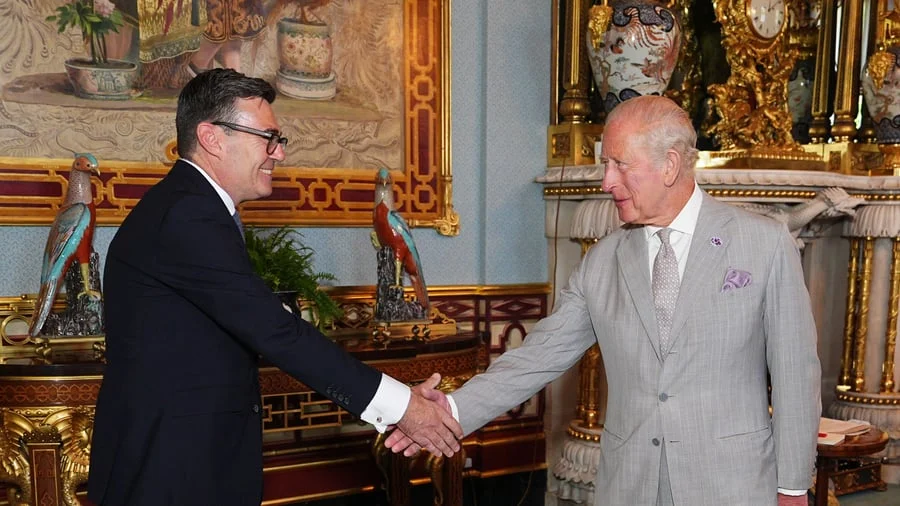
LONDON — In a move that signals a seismic shift in British politics, Andy Burnham, the charismatic and battle-hardened former Mayor of Greater Manchester, has been appointed as the new Prime Minister of the United Kingdom. King Charles III officially commissioned Burnham to form a government, marking the end of a tumultuous period for the Labour Party and the beginning of what many hope will be a transformative chapter for the nation.
Burnham’s ascent to 10 Downing Street follows the dramatic resignation of his predecessor, Keir Starmer, who stepped down in June after months of intensifying pressure. Starmer, who led the party to a commanding parliamentary majority in the summer of 2024, found himself unable to translate that electoral success into effective governance, crippled by internal factionalism and a dwindling public mandate.
The "King of the North" Rises to the National Stage
For years, Andy Burnham has cultivated a reputation as the "King of the North," a moniker earned through his staunch advocacy for the regions of Northern England. His popularity, rooted in his ability to articulate the grievances of "left-behind" communities, has long positioned him as a potential savior for a Labour Party struggling to retain its traditional heartlands.
Burnham’s appointment was finalized on Friday, following an uncontested selection process that saw him crowned as the new Labour leader. In his inaugural address, he framed himself as a "man of the grassroots," distancing himself from the perceived elitism of the Westminster bubble. A veteran of the political trenches, Burnham identifies as a classic social democrat, situating his platform firmly on the center-left.
A Chronology of Crisis and Transition
To understand the current political landscape, one must look at the rapid decay of the Starmer administration.
- Summer 2024: Labour achieves a landslide victory, promising a new era of stability after years of conservative turmoil.
- Autumn 2024: The honeymoon period ends abruptly. Internal party disputes regarding fiscal policy and constitutional reform paralyze the legislative agenda.
- Winter 2024/2025: The rise of the right-wing populist party Reform UK begins to dominate polling, as voters express disillusionment with Labour’s failure to address the cost-of-living crisis.
- June 2025: Facing a collapse in polling numbers and an open rebellion from his own backbenchers, Keir Starmer announces his resignation.
- July 2025: Andy Burnham is confirmed as the new leader of the Labour Party and is invited by King Charles III to form a government.
Supporting Data: The Economic and Social Landscape
The challenges awaiting Prime Minister Burnham are monumental. Recent economic data paints a grim picture: stagnant GDP growth, persistent inflation in energy costs, and an acute housing shortage that has left a generation priced out of homeownership.
Public opinion polls conducted in the lead-up to the leadership change showed that nearly 60% of the electorate felt the country was on the "wrong track." The rise of Reform UK—which has been poaching voters from both traditional Labour and Conservative demographics—serves as a warning that the British public is losing patience with mainstream political offerings.
Furthermore, the nation’s standing on the international stage has been perceived as diminishing. The transition of power comes at a time when the UK is navigating the complex geopolitical realities of a post-Brexit landscape. While Burnham has signaled a pragmatic approach to foreign policy, he has ruled out a full return to the European Union, favoring instead a model of "closer cooperation without institutional integration."
Policy Shifts: The "Public First" Mandate
In his first official statements as Prime Minister, Burnham has outlined an ambitious, if controversial, agenda. Central to his platform is the reversal of decades of privatization. He has pledged to bring water utilities, energy providers, and public transport systems back under public ownership.
"The era of the state as a mere observer is over," Burnham declared. "We will reclaim the essentials of life for the people."
However, this radical shift in economic policy has raised concerns among market analysts. Critics argue that such massive state interventions could lead to capital flight and long-term fiscal instability. Additionally, recent reports suggest that Burnham may be considering a pivot on environmental policy, potentially authorizing new oil and gas exploration in the North Sea. While this would be a direct contradiction of Labour’s previous climate commitments, supporters argue it is a necessary pragmatic move to ensure energy security during a period of global price volatility.
Official Responses and Political Reaction
The reaction to Burnham’s appointment has been polarized. Supporters view him as the only politician capable of bridging the divide between the affluent south and the neglected north.
"Andy is a pragmatist," says one Labour MP who requested anonymity. "He understands that we cannot just talk about socialism; we have to deliver services that actually work. If he can fix the trains and lower the heating bills, he will be untouchable."
Conversely, the Conservative opposition has labeled his appointment a "desperate lurch to the left." A spokesperson for the Shadow Cabinet stated, "Mr. Burnham is a creature of the old-school union politics. His plans for mass nationalization are a recipe for economic ruin that will leave the UK isolated and poorer."
Implications: The Challenge of Governance
The transition from Mayor to Prime Minister is rarely smooth, and Burnham faces a unique set of hurdles. He is tasked with managing a party that remains internally fractured between those who favor radical change and those who still cling to the centrist policies of the Starmer era.
Furthermore, the "strippenzieher" (string-puller) accusations—a term recently used by the BBC to describe his political maneuvering—suggest that he may face a difficult time building a broad coalition within Parliament. His ability to navigate the intricacies of Westminster will be tested immediately as he prepares to introduce his first budget. The expectation is that he will focus on "re-regionalization," shifting both political power and economic investment away from London and toward the Midlands and the North.
A Personal Glimpse: Beyond the Dispatch Box
Andy Burnham’s identity is inextricably linked to his roots. Born and raised in the village of Culcheth, between Manchester and Liverpool, he was instilled with Labour values by his working-class parents. His personal life is marked by a long-standing marriage to Marie-France van Heel, whom he met at university, and a devotion to his three children.
His cultural touchstones—such as his lifelong support for the Everton Football Club—have been used to bolster his image as a man of the people. In his speech, he notably remarked on his hope to attend matches as a season ticket holder, a sentiment that resonates with those who view the Westminster elite as being disconnected from the daily lives of citizens.
Yet, his life has also been touched by hardship. In a candid interview with The Times, he spoke openly about his father’s battle with Alzheimer’s disease, a condition that has robbed his father of the ability to witness his son’s pinnacle achievement. This human element has, in some quarters, softened his public image, adding a layer of empathy to his otherwise steely political persona.
Conclusion: The Road Ahead
As Andy Burnham settles into the residence at 10 Downing Street, he does so with the weight of a nation’s expectations on his shoulders. Whether he will be remembered as the leader who finally unified a fractured Britain or as the figurehead of a temporary reprieve from a deeper malaise remains to be seen.
The next few months will be critical. With the economy teetering, the electorate impatient, and the opposition waiting for any sign of weakness, Burnham’s term as Prime Minister promises to be anything but quiet. He has positioned himself as a reformer, a regional champion, and a pragmatist. Now, he must prove that these roles can coexist in the highest office of the land.
The "King of the North" has reached the capital. Now, he must lead the entire country through one of its most challenging winters in recent history. The verdict of the British people, as always, will be delivered in the ballot boxes to come.