Berlin, Germany – The Deutsches Theater Berlin recently concluded its highly anticipated AutorinnenTheaterTage (ATT) with a captivating "Lange Nacht der Autorinnen" (Long Night of Authors). This unique event showcased three compelling new works commissioned from the ATT-Atelier playwrights, offering audiences a profound journey through diverse narratives ranging from the existential angst of soap stars to the profound mysteries of death and the primal struggle within a forest of pines. The evening served as a vibrant testament to the Deutsches Theater’s commitment to nurturing contemporary German drama and providing a vital platform for emerging voices.
The "Lange Nacht der Autor*innen" is more than just a series of readings; it is a carefully curated experience where new texts receive their initial "scenic arrangements" by the Deutsches Theater’s own ensemble and technical staff. This approach allows the nascent dramatic works to breathe, offering a glimpse into their theatrical potential before full-scale productions. The three featured authors – Simone Saftig, Gesa Geue, and Marcus Peter Tesch – spent the current season as playwrights-in-residence, each crafting an original piece specifically for the DT, culminating in these much-anticipated premieres. The evening’s program, a compact yet expansive exploration of modern anxieties and timeless human conditions, underscored the sheer versatility and intellectual depth currently present in German-language playwriting.
The Genesis of New Drama: Understanding the Autor*innenTheaterTage
The AutorinnenTheaterTage (ATT) stands as a crucial institution within the German theatrical landscape, dedicated to identifying, developing, and promoting new dramatic texts. In an era where cultural narratives are constantly evolving, the ATT provides a critical space for playwrights to experiment with form, challenge conventional storytelling, and address pressing contemporary issues. The "ATT-Atelier-Autorinnen" program, a cornerstone of this initiative, offers selected playwrights the invaluable opportunity to work closely with a renowned institution like the Deutsches Theater. This residency not only provides financial and logistical support but also fosters a direct dialogue between authors, directors, and actors, allowing for a dynamic process of creation and refinement.

The Deutsches Theater, with its rich history and reputation for artistic excellence, plays a pivotal role in this ecosystem. By commissioning new works and providing a platform for their initial presentation, the DT actively shapes the future of theatre, ensuring that the stage remains a relevant and resonant mirror to society. The "Lange Nacht der Autor*innen" is the public culmination of this intensive development process, inviting audiences to be among the first to encounter the raw power and imaginative scope of these newly minted dramas. It’s an evening designed to stimulate thought, provoke emotion, and ultimately, celebrate the enduring potency of the spoken word in a theatrical context.
"Jo schmeißt hin" (Jo Quits): A Scathing Satire of Celebrity Culture
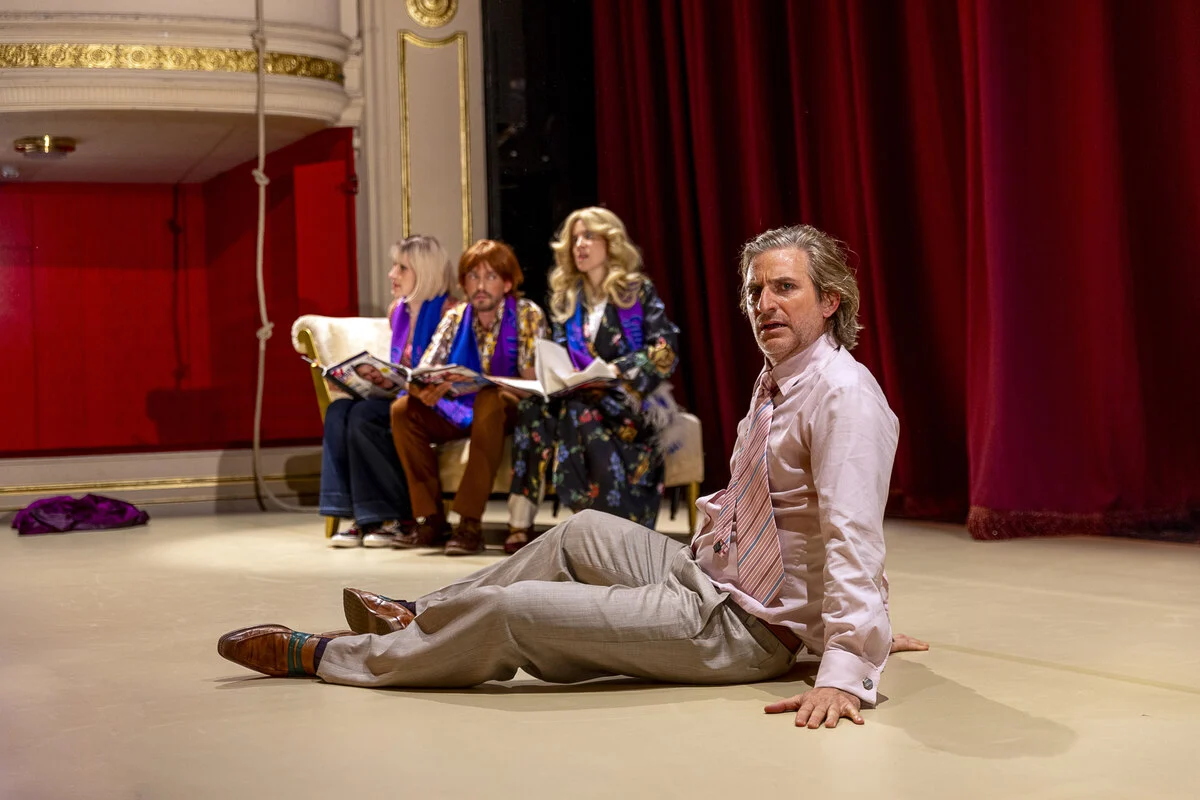
The evening commenced in the grand hall with Simone Saftig’s "Jo schmeißt hin," a sharp, often humorous, critique of modern celebrity and media manipulation. The stage, adorned with a striking golden, pulsating heart (designed by Ramona Hufler), immediately set a tone of theatrical exaggeration. At its center was Jonas Hien as Jo, a seemingly "slick" soap opera star, grappling with what he meticulously stages as a profound professional crisis. His existential doubts, however, are merely a meticulously crafted performance designed for maximum media exploitation.
Saftig masterfully surrounds Jo with three devoted fans, who serve as a curious, almost academic, chorus. As Jo dramatically announces his departure from the series, these fans, speaking in unison, react with an almost ritualistic despair, clinging to their idol in an act of collective devotion. What makes Saftig’s caricature particularly intriguing is the incongruity of the fans’ dialogue. Their lines are not the typical gushing adoration one might expect; instead, they often echo the language of popular sociological essays, dissecting fandom and celebrity culture with an unexpected academic rigor. This creates a surreal and darkly comedic effect, highlighting the manufactured nature of fame and the often-unconscious participation of the audience in its construction.

The play skillfully navigates the thin line between genuine human emotion and calculated media spectacle. Saftig, who openly admits her own fondness for popular German soap operas like GZSZ in a pre-recorded video portrait shown during the evening, brings an insider’s understanding to her critique. Jonas Hien’s portrayal of Jo is a tour de force, embodying the superficial charm and underlying cynicism of a star who knows exactly how to play the game. "Jo schmeißt hin" is a poignant reflection on the performative aspects of modern life, where authenticity is often just another carefully constructed brand. It forces the audience to question the narratives they consume and the figures they idolize, reminding us that even perceived vulnerability can be a tool for self-promotion.
"… und hinter der Nacht erscheint die Welt" (… and Behind the Night, the World Appears): A Whimsical Journey Through Grief and the Afterlife
Gesa Geue’s "… und hinter der Nacht erscheint die Welt" transported the audience to the more intimate setting of the DT’s chamber theatre, venturing boldly beyond conventional experience. This imaginative piece delves into themes of death, grief, and the afterlife with a blend of dark humor and profound tenderness. The narrative centers on Fredi, a 16-year-old girl, who has just lost her beloved grandmother. Enter Bernd Moss as Death, a weary figure who, instead of solemnly collecting souls, is desperate for a break. He dramatically hauls himself onto a referee’s high chair, then collapses onto Fredi’s grandmother’s bed, declaring his exhaustion.
In a move that is both absurd and deeply moving, Death forces Fredi to assume his ancient, formidable office. Fredi, driven by her grief and an unwavering desire to remain connected to her grandmother, accepts the mantle. This unconventional arrangement allows her to follow her grandmother into the realm of the dead, where, remarkably, her grandma remains the same comforting presence she was in life. Geue’s text, brought to life by Karsten Dahlem’s astute scenic arrangement, finds its greatest charm in these moments of delightful surrealism, when the narrative embraces its inherent strangeness.

One of the most memorable and captivating scenes features Fredi (Josephine Kunze) and her Oma (Tatja Seibt) on their journey to the afterlife, encountering a truly extraordinary character: a Diva seashell, also played by Bernd Moss. Moss’s portrayal of the seashell is nothing short of magnificent. Adorned in a delicately shimmering, padded cloak and an extravagantly matching headdress (costumes by Lena Beck), this mollusk is a creature of immense, languid grandeur. Geue bestows upon the seashell a deeply relaxed yet profoundly conservative philosophy, articulated with an almost hypnotic cadence: "I do what a seashell must do. I dig myself out, I dig myself in." Moss delivers this line with such effortless grace and grandezza that the seashell, despite its brief appearance, leaves an indelible impression, a fleeting moment of profound, self-contained wisdom that resonates long after its departure. The play is a beautiful meditation on how grief can open portals to unexpected realities and how love can transcend the boundaries of life and death, all while maintaining a unique, quirky sensibility.
"Böse Bäume" (Evil Trees): The Profound Force of Vocal Theatre
The evening reached its energetic crescendo in the Deutsches Theater’s courtyard with Marcus Peter Tesch’s "Böse Bäume," performed amidst the set of "Der Gesang des Pottwals." The performance began with a jolt: an old pickup truck roaring across the courtyard, screeching to a halt beside the audience tribune. From its doors and windows, actors spilled out, swiftly grabbing cardboard pine trees from the truck bed and carrying them onto the stage, ingeniously designed by Korbinian Schütze to resemble a "Pappwald" (cardboard forest).
What unfolded over the next hour was a masterful display of "Laut-Theater" – sound-based theatre – that brilliantly deconstructed group dynamics and power structures. Tesch’s work is a vibrant, witty exploration of language itself, transforming it into a raw, physical, and often hilarious medium. Two protagonists, played by Moritz Kienemann and Nele Trebs, stand at the heart of the narrative, each adamantly claiming to be the "only true forest." Their dialogue, initially a battle of wills and assertions, gradually evolves into a negotiation of responsibilities and, surprisingly, even a moment of tender closeness towards the end.

Supporting this central dynamic are Peter René Lüdicke, Jens Koch, and Abak Safaei-Rad, who deliver performances of exhilarating intensity. They embody various forest animals in rapid succession, their vocalizations and physical comedy reaching a fever pitch. The reviewer rightly notes that the late Austrian poet Ernst Jandl, a pioneer of concrete poetry and sound poetry, would have undoubtedly reveled in their artistry. Tesch provides them with a magnificent "Lautlibretto" – a libretto of sounds – that would be entertaining even if devoid of meaning. However, here it is cleverly interwoven into the dramatic fabric, enhancing the exploration of territoriality, identity, and the inherent struggles within any community.
One particularly striking and uproariously funny sequence involves Lüdicke, Koch, and Safaei-Rad attempting to articulate the German word "Männer" (men) through a process of prolonged, almost hesitant vocalization. They approach the word repeatedly, as if encountering it for the very first time. Its vowels and consonants are tentatively tasted, stretched, and ultimately "crushed" between the cardboard pines, dissolving into a cacophony of fragmented sounds. This act is a brilliant, immediate deconstruction of language, revealing its arbitrary nature and the power embedded within its pronunciation and interpretation. "Böse Bäume" possesses an immense linguistic and thematic power, a profound force that, as the reviewer concluded, would have "galloped past the other two pieces" in any competitive race. Its originality, intellectual rigor, and sheer theatricality made it a standout.
Official Responses and Critical Reception
While the original article does not provide direct official responses from the Deutsches Theater management or the authors, the very nature of the "Lange Nacht der Autorinnen" and the AutorinnenTheaterTage itself serves as an official endorsement of new dramatic writing. The institution’s investment in commissioning new works and providing a public platform for their development speaks volumes about its commitment to the contemporary theatrical landscape.

The critical reception, as articulated by the review, is overwhelmingly positive, highlighting the diversity and ambition of the showcased works. The reviewer’s detailed analysis of each play, from the "loving caricature" of Saftig’s media satire to the "skurrile Szenen" of Geue’s fantastical journey and the "unheimliche Wucht" of Tesch’s vocal theatre, indicates a profound engagement with the material. The enthusiastic description of specific performances and staging elements further underscores the success of the evening in engaging both critics and, by extension, the audience. The observation that Tesch’s "Böse Bäume" outshone the others is not a detraction from the quality of the first two, but rather an affirmation of its particular impact and innovative approach.
Implications for Contemporary German Drama
The "Lange Nacht der Autor*innen" at the Deutsches Theater Berlin carries significant implications for the future of German drama. Firstly, it reinforces the crucial role of established institutions in fostering new talent. By providing a residency program and commissioning new works, the Deutsches Theater actively ensures a continuous influx of fresh perspectives and narratives into the theatrical canon. This is vital for keeping theatre relevant and reflective of societal changes.
Secondly, the diversity of themes and theatrical approaches presented – from media satire and existential fantasy to experimental sound theatre – demonstrates the vibrant and multifaceted nature of contemporary German playwriting. It indicates a willingness on the part of playwrights to tackle complex issues with innovative forms, pushing the boundaries of what theatre can be and do. This kind of experimentation is essential for the art form’s evolution and its ability to engage diverse audiences.

Finally, the format of "scenic arrangements" or staged readings is itself significant. It provides a crucial intermediate step between a raw manuscript and a full-blown production, allowing playwrights to see their words come alive, refine their vision, and gauge audience reaction. For audiences, it offers a unique opportunity to witness the birth of new drama, connecting them more intimately with the creative process. The "Lange Nacht der Autor*innen" is not just an event; it is a vital laboratory for theatrical innovation, ensuring that the uncanny power of words continues to resonate profoundly on the German stage and beyond. It is a celebration of language as a dynamic force, capable of deconstructing reality, exploring the unknown, and ultimately, moving the human spirit.