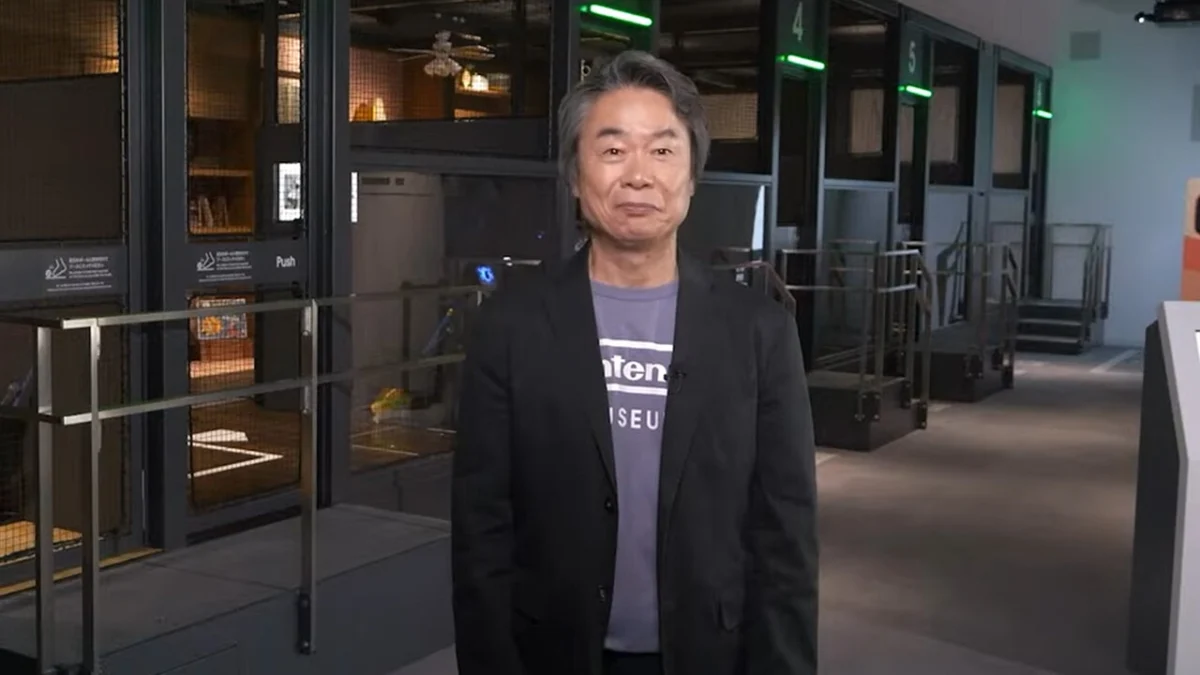
In a landmark moment for the global entertainment industry, Shigeru Miyamoto—the legendary creative force behind Nintendo’s Super Mario and The Legend of Zelda—has become the first figure from the Japanese video game sector to be awarded the prestigious Order of Culture (Bunka Kunshō). This honor, bestowed by the Japanese government, represents not only a personal career pinnacle for Miyamoto but a historic institutional validation of video games as a vital pillar of modern culture.
Yet, as the world celebrates his legacy, Miyamoto’s focus remains sharply fixed on the future. In a series of candid reflections following the announcement, he offered a sophisticated, nuanced perspective on the rise of generative artificial intelligence (AI), arguing that the technology acts as a mirror, clarifying the essential, irreplaceable role of human intent in the creative process.
I. The Highest Cultural Honor: A Milestone for Interactive Media
The Order of Culture, established in 1937, is Japan’s most esteemed civilian award. It is reserved for individuals who have made extraordinary contributions to the advancement of Japanese arts, literature, technology, and science. Traditionally presented by the Emperor on November 3rd—Japan’s Culture Day—the award is a symbol of national reverence.
A Humble Reception
Despite the magnitude of the accolade, Miyamoto’s initial reaction was one of characteristic modesty. During a press conference in Tokyo, he admitted that the prospect of receiving the honor felt “a little uncomfortable.” His reasoning stems from his philosophy of creation: “Games are not things that arise from a single source; they are the result of the collaboration of many people.”
For Miyamoto, the award is not a recognition of his genius alone, but a tribute to the thousands of developers, designers, and engineers who have labored alongside him for decades. He views the medal as a collective victory for the spirit of collaborative creation that defines Nintendo’s studio culture.
Institutional Validation
Beyond personal modesty, Miyamoto recognizes the broader implications for the industry. For years, video games struggled for recognition as a legitimate art form, often relegated to the status of mere "toys" or "tech gadgets." By inducting a game designer into the ranks of Japan’s elite cultural contributors, the government has officially signaled that interactive digital media is as central to the Japanese cultural identity as traditional painting, literature, or architecture. Miyamoto noted his intent for the future: to continue crafting experiences that “remain at the center of the living room,” cementing the role of games in the domestic and cultural fabric of society.
II. A New Frontier: Miyamoto’s Stance on Generative AI
While the industry often reacts to generative AI with either utopian fervor or existential dread, Miyamoto has adopted a stance of pragmatic philosophical inquiry. He views the current technological shift not as a replacement for human creativity, but as a filter that strips away the superficial, leaving only the essential.
Parallels with Technological History
Miyamoto frames the AI debate through the lens of historical transition. He draws direct parallels to the shift from typewriters to word processors, and the subsequent computerization of graphic design. In each instance, the industry feared the loss of "the craft."
“In the past, we had to learn specific, manual skills to achieve a certain result,” Miyamoto explained. “As technology evolved, the mechanical execution became easier, but the demand for a refined sense of layout, intent, and composition grew.” He argues that just as the word processor did not replace the novelist, generative AI will not replace the game designer. Instead, it shifts the focus from the execution of the work to the conception of the work.
The Danger of Confusion
A recurring theme in Miyamoto’s commentary is the distinction between "creation" and "execution." He expresses concern that modern creators often mistake the joy of technical execution (the act of drawing a line or coding a script) with the quality of the ultimate creative result.
“If a computer can generate a texture or a line of code, the person who spends hours doing it manually might feel a sense of satisfaction,” he noted. “But that satisfaction is internal. The audience cares about the vision, not the labor.” Miyamoto warns that relying on AI to fill in the blanks without a guiding human intent leads to a hollow output—a "copy-paste" aesthetic that lacks the soul required for long-term cultural impact.
III. Supporting Data: The Changing Landscape of Game Development
The intersection of AI and game development is currently one of the most volatile sectors in the global economy. To understand why Miyamoto’s comments carry such weight, one must examine the current state of the industry:
- Efficiency vs. Artistry: Industry reports suggest that AI-driven procedural generation and asset creation can reduce development time by 30-40%. However, these same reports indicate a rise in "generative fatigue," where players find AI-generated environments and dialogue increasingly predictable and devoid of the "hand-crafted" charm that defines titles like Breath of the Wild.
- The Nintendo Strategy: Unlike many of its Western counterparts—such as Ubisoft or Electronic Arts, which have aggressively integrated AI into their production pipelines—Nintendo has remained notably reserved. While they utilize back-end tools to optimize performance, the company has consistently prioritized human-led, iterative design.
- The "Human Touch" Metric: Recent market analysis indicates that indie games with a distinct "human" art style or narrative voice continue to outperform procedurally generated, high-budget titles in terms of player engagement and retention. This supports Miyamoto’s theory that the market eventually rejects mass-produced, automated content in favor of works with a clear "creative signature."
IV. Official Responses and Industry Sentiment
The announcement of Miyamoto’s award and his subsequent statements on AI have reverberated throughout the gaming world.
Industry Leaders
Industry analysts have lauded Miyamoto’s ability to remain grounded. "Miyamoto is essentially saying that AI is a tool, not a creator," says Hiroshi Tanaka, a senior tech journalist in Tokyo. "He’s reframing the conversation from ‘Will AI take our jobs?’ to ‘What is the human contribution that AI cannot replicate?’ It is a much more empowering narrative."
The Nintendo Perspective
While Nintendo has not issued a formal "AI Policy," corporate filings suggest that the company’s internal philosophy aligns with Miyamoto’s view. They are investing heavily in "tools that empower creativity," rather than tools that "automate the vision." This cautious approach is seen as a safeguard for their intellectual property, ensuring that their games remain synonymous with quality and human-centric design.
V. Implications: The Future of Creative Labor
Miyamoto’s outlook suggests a future for the gaming industry that is not binary, but dialectical.
The Refinement of "Creative Intent"
As generative AI lowers the barrier to entry for technical execution, Miyamoto posits that the value of a human designer will shift toward their ability to make choices. If an AI can generate a thousand variations of a level, the "creative act" is no longer building the level, but choosing the one variation that best serves the player’s emotional experience. This elevates the role of the director or designer to a level of "curatorial brilliance."
The Survival of the Individual
Miyamoto’s most optimistic assertion is that even if an AI were technically capable of producing a game from start to finish, the need for human input would remain. Why? Because art is a dialogue between the creator and the audience.
“Je mehr KI diese Aufgaben übernimmt, desto stärker bietet sie in diesem Sinne die Gelegenheit, darüber nachzudenken, was wirklich wichtig ist,” he remarked (The more AI takes over these tasks, the greater the opportunity to reflect on what is truly important).
For Miyamoto, the future of gaming is not a race to automate production, but a race to define the human experience. As long as humans crave stories that reflect their own struggles, joys, and complexities, the "human touch" will remain the most valuable resource in the development studio.
Conclusion: A Legacy of Persistence
As Shigeru Miyamoto steps onto the stage to accept the Order of Culture, he does so as a sentinel for the future of interactive art. He has successfully navigated the transition from the era of pixels and punch cards to the era of global digital networks and artificial intelligence. By emphasizing that his greatest successes were never the work of one, but the work of a collaborative human effort, he provides a blueprint for an industry facing its most significant technological challenge yet.
The message is clear: The tools may change, the methods may evolve, and the industry may grow exponentially, but the soul of the work remains fundamentally human. For Miyamoto, the ultimate test of any technology is simple: Does it bring us closer to the player, or does it distance us from the spark of creation? As he continues his work at Nintendo, the world will be watching to see how he translates these philosophies into the next generation of play.