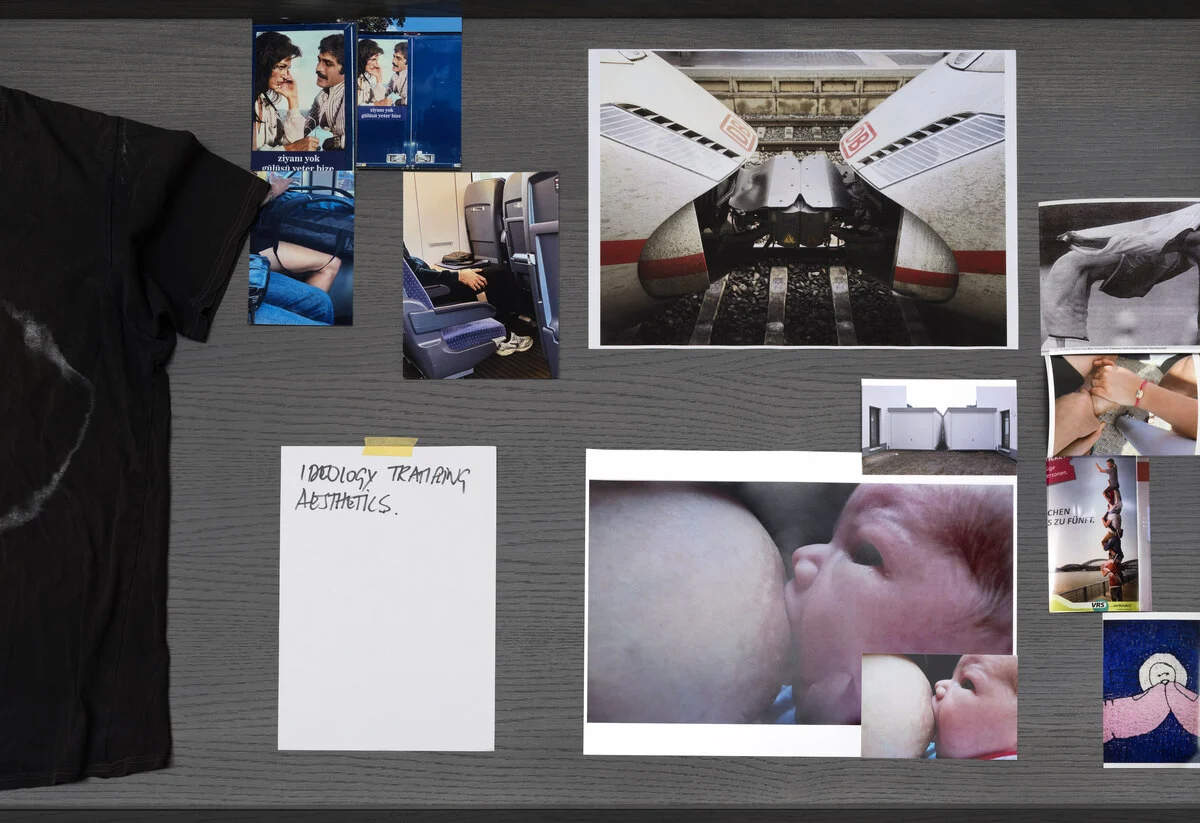
In the hallowed, minimalist architecture of the Langen Foundation in Neuss, a profound shift is taking place. Alexandra Bircken, the German artist globally renowned for her visceral, often aggressive sculptural interrogations—most notably her habit of bisecting motorcycles—has pivoted toward a quieter, more vulnerable register. Her latest exhibition, Silver Lining, is not a roar of machinery, but a delicate, sprawling archive of human experience. Spanning a 23-meter-long glass display, the exhibition invites visitors to lean in, neck-strained, to witness a life’s work reconfigured into an associative map of the modern condition.
The Architecture of Memory: Main Facts
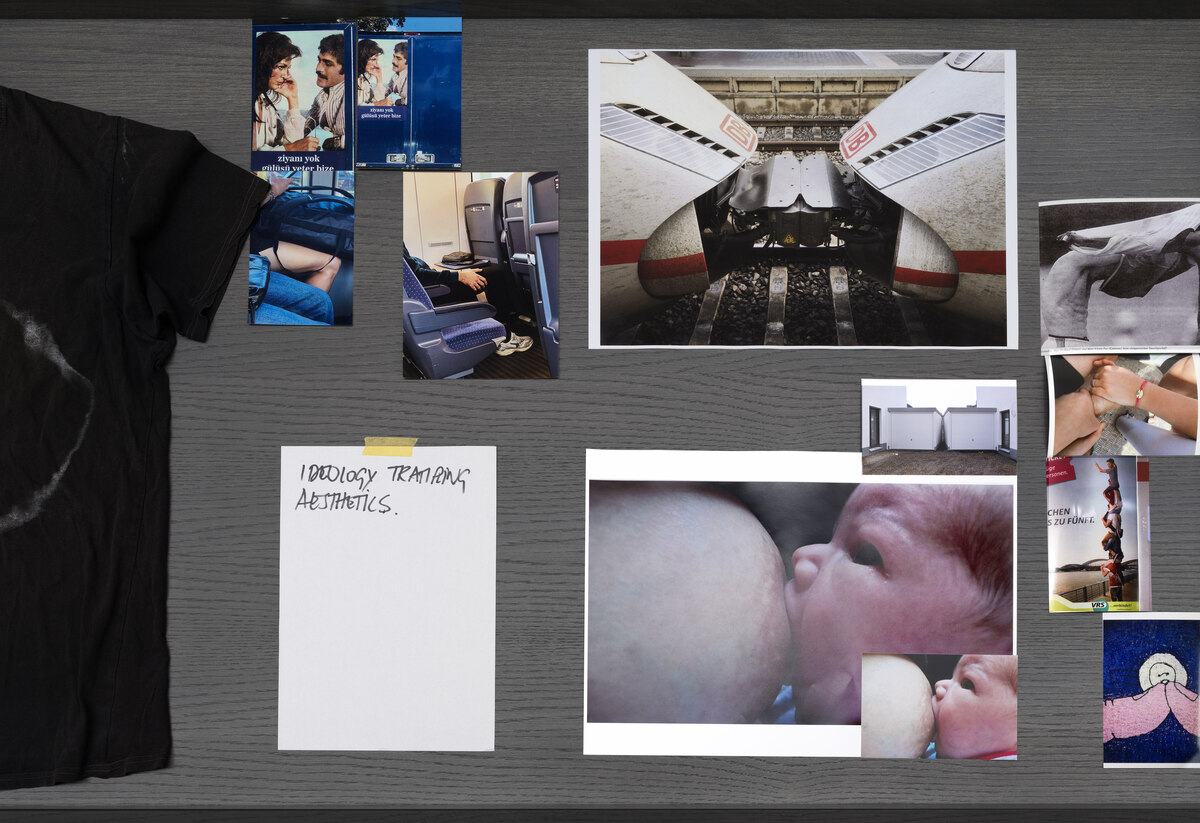
Silver Lining is a sprawling, non-linear archive that documents Bircken’s artistic evolution from the 1990s to the present. Unlike a traditional retrospective, which seeks to establish a clear chronological narrative, this exhibition presents a constellation of fragments: magazine clippings, personal photographs, digital screenshots, textile works, and found objects.
The exhibition acts as a laboratory of visual culture. By placing a lipstick-smeared magazine page next to a wooden shell casing, or a photograph of a breastfeeding infant alongside the industrial geometry of two docking ICE trains, Bircken challenges the viewer to find meaning in the "in-between." The exhibition, which runs until April 11, 2027, serves as an investigation into the relationship between the physical body, the consumer object, and the fleeting nature of contemporary existence.
A Chronology of Artistic Evolution
To understand the significance of Silver Lining, one must look at the trajectory of Bircken’s career. Born in 1967, Bircken initially established herself through powerful, often violent physical transformations of everyday objects. Her iconic "sliced" motorcycles are not merely aesthetic choices; they are metaphors for the fragility of the human body in a world of high-speed industrial consumption.
- 1990s – Early 2000s: The formative years, characterized by a deep exploration of materials and the "thingness" of objects.
- 2010: The creation of Lapsus, a textile work that currently hangs at the entrance of the Langen Foundation. This piece serves as a bridge, reminding the audience that arranging objects is, at its core, a form of weaving—an attempt to bind disparate threads of narrative into a coherent tapestry.
- Present: Silver Lining marks a departure into a more "sentimental" landscape. While the visual power remains—evidenced by the use of Swarovski-encrusted hats and medical imagery—the focus has shifted from the destruction of the object to the preservation of the moment.
Supporting Data and Thematic Clusters
The exhibition is organized into thematic "islands" rather than a single, rigid timeline. Bircken’s method mirrors that of the legendary art historian Aby Warburg, specifically his Mnemosyne Atlas. However, while Warburg sought an empirical, exhaustive mapping of the evolution of visual imagery, Bircken’s approach is notably more poetic and subjective.
The Logic of the Fragment
The exhibition relies on "associative chains." For instance, the sharp, aestheticized form of an Aimovig migraine syringe is visually linked to a silver ring shaped like a fingernail, which in turn leads the eye toward a simple ballpoint pen. This "poetry of the pointed" demonstrates how Bircken elevates the mundane to the symbolic.

The Intersection of Nature and Industry
A recurring theme is the friction between the organic and the synthetic. In one particularly striking juxtaposition, a photograph of a tree trunk—its bark stubbornly pushing against the grid of a metal fence—is placed next to an image of a human knee bearing the physical imprint of that same fence. This documentation of the "vorbeihaschende" (the fleeting or passing-by) shares a distinct DNA with the works of Wolfgang Tillmans, reflecting a shared heritage in the fashion industry and a keen eye for the unnoticed.
Official Context and Curation
The Langen Foundation, housed in a building designed by Tadao Ando, provides a stark, meditative backdrop that complements Bircken’s intricate display. The decision to house this extensive archive within a 23-meter vitrine forces a specific mode of engagement. It is a slow, horizontal experience that demands patience.
"Bircken is less interested in the history of the object than she is in the sentiment it carries," notes the curatorial framing of the exhibition. By including objects as diverse as pressed orange peels—which echo the texture of her signature leather motorcycle suits—and articles on "Longevity and Anti-Aging" placed next to a fresh baguette, the artist invites a sense of irony and "memento mori" that would have surely pleased the late, great Dieter Roth.

Implications: The Legacy of "Silver Lining"
The implications of this exhibition for contemporary art are twofold. First, it marks a maturation of the "sculptural" approach to curation. Bircken proves that an archive of ephemera can be just as potent as a singular, monumental sculpture. By treating her own past work as a source material for new meaning, she suggests that the artist’s life is an ongoing, fluid process rather than a static body of work.
Second, the exhibition serves as a critique of our digital age. In a time of infinite, scrolling feeds and disposable content, Bircken’s physical, curated display feels like an act of resistance. She is asking the viewer to stop "scrolling" and start "reading" the physical world around them.
The juxtaposition of the deeply personal (the breastfeeding infant) with the hyper-modern (the ICE trains) highlights the central tension of the 21st century: the struggle to maintain human connection and emotional depth in an increasingly automated and high-speed world.

Conclusion
Alexandra Bircken: Silver Lining is a masterclass in the art of the associative. It is a vulnerable, sprawling, and deeply intelligent exhibition that succeeds in finding the "silver lining" in the debris of modern life. For those willing to walk the length of the 23-meter vitrine, the exhibition offers more than just a retrospective; it offers a mirror to our own fragmented, sentimental, and ever-evolving selves. As the exhibition remains open until April 2027, it stands as a significant marker in the ongoing dialogue between the body, the machine, and the ephemeral nature of memory.
Whether one interprets the work as a commentary on the vanity of the fashion industry or a sincere attempt to catalog the "residue" of a life, the impact is undeniable: Alexandra Bircken has successfully moved beyond the machine, finding that the most resilient material of all is, perhaps, human sentiment.