By Dr. Daniel Niemetz, MDR History
Updated: October 18, 2026
The "Battle of the Nations" at Leipzig, fought between October 16 and 19, 1813, stands as the most cataclysmic military engagement in human history up to that point. When the smoke cleared, the Saxon city and its surrounding countryside were transformed into an apocalyptic landscape of carnage. Estimates suggest that upwards of 100,000 soldiers from the coalition of Austria, Prussia, Russia, and Sweden, as well as Napoleon’s French forces, were killed or mortally wounded. The sheer scale of the slaughter left a profound collective trauma that did not merely end a war—it fundamentally altered the consciousness of Europe’s ruling class and paved the way for the diplomatic restructuring of the continent at the Congress of Vienna.
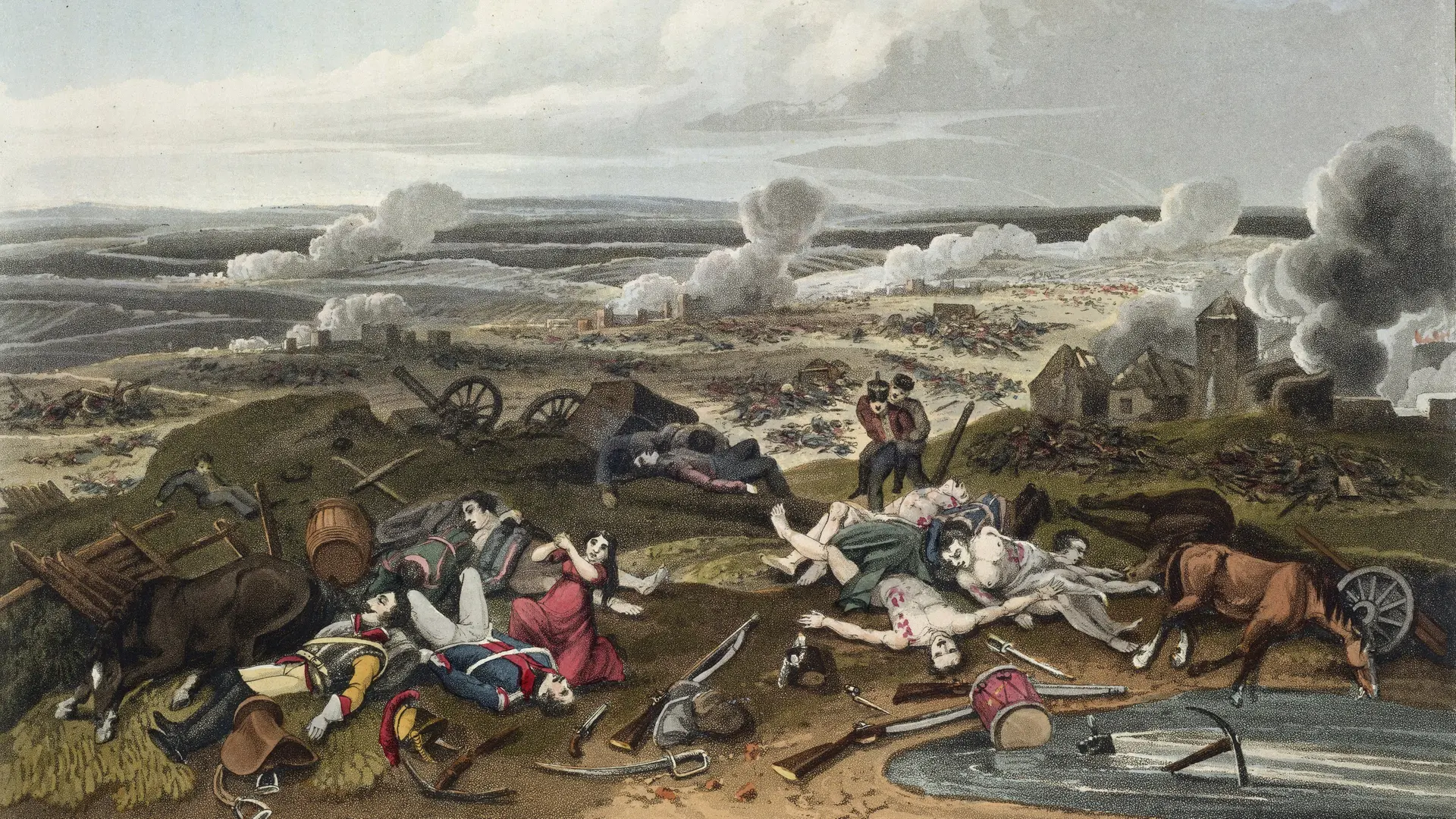
The Landscape of Despair: A City Under Siege
Following the final, desperate retreat of Napoleon’s troops on October 19, 1813, eyewitnesses described a scene that defied comprehension. The city of Leipzig, usually a vibrant hub of trade, had become a graveyard. Ludwig Hüffel, a local citizen, later recorded his harrowing observations: "The dead covered all the streets, especially in the suburbs. There was hardly a place that had not been a theater of combat. Everywhere, one stumbled upon the fallen."
The carnage was not confined to the streets. The Elster River, which served as a bottleneck for the fleeing French army, became a liquid tomb. As the bridge over the river was prematurely detonated, thousands of soldiers were trapped in the freezing water. Ferdinand Grautoff, another witness, recalled the sight of the river, which he described as "dammed by the corpses of men and horses." He noted that along the banks, thousands of hands reached out of the water, grasping at the grass in a final, futile attempt to escape the mire.

Chronology of the Catastrophe
The scale of the disaster was the result of a four-day escalation of violence.
- October 16, 1813: The initial clashes erupted at the villages of Wachau, Liebertwolkwitz, and Möckern. The intensity of the fighting at Möckern, where the Prussian forces under Blücher engaged Napoleon’s reserves, set a precedent for the high casualty rates that would follow.
- October 17, 1813: A day of relative lull in the fighting allowed for the grim accumulation of casualties. Both sides scrambled to reorganize as the sheer volume of the wounded began to overwhelm any semblance of medical infrastructure.
- October 18, 1813: The coalition forces launched a massive, coordinated assault on the city, squeezing the French forces into an ever-narrowing defensive perimeter.
- October 19, 1813: The final collapse of the French defense. The chaotic retreat through the narrow gates of Leipzig led to the destruction of the Elster bridge and the abandonment of thousands of wounded soldiers to the mercy—or lack thereof—of the victors.
The Medical Crisis: "Stump Knives and Despair"
The medical reality of 1813 was as gruesome as the combat itself. Johann Christian Reil, a physician serving in the Prussian ranks, surveyed the aftermath and found approximately 20,000 wounded and sick soldiers from various nations abandoned in the city. His accounts detail the horror of primitive surgery: "I witnessed an amputation performed with blunt knives. The brownish-red color of the severed muscles, the condition of the patient, and the lack of proper care gave me little hope for his survival."

For those who were not immediately killed, the "mercy" of the victors was often nonexistent. Reports indicate that French soldiers, if they survived the initial skirmishes, were left to die of hunger or, in some documented cases, were summarily executed by the advancing coalition troops. Even for the victors, the medical facilities were utterly inadequate, turning the city of Leipzig into a sprawling, makeshift infirmary where infection, gangrene, and starvation claimed as many lives as the musket fire had in the preceding days.
The "Cannibalism" of the Fallen
Perhaps the most harrowing aspect of the aftermath was the breakdown of basic human morality under the weight of extreme suffering. Ferdinand Grautoff reported the account of a French guardsman whose legs had been shattered by a cannonball. The soldier, having been abandoned for five days and nights in the cold, wet autumn weather, was discovered in a state of starvation. He confessed to feeding upon the flesh of a nearby corpse to sustain his own life—an act of desperation that became a grim, recurring anecdote among the survivors.

The stench of the unburied dead eventually forced the local authorities to organize mass graves. On the Johannisfriedhof, hundreds were buried in simple trenches. Outside the city walls, on the vast battlefields covering over 200 square kilometers, tens of thousands were interred in shallow mass graves, often covered with nothing more than quicklime to manage the inevitable sanitary nightmare.
Official Responses and the Shift in Military Doctrine
The sheer horror of the scenes at Leipzig and the later, similarly devastating Battle of Waterloo in 1815, triggered a psychological shift among the European leadership. General Gebhard Leberecht von Blücher, the Prussian commander who had seen his fair share of conflict, wrote to his wife after the events of 1815: "I have had enough of this murder, to the point of nausea."

This sentiment was not unique to Blücher. Dr. Steffen Poser, former director of the Völkerschlachtdenkmal (Monument to the Battle of the Nations), argues that the trauma of the 1813 campaign was the primary catalyst for the diplomatic shift seen at the Congress of Vienna. The monarchs and generals of Europe were physically and mentally exhausted. "They were all finished," Poser explains. "They were completely drained. It is no wonder they chose to meet at the Congress of Vienna to settle disputes through dialogue rather than by bashing each other’s skulls in."
The Legacy of the Congress of Vienna
The Congress of Vienna (1814–1815) represented an unprecedented diplomatic endeavor. For the first time, representatives from roughly 200 European states gathered to construct a framework for long-term peace. While critics often dismissed the proceedings as a "horse-trading" exercise among elites to restore old power structures, the resulting peace lasted, in various forms, for decades.

This stability was built upon the collective memory of the "Battle of the Nations." The political leaders of the time understood that the cost of total war, as demonstrated by the mounds of corpses at Schönefeld and the blood-soaked fields of Möckern, had become an existential threat to the stability of their respective regimes.
Implications: A Lesson for Modernity
The memory of Leipzig serves as a cautionary tale about the limits of military ambition. The "Battle of the Nations" was not merely a tactical victory for the coalition; it was a profound realization that war, when conducted on an industrial scale, consumes the very society it claims to defend.

In the modern context, the legacy of Leipzig is twofold. First, it marks the birth of modern humanitarian concern regarding the treatment of the wounded and the ethics of warfare. Second, it highlights the importance of multilateral diplomacy. As Dr. Poser emphasizes, the fact that these nations turned from the battlefield to the negotiating table suggests that even in the darkest moments of human history, there exists a path toward systemic reform.
The scars of 1813 are still felt in the region, visible in the monuments that dot the landscape around Leipzig. However, the true monument to the victims of the Völkerschlacht may not be the stone structure that stands today, but the realization that followed: that the alternative to the "nauseating murder" of war is the tedious, yet necessary, work of diplomacy. As we look back at the events of October 1813, we are reminded that peace is not merely the absence of conflict, but the deliberate, exhausting effort to avoid the repetition of the horrors that turned the fields of Saxony into a graveyard.