In the digital age, music consumption is almost exclusively synonymous with cloud-based streaming. We have become accustomed to instant gratification, where a simple tap on a smartphone screen—or a scan of a QR code—grants us immediate access to vast, ethereal libraries of sound stored on remote servers. But what if that infrastructure were to vanish? What if the "cloud" became unreachable, leaving us in a state of digital silence?
A fascinating project recently surfaced on the maker platform Instructables, challenging the very foundations of modern media consumption. Created by a developer known as "Makestreme," the project, titled "Paper Tunes," effectively reimagines the classic analog cassette tape for the 21st century. Instead of magnetic tape, however, it uses the humble medium of paper. By encoding audio data into high-density QR codes, Makestreme has demonstrated that it is possible to carry an entire song on a single sheet of paper—without the need for the internet, a subscription service, or even a cellular signal.
The Genesis of "Doomsday Spotify"
The spark for this unconventional experiment was a philosophical question: "What if you could carry an entire song with you on a single sheet of paper?"
Makestreme, an Indian developer with a penchant for pushing the boundaries of digital storage, sought to explore a world devoid of the technological crutches we take for granted. The project, which the creator jokingly refers to as "Doomsday Spotify," is a serious technical inquiry into the resilience of data. It forces us to reconsider the definition of "offline media."
In its raw form, a digital MP3 file is far too large to be contained within the standard constraints of a QR code. A typical high-quality MP3 would require roughly 1,000 "Version 40" QR codes—the highest capacity version available—to be represented in visual format. This would turn a three-minute song into a small booklet of paper, rendering the concept impractical. The solution, therefore, lay not in the storage medium itself, but in how we condense the information.
Neural Networks: The Compression Engine
The crux of the Paper Tunes project is a sophisticated compression pipeline powered by Meta’s EnCodec. EnCodec is a neural audio codec that leverages artificial intelligence to achieve high-fidelity compression. Unlike traditional lossy compression (like standard MP3 or AAC) that discards frequency bands based on human psychoacoustics, EnCodec uses neural networks to learn the underlying patterns of audio, reconstructing the waveform from the "absolutely necessary" information.
By utilizing this AI-driven approach, Makestreme successfully reduced a 2.9 MB MP3 file down to a mere 21 KB. While this is an impressive 140-fold reduction in size, it still exceeds the storage capacity of a single standard QR code, which typically tops out at about 3 KB of data.
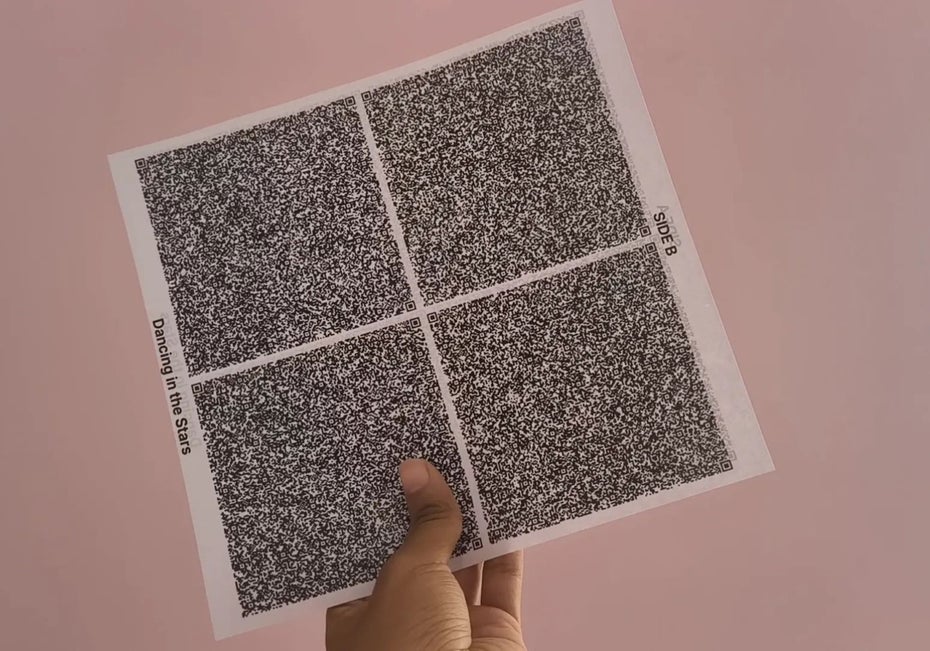
The developer’s final solution was a testament to design efficiency: the compressed audio file is segmented into eight distinct QR codes—four printed on the front of a sheet of paper and four on the back. This single sheet now serves as a high-density, physical "hard drive" for a single piece of music.
Audio Fidelity: The Surprising Reality
One might expect the audio quality of a file compressed to such an extreme degree to be unintelligible. However, the results have surprised both the developer and the maker community.
Makestreme initially experimented with a transmission rate of 1.5 kilobits per second (kbps). At this bitrate, the audio was noticeably degraded, suffering from heavy artifacts and metallic distortion. However, upon increasing the bitrate to 3 kbps, the neural network was able to retain enough structural integrity to make the music not only recognizable but surprisingly listenable.
While audiophiles would certainly notice the lack of high-frequency detail and the presence of compression artifacts, the playback is miles ahead of the "robotic" sounds associated with early-2000s low-bitrate internet audio. It is a striking example of how AI models can preserve the "soul" of an audio recording even when stripping away 99% of its original data.
The Technical Infrastructure: Beyond the Screen
The project does not stop at printing. To make the music truly "streamable" without a network, Makestreme implemented a secondary layer of hardware using LoRa (Long Range) technology. LoRa is a low-power, wide-area network (LPWAN) protocol designed for long-distance communication with minimal energy consumption.
The setup consists of two primary components:
- The Encoding/Decoding Script: A Python-based software suite that automates the entire lifecycle of the file. It takes an MP3, compresses it using the EnCodec model, splits the data into eight packets, generates the QR codes, and outputs two ready-to-print PNG images. On the receiving end, the script scans the QR codes and reconstructs the digital audio file for playback.
- The LoRa Transmitter/Receiver: To demonstrate that these files can be moved across distances without a traditional network, Makestreme built custom hardware using ESP32 development boards paired with Reyax RYLR998 LoRa modules. This allows users to transmit the data packets directly from one device to another over distances of several kilometers, depending on the environment, independent of any cellular tower or Wi-Fi router.
Implications for Digital Archiving
The Paper Tunes project, while framed as a fun, DIY "doomsday" experiment, touches on critical themes in digital archival and information theory. As we continue to move our personal and cultural history into cloud-based silos, we become increasingly vulnerable to service outages, account deletions, and the "bit rot" of proprietary server-side storage.
By demonstrating that even complex data like high-fidelity audio can be stored on low-tech, non-electronic media (paper) and transmitted via low-energy radio frequencies, Makestreme is highlighting a path for "analog-resilient" digital storage.
If a disaster were to occur—whether a localized internet blackout or a broader societal collapse—the ability to physically print and manually store data becomes a powerful insurance policy. It shifts the power dynamic of information from the platform owner back to the individual user. You own the paper, you own the code, and you own the music.
A Call to the Maker Community
For those interested in the technical minutiae, the full documentation, including the Python scripts, the wiring diagrams for the ESP32 boards, and the specific parameters used for the EnCodec model, is available on the Instructables project page.
The project is an open invitation to hackers, engineers, and curious hobbyists. Whether the goal is to create a tangible "music archive" that can survive for decades, or simply to understand how AI-driven compression can bridge the gap between digital data and physical reality, Paper Tunes provides the roadmap.
Conclusion
The evolution of Paper Tunes represents a bridge between the physical and the virtual. We have spent decades trying to escape the limitations of physical media—the scratching of vinyl, the tangling of cassette tapes, and the fragility of CDs. Yet, in our pursuit of infinite, weightless digital libraries, we have lost a degree of autonomy over our content.
Makestreme’s experiment is not a practical replacement for Apple Music or Spotify in our daily lives. However, it is a profound proof of concept. It reminds us that technology, at its core, is just information—and information, when properly compressed and formatted, can exist anywhere. Whether it is stored on a server in a remote data center or on a scrap of paper in your pocket, the music remains the same. In a world of increasing digital complexity, sometimes the most radical innovation is a return to the basics.