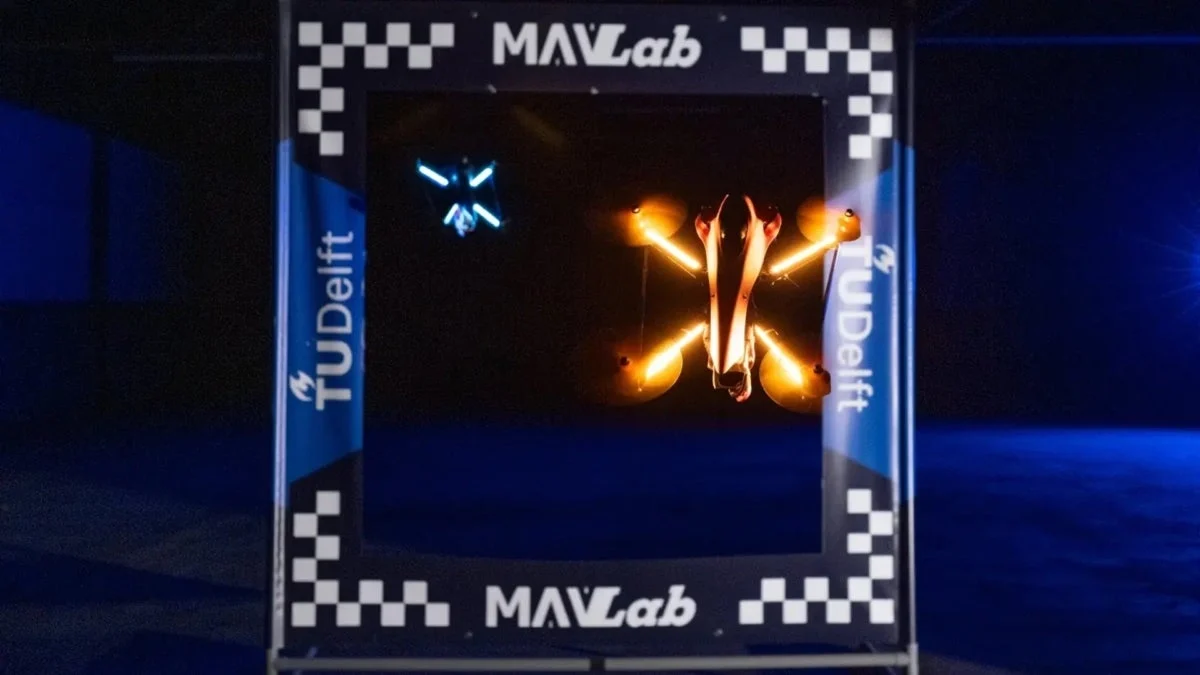
In the high-octane world of the Abu Dhabi Autonomous Drone Racing Competition, the atmosphere is electric. At speeds reaching 100 kilometers per hour, quadcopters blur into streaks of neon light, their presence announced only by the piercing, high-pitched whine of rotors pushing against the air. It is a sport defined by extreme technical precision, split-second reaction times, and the delicate intuition of the pilots behind the controls. However, the paradigm of this sport has shifted fundamentally.
In a landmark display of technological dominance, a team from the Netherlands, MAVLab at the Delft University of Technology (TU Delft), proved that the future of drone racing—and perhaps autonomous robotics at large—lies not in human reflexes, but in highly efficient artificial intelligence. Their system, "MonoRace," recently made international headlines after a detailed analysis was published in the journal Science Robotics, shedding light on how a machine outperformed the world’s elite human pilots with little more than a budget camera and a small, embedded computer.
The Duel in the Desert: Man vs. Machine
The narrative of this technological leap began in the competitive arena of Abu Dhabi. For years, the event served as a proving ground for the finest human drone racers, including world champion Yuki Hashimoto. These pilots represent the pinnacle of "First Person View" (FPV) racing, navigating complex, three-dimensional courses with gear-shifting speed.
However, the 2023/2024 iteration of the competition provided a stark contrast. While Hashimoto and other human competitors relied on their biological nervous systems to process visual data and adjust throttle and yaw, MAVLab entered an autonomous agent. The outcome was a watershed moment for robotics: the AI, MonoRace, navigated the course with a level of consistency and speed that left the human competition behind.
Unlike previous attempts at autonomous racing, which often relied on external motion-capture systems, GPS, or arrays of expensive LIDAR sensors, MonoRace operated with "eyes" comparable to a human’s: a single, low-cost camera. This was not merely a victory of speed; it was a victory of minimalist engineering.
Technical Architecture: Intelligence on a Budget
The brilliance of the MonoRace system lies in its resourcefulness. While many autonomous research projects rely on heavy-duty computing clusters and arrays of high-end sensors, the team at TU Delft took a radically different approach.
Hardware Specifications
The team equipped a standard racing drone with a modest set of components:
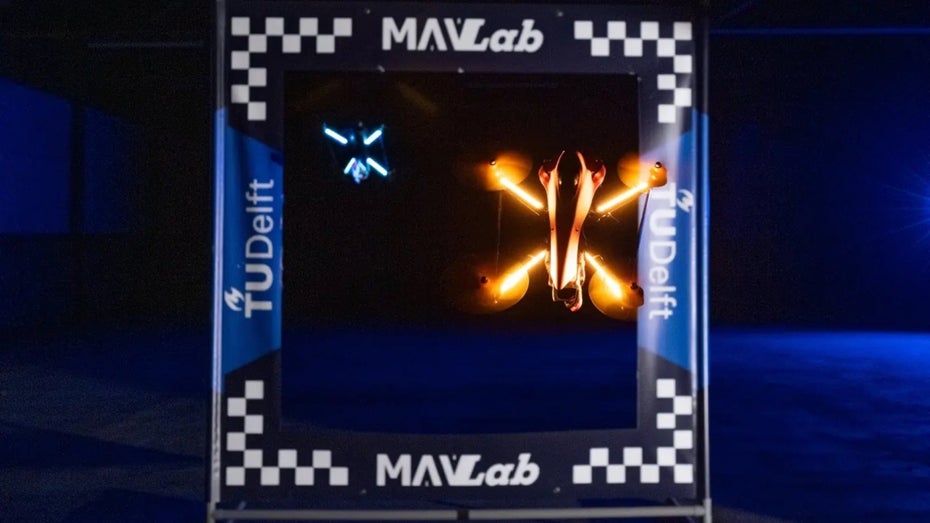
- Vision System: A single 8-megapixel camera, retailing for roughly €30.
- Processing Power: An Nvidia Jetson Orin embedded computer, optimized for AI workloads.
- Control: A standard flight controller managing the physical maneuvers.
The central challenge, according to lead author Stavrow Bahnam, was the sheer volatility of the flight environment. "Flying at very high speeds with only one camera is a significant challenge," Bahnam explained. "The images are naturally blurry and distorted, and the AI has a microscopic window of time to process the position of the drone relative to the course."
The "Less is More" Strategy
Rather than attempting to map the entire environment or process high-resolution video streams—which would lead to latency bottlenecks—MonoRace focuses on a specific, 384×384 pixel subset of its field of view. The system predicts where the next two gates in the course should appear based on the drone’s current trajectory, allowing it to "anticipate" the turn rather than merely reacting to it.
The Mechanics of Flight: 500 Commands Per Second
The process by which MonoRace navigates is a testament to modern deep learning and algorithmic efficiency. The workflow is split into a rapid, continuous loop:
- Vision Processing: Incoming images are fed into a neural network that identifies the outlines of the racing gates. It effectively strips away the background, creating a high-contrast mask that highlights only the gate structure.
- Geometric Analysis: The system identifies the specific lines and intersection points of the gate frame, providing an instantaneous coordinate for the drone’s next flight path.
- Command Execution: These coordinates are translated into flight commands at a staggering rate of 500 updates per second.
This cycle is supported by a foundational training phase involving "Reinforcement Learning." In a simulated environment, the AI was subjected to millions of iterations of flight. It learned not just how to fly, but how to handle the physical realities of racing: aerodynamics, center-of-gravity shifts, motion blur, and the chaotic vibrations of high-speed flight. By the time it took to the air in Abu Dhabi, the AI had "experienced" more near-crashes and recoveries than a human pilot could encounter in a lifetime.
Implications for Autonomous Robotics
The success of MonoRace transcends the niche of drone racing. By demonstrating that high-speed, autonomous navigation can be achieved with minimal, low-cost hardware, the TU Delft team has provided a blueprint for the future of robotics.
From Racing to Real-World Utility
The ability to navigate at high speed using only visual input has profound implications for:
- Search and Rescue: Drones that can enter unstable or collapsed buildings at high speed without relying on GPS.
- Infrastructure Inspection: Autonomous systems that can navigate complex, narrow environments like power grids or piping networks.
- Logistics: Faster, more efficient delivery drones capable of operating in dense urban environments where satellite signals are often blocked or unreliable.
Christophe De Wagter, a key researcher on the project, noted the broader intent of the study: "Instead of burdening the drone with ever more powerful sensors and massive computers, we wanted to discover how much intelligence we could extract from severely limited resources."
The Superiority of Neural Networks
The study published in Science Robotics highlights that neural networks are evolving to be the ideal interface for hardware-constrained robotics. Where traditional control algorithms often struggle with the "noise" of the real world—such as changing lighting conditions or camera vibration—deep learning models thrive. They effectively filter out the "garbage" data and focus on the spatial geometry required for flight.
Official Responses and Peer Recognition
The scientific community has lauded the project for its transparency and its focus on "frugal AI." By using an off-the-shelf camera and an embedded GPU, the team showed that the bottleneck to autonomous flight is rarely the hardware itself, but rather the intelligence of the software stack.
In the academic circles surrounding Science Robotics, the MonoRace project is now cited as a benchmark for "Edge AI." The ability of the drone to make real-time decisions on the fly, without a connection to a remote server or a massive external supercomputer, is the "holy grail" of robotics. It signifies a move away from the "cloud-connected" dependency of early-stage robotics toward true, edge-based autonomy.
The Future of the Sport and Beyond
Looking toward the 2025 season and beyond, the competition in Abu Dhabi is set to become even more intense. While human pilots retain a unique "intuition" and ability to adapt to non-linear changes in a race environment, the gap is closing rapidly.
The success of the TU Delft team suggests that we are entering an era where robots will move with the grace and agility of birds, using nothing more than their own eyes to interpret the world. As these systems become smaller, cheaper, and more capable, the boundary between the "programmed" and the "intuitive" will continue to blur.
For now, the record books reflect a clear winner: a collection of lines of code and a 30-euro camera, proving that in the race of the future, intelligence is the ultimate performance upgrade. The MonoRace experiment serves as a profound reminder that when technology is stripped down to its most efficient core, it is capable of achieving feats that were once considered the exclusive domain of human mastery.