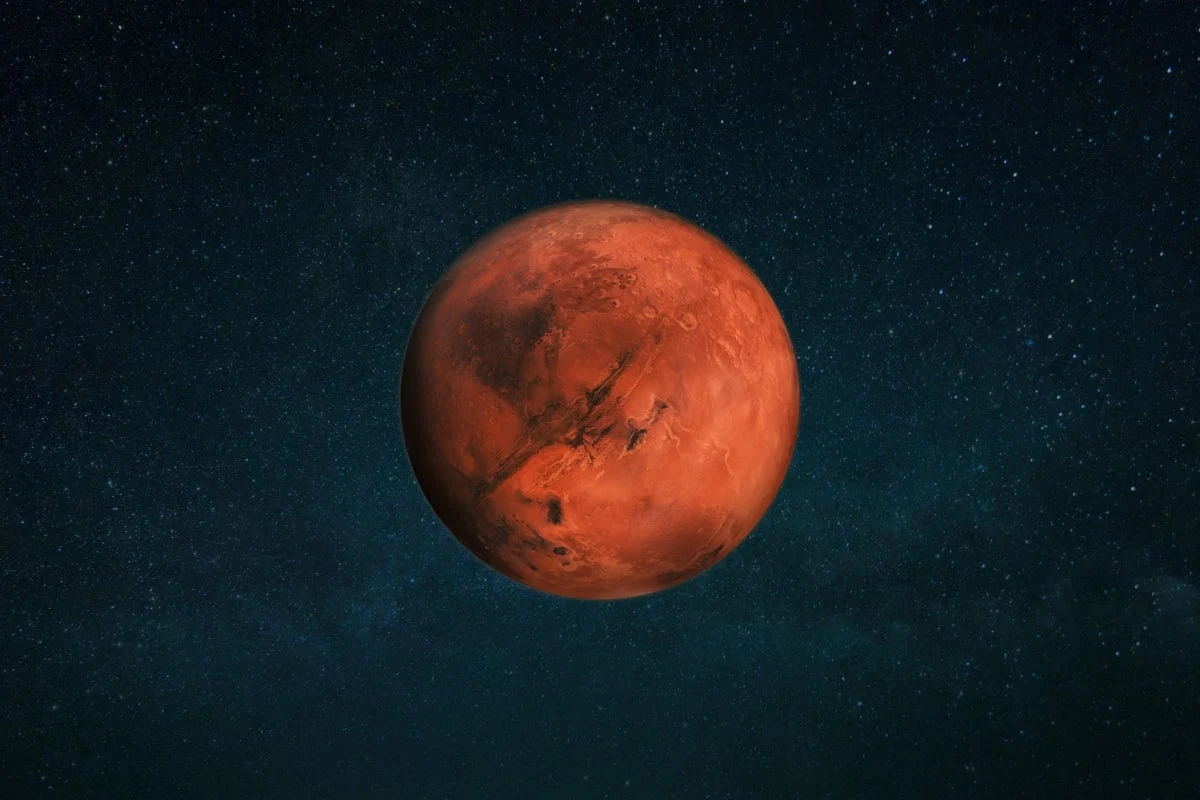
In the ongoing quest to determine whether Earth is the sole harbor of life in the universe, the Red Planet has long remained our primary point of interest. A groundbreaking study, recently published in the Planetary Science Journal, has provided a new, highly specific roadmap for future exploration. A research team led by scientists at the Institute of Science Tokyo has successfully modeled ancient Martian rainfall patterns, creating a map that highlights where vital prebiotic molecules—specifically formaldehyde (H₂CO)—may have been deposited billions of years ago. This discovery offers a transformative tool for space agencies worldwide, potentially guiding both uncrewed and crewed missions to the exact locations where the chemical signatures of extinct life might still be preserved.
The Primeval Mars: A Warmer, Wetter World
To understand the significance of this map, one must first look back to a time when Mars was a radically different world. Contemporary scientific consensus, backed by decades of geological data from orbiters and rovers, suggests that between 3.5 and 4.1 billion years ago—during the Noachian period—the Martian climate was significantly warmer and more humid.
During this epoch, the planet likely possessed a thicker atmosphere and a hydrological cycle involving clouds, rain, and surface runoff. This realization has long fueled the "follow the water" strategy adopted by NASA and the ESA. However, the Tokyo-led research team suggests that we should go beyond merely looking for water; we must look for the chemical messengers carried by that water. If the early Martian environment was indeed conducive to the development of life, it would have required a suite of organic building blocks—sugars, amino acids, and the complex molecules that serve as the foundation for biological processes. Formaldehyde is widely considered the "primordial soup’s" most essential ingredient, acting as a chemical precursor that bridges the gap between simple inorganic elements and complex organic life.
The Chemistry of Life: The Role of Formaldehyde
Formaldehyde is more than just a chemical compound; it is a catalyst for the assembly of biological structures. In the presence of water, formaldehyde acts as an architectural foundation, facilitating chemical reactions that lead to the synthesis of ribonucleic acid (RNA) and other critical molecules.
The core challenge for astrobiologists has always been understanding how these molecules might have been distributed across a planet as vast and geologically complex as Mars. By utilizing complex climate simulations, the research team sought to answer a fundamental question: Under the atmospheric conditions of 4 billion years ago, where would the rain have fallen, and what chemicals would it have carried to the surface?
The study builds upon existing knowledge of atmospheric chemistry, specifically the pathway through which formaldehyde is synthesized in a carbon-dioxide-rich environment. The research confirms that the chemical dissociation of water—driven by the intense UV radiation that would have penetrated the thinner, ancient Martian atmosphere—would have released reactive hydrogen. This hydrogen, in turn, would have combined with other atmospheric components to form formaldehyde, which would then be scrubbed from the sky by precipitation and deposited into the Martian crust.

Simulation: Recreating 4 Billion Years of History
To map these potential "hotspots," the research team developed a sophisticated computer model that reconstructed the environmental variables of the early Martian surface. They integrated data regarding surface temperature, atmospheric pressure, water vapor concentrations, and the intensity of solar radiation to track the movement of formaldehyde from the upper atmosphere to the lithosphere.
The Mechanism of Distribution
The simulation revealed that the distribution of H₂CO was not uniform. Instead, it was dictated by the planet’s early water cycle. Just as rainfall on Earth creates river basins and mineral deposits, the ancient rains on Mars would have concentrated formaldehyde in specific topographical depressions, crater lakes, and low-lying plains.
The researchers hypothesized that these specific areas would have acted as natural "chemical traps." As water evaporated, the formaldehyde would have been left behind in high concentrations, potentially sheltered from subsequent environmental degradation. By mapping these hydrological pathways, the team has effectively created a "treasure map" for the next generation of robotic explorers.
Bridging the Gap: From Theory to Exploration
The final phase of the research involved cross-referencing these theoretical hotspots with the actual landing sites of previous missions. This retrospective analysis provides a fascinating look at our past efforts and underscores the potential for future success.
Study lead Shungo Koyama, speaking to Universe Today, emphasized the significance of this spatial correlation. "By comparing our map with the results from Mars rovers, we can investigate whether locations with a higher H₂CO concentration possibly provided more favorable conditions for chemical processes linked to the origin of life," Koyama explained. "If future observations confirm this connection, our map could help identify promising targets for future Mars missions."
The data suggests that several sites previously visited by rovers, such as the Gale Crater or Jezero Crater, exhibit characteristics consistent with the team’s modeled accumulation zones. This provides a sense of validation for the selection of those landing sites while simultaneously pointing toward new, unexplored regions that may hold even greater scientific potential.
Implications for Future Missions
The implications of this study are profound, particularly as we stand on the precipice of a new era of space exploration. As private companies like SpaceX and national agencies like NASA prepare for human missions, the criteria for selecting landing sites must shift from simple safety and terrain accessibility to high-priority scientific yield.
A New Strategic Approach
- Targeted Sampling: Future robotic missions can be programmed to prioritize sites that show both high hydrological activity and high projected formaldehyde deposition.
- Human Exploration Strategy: If humans are to land on Mars, mission planners will need to choose locations that offer the highest probability of biological discovery to justify the massive cost and risk. This map provides a quantitative basis for those high-stakes decisions.
- Refining Laboratory Analysis: Knowing where to look is only half the battle; knowing what to look for is the other. By predicting the presence of H₂CO, researchers can calibrate the analytical equipment on upcoming rovers and landers to specifically detect these organic markers.
The Search for "The Second Genesis"
The search for life on Mars is fundamentally a search for the history of our own existence. If we find evidence that life emerged on Mars—even if it is limited to the chemical precursors of life—it would fundamentally alter our understanding of biology. It would suggest that the transition from chemistry to biology is not a fluke of Earth’s specific conditions, but a natural, perhaps inevitable, consequence of planetary evolution in the presence of water and organic building blocks.
Conversely, if we find that the conditions for life were perfect—that formaldehyde and water were present in abundance—yet life never emerged, that would be a discovery of equal magnitude. It would suggest that the "spark" of life is significantly rarer than we currently assume.
Conclusion: A Roadmap for the Future
The work conducted by the Institute of Science Tokyo provides a bridge between the abstract simulations of atmospheric science and the tangible, dusty reality of the Martian surface. By utilizing ancient climate data to predict the distribution of chemical building blocks, the team has turned the page on a new chapter of planetary science.
As we continue to peer through the lenses of our orbiters and trundle across the Martian landscape with our robotic surrogates, we are no longer just exploring a dead planet. We are systematically narrowing the search for a needle in a cosmic haystack. With every new map, every new simulation, and every refined landing coordinate, we bring ourselves closer to answering the oldest question of all: Are we alone?
The rains that fell on Mars four billion years ago may have stopped, but the chemical legacy they left behind is still there, waiting for us to uncover it. This map is the first step in ensuring that when we do arrive, we know exactly where to start digging.