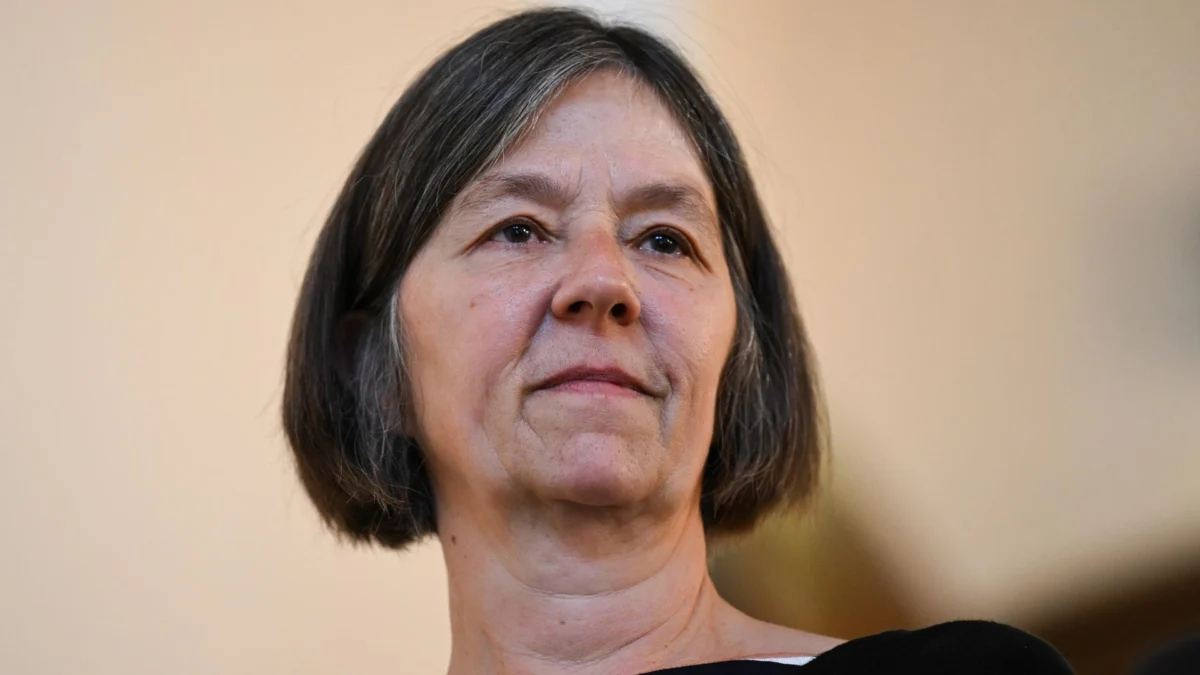
DARMSTADT, Germany – The German literary world turns its gaze toward the city of Darmstadt today as the esteemed author Christine Wunnicke is officially presented with the Georg Büchner Prize, the most significant literary award in the German-speaking world. The ceremony, held at the Staatstheater, marks the culmination of a distinguished quarter-century of writing that has redefined the boundaries between historical narrative and contemporary fiction.
The 59-year-old author, whose body of work has been described by critics as both "brilliant" and "singular," is being recognized for a career characterized by stylistic precision and a relentless, inventive spirit. As the literary community gathers to celebrate this milestone, the event serves as a poignant reminder of the enduring power of the German language in an era of global cultural flux.
The Core of the Accolade: Why Wunnicke?
The decision to award the 50,000-euro prize to Wunnicke was made by the Deutsche Akademie für Sprache und Dichtung (German Academy for Language and Literature). In its official citation, the jury praised Wunnicke’s ability to navigate the "vermeintlich Historischen" (the supposedly historical) to extract the "Fiktionale" (the fictional).
For the academy, Wunnicke is not merely a writer; she is a cartographer of the past who employs a sharp, almost surgical wit to dismantle traditional biographical structures. Her prose, which often bridges the gap between historical curiosity and existential meditation, has garnered her a reputation as one of the most intellectually rigorous authors currently writing in German. The jury highlighted her "unwavering work over a quarter-century," noting that her ability to surprise the reader—even when dealing with well-documented historical figures—is a hallmark of her unique literary voice.
A Career in Context: A Chronology of Excellence
To understand the weight of today’s honor, one must look at the trajectory of Christine Wunnicke’s career, which has evolved from specialized literary translation to the pinnacle of modern German prose.

- Early Beginnings: Wunnicke first established her reputation as a meticulous translator, bringing the nuances of Italian and English literature into the German language. This background in translation is often cited as the bedrock of her own prose style, which is frequently noted for its rhythmic precision and linguistic agility.
- 2015: The Breakthrough: The publication of Der Fuchs und Dr. Shimamura (The Fox and Dr. Shimamura) brought her to a wider audience. The novel, which explores the intersections of neurology and cultural collision in the 19th century, was a critical darling and cemented her status as a serious novelist.
- 2020: The Masterpiece: Die Dame mit der bemalten Hand (The Lady with the Painted Hand) showcased her ability to weave complex, historically grounded narratives with a modern sensibility. The book was widely lauded for its intellectual depth and atmospheric tension.
- 2025: Continued Recognition: Her most recent work, Wachs, garnered significant attention, landing on the shortlist for the German Book Prize. This recognition served as a precursor to today’s Georg Büchner Prize, signaling a year of immense professional accomplishment for the author.
Supporting Data: The Landscape of the Büchner Prize
Since its inception in 1951, the Georg Büchner Prize has functioned as the "Nobel Prize of German literature." It is not merely a financial award—funded jointly by the German federal government, the state of Hesse, and the city of Darmstadt—but a cultural barometer for the German-speaking world.
A Legacy of Laureates
The prize carries a heavy historical burden, having been awarded to giants of the 20th century who shaped the post-war German identity. The list of past winners reads like a map of the German intellectual landscape:
- Max Frisch (1958): A titan of Swiss literature, recognized for his explorations of identity and social expectation.
- Günter Grass (1965): The quintessential chronicler of the post-war era.
- Heinrich Böll (1967): A moral conscience for the nation during its reconstruction.
By joining this list, Wunnicke follows in the footsteps of recent predecessors, including the 2025 laureate, Ursula Krechel. The lineage of the prize ensures that the recipient is not just honored for a single book, but is integrated into the canon of German intellectual history.
Financial and Institutional Support
The 50,000-euro endowment, while substantial, is secondary to the institutional backing provided by the Academy. The prize mandates that the recipient must be someone who has "contributed significantly to the shaping of contemporary German cultural life." This requirement places a heavy burden of public intellectualism on the winner, a challenge that Wunnicke’s body of work—which explores the intellectual history of Europe—is well-equipped to handle.
Official Responses and Cultural Impact
The response to the announcement in July has been overwhelmingly positive. Academic critics and bookstore owners alike have pointed to the "refreshing lack of pretension" in Wunnicke’s work. Despite her high academic standing, her novels maintain a narrative pull that appeals to a diverse demographic of readers.

"Wunnicke does not write for the ivory tower," noted one literary critic following the initial announcement. "She writes for the reader who wants to be challenged by the past, not just instructed by it."
The Academy’s decision has also been praised for its inclusivity in terms of genre. By honoring someone who moves fluidly between biography, the novel, and radio plays, the jury has signaled that the "literary novel" is no longer a fixed category. In an era where digital content and audiobooks are transforming the act of reading, Wunnicke’s versatility is seen as a model for the contemporary author.
Implications: The Future of the Historical Novel
The awarding of the Georg Büchner Prize to Wunnicke raises significant questions about the direction of German literature. In recent years, there has been a resurgence in historical fiction, yet much of it leans toward the sentimental or the didactic. Wunnicke stands apart by refusing to treat history as a static backdrop.
The "Fictionalization" of History
Wunnicke’s work implies that the past is always a construction. By highlighting the "fictional" elements within the "historical," she forces her readers to question the nature of truth in narratives. This is a particularly pertinent theme in an age of "fake news" and historical revisionism. Her work acts as a form of intellectual resistance, showing that while history is a series of facts, our understanding of it is always an act of storytelling.
Global Reach
As an translator herself, Wunnicke’s work is uniquely positioned to travel. The themes she tackles—science, exploration, the nature of genius, and the fragility of the human ego—are universal. The international interest in her work is expected to rise sharply following this award, with publishers across Europe and the Americas likely looking to acquire rights to her catalog.

Conclusion: A Living Legacy
As the festivities in Darmstadt conclude, the focus will inevitably shift from the ceremony to the ongoing impact of Christine Wunnicke’s work. She represents a generation of writers who are not content to simply observe the world, but who feel compelled to pick apart its foundations.
For those unable to attend the ceremony in person, the livestream provided by the hessenschau portal allows for a rare, intimate look at the moment a writer is cemented into the history books. It is a moment of celebration, yes, but also a moment of reflection. As the curtains close on this year’s Georg Büchner Prize ceremony, one thing is certain: the conversation around Christine Wunnicke’s work is only just beginning. She has proven that in the hands of a master, the past is never dead; it is merely waiting for the right storyteller to bring it back to life.