In the rarefied world of video game collecting, few franchises command the reverence of Nintendo’s Pokémon. As the series approaches its third decade of global dominance, relics from its inception have transitioned from childhood curiosities to high-stakes investment assets. Currently, the auction house Goldin is hosting a listing for a rare developmental prototype of Pokémon Red for the Nintendo Game Boy—a piece of hardware that has already commanded a $25,000 bid despite being technically "unplayable" on standard retail hardware.
Main Facts: A Digital Relic Under Scrutiny
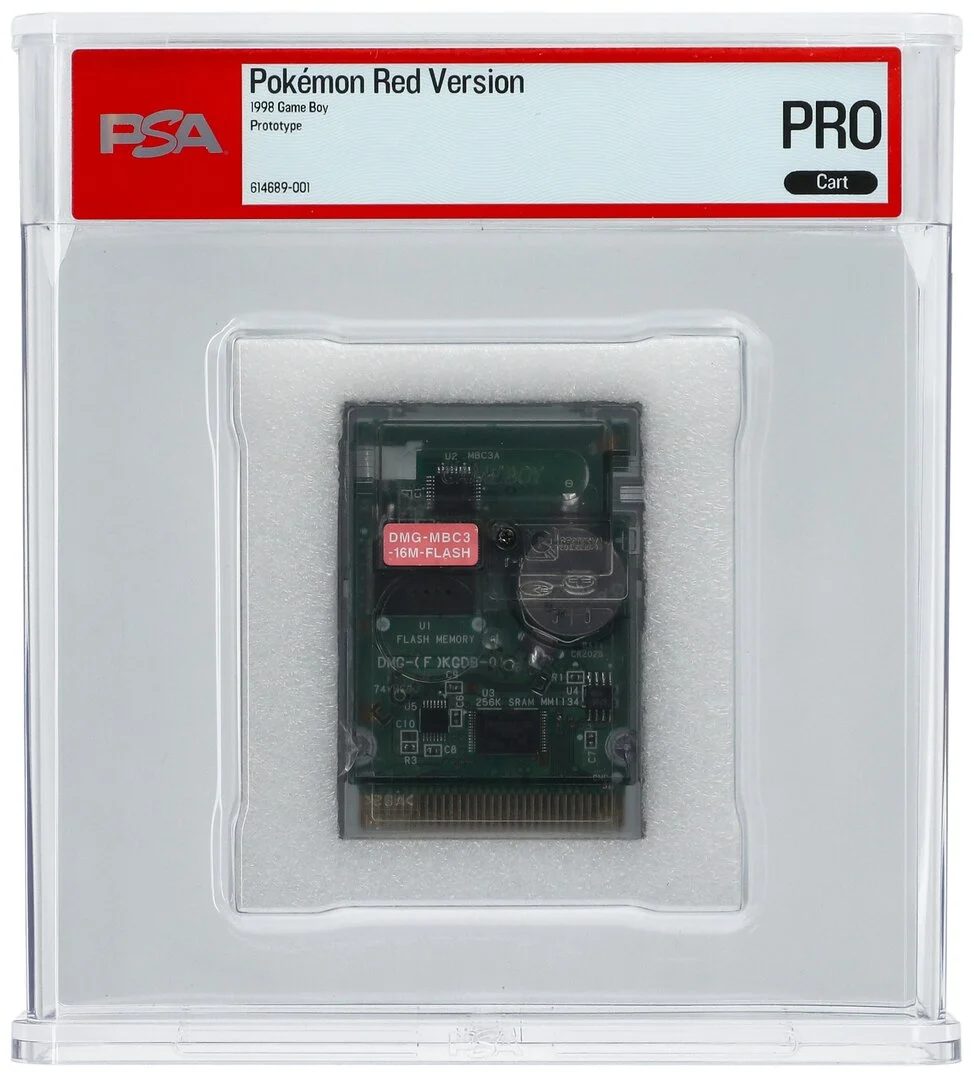
The item in question is not a standard retail cartridge found in the collections of 90s-era gamers. It is a chunky, industrial-grade development module—specifically, a Flash-memory prototype board. The unit is clearly marked with the identification "DMG-(F)KGDB-01" and bears a distinctive sticker labeled "DMB-MBC-16M-FLASH."
Authenticated by PSA (Professional Sports Authenticator) under serial number 614689-001, the item has been encapsulated in a protective plastic slab and graded as "Pro." While PSA is the industry standard for grading trading cards and sports memorabilia, its foray into hardware authentication brings a unique set of challenges. Technical limitations in the equipment used by the firm prevented a full dump of the module’s memory; to date, only the first 32 KB of data have been successfully extracted.
The data retrieved from this initial segment reveals a curious anomaly. While the code largely mirrors the final US retail release of Pokémon Red, the header information contains a discrepancy. At Offset 0x014C, which dictates the Mask-ROM version, the value is set to "55" rather than the standard "00." Consequently, the checksum calculation at Offset 0x014D deviates from the official release, displaying "CB" instead of the expected "20."
Chronology of a Global Phenomenon
To understand the value of this prototype, one must contextualize the era of its creation. Pokémon Red and Blue were released in North America on September 28, 1998, serving as the spark that ignited a global cultural wildfire.
- September 1998: The titles launch in North America. Within the first fortnight, Nintendo records 200,000 units sold—an unprecedented figure for a handheld title at the time.
- Late 1998: Sales accelerate exponentially, reaching four million units by the end of the calendar year.
- The Lifetime Legacy: Over the subsequent decades, the original Pokémon entries would go on to sell more than 31 million copies combined, cementing their place as the foundation of one of the highest-grossing media franchises in history.
The prototype currently at auction represents the "pre-production" phase of this juggernaut. It serves as a tangible link to the period when Nintendo of America was finalizing the translation and technical localization of the Japanese Pocket Monsters software.
Supporting Data: The Technical Hurdle
The primary point of contention for potential bidders is the inability to run the cartridge on a standard Game Boy. Because this is a development flash-module, it lacks the specific hardware configuration of a mass-produced consumer cartridge. Collectors are effectively bidding on a "black box"—an object whose internal contents remain largely obscured by the limitations of current diagnostic tools.
PSA’s authentication relies heavily on the partial data dump. They posit that because the first 32 KB are consistent with the final retail build, the remainder of the memory is likely identical. However, in the world of high-end preservation, "likely" is not "certain." For a bidder prepared to drop tens of thousands of dollars, the inability to verify the full ROM image introduces a layer of risk that is rarely seen in the market for physical sports cards or sealed boxes.
Official Responses and Market Context
The auction house Goldin has positioned this item as a premier piece for the "serious collector." PSA’s involvement, serving as a strategic partner, provides a veneer of institutional legitimacy. However, the market for such items is notoriously volatile.

Historically, hardware prototypes often struggle to achieve the same price floor as "factory-sealed" retail games, primarily because their provenance is harder to track. Unlike a sealed copy of Super Mario Bros., which has a clear supply chain from warehouse to auction block, development hardware often left the company via unofficial channels—employee hand-me-downs, trade show samples, or testing laboratory disposals.
Despite this, the appetite for Pokémon history is insatiable. Only two months prior to this listing, a "mock-up" packaging prototype for the English-language version of Pokémon Red was listed with a staggering $500,000 minimum bid. Compared to that, the $25,000 price point for the actual functional hardware (or what remains of it) could be interpreted by some analysts as a potential entry point for investors looking to diversify their gaming portfolios.
Implications for the Future of Video Game Preservation
The auction of the Pokémon Red prototype raises significant questions regarding the intersection of commerce and history. As the video game market matures, the demand for "behind the scenes" materials is growing. However, the current model of selling these items via high-end auction houses often prioritizes the encapsulation of the object over its accessibility.
The Conflict of Interest
When a unique piece of code—such as the data inside this flash module—is locked behind a plastic slab and sold to a private collector, it effectively disappears from the public record. Researchers and historians, who might be able to identify the exact nature of the "55" version header or discover hidden debug menus in the unread memory, lose the opportunity to study the artifact.
The Investment Trend
The entry of firms like PSA into the gaming space has accelerated the "commodification" of these items. By treating development modules like trading cards, the market incentivizes the preservation of the physical item, but often at the expense of the data inside. The auction ends on October 26, and whoever wins the bid will likely treat the module as a display piece. Whether the code is ever fully dumped and analyzed remains a matter of speculation.
Conclusion: A Price Tag on Ambiguity
The Pokémon Red prototype is a fascinating study in modern collecting. It is an object defined by its ambiguity: it is a piece of software history that cannot be played, a verified relic that has not been fully verified, and a high-value asset whose worth is dictated more by the Pokémon brand than by the tangible functionality of the item itself.
As the clock ticks toward the October 26 deadline, the $25,000 price tag serves as a testament to the enduring power of the franchise. Whether the buyer is a private investor looking to flip the item or a preservationist hoping to eventually extract the remaining memory, the sale underscores a reality of the digital age: even in the era of cloud computing and digital distribution, the physical ghosts of the 8-bit generation remain among the most coveted treasures in the world.
For those watching the auction, the lesson is clear: in the world of high-end collectibles, the story of the object—the provenance, the mystery of its creation, and the, at times, incomplete nature of its history—is often far more valuable than the object itself.