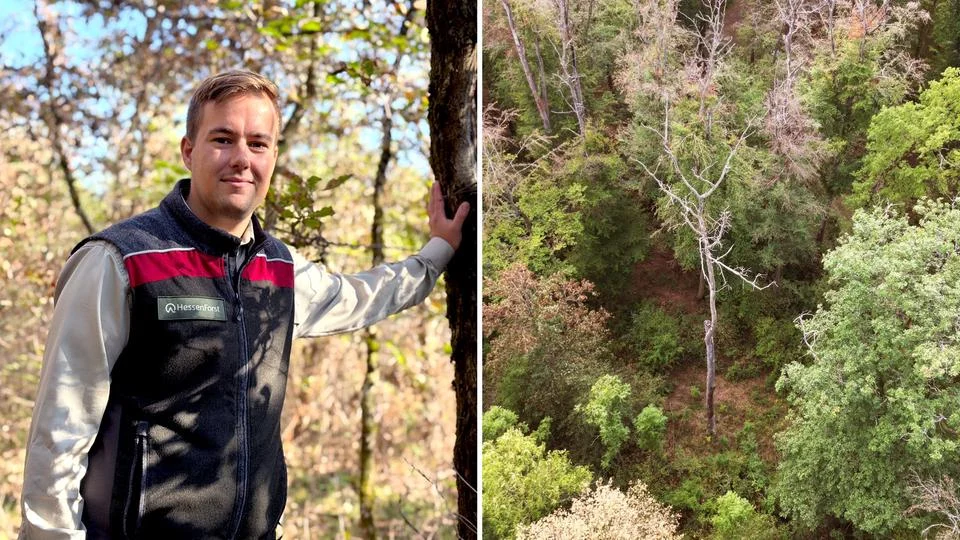
The autumnal palette arriving in the forests of Nidda, located in the heart of the Wetterau region, is deceptive. While the golden, russet, and amber hues typically signal the seasonal transition, the premature browning observed this year tells a far more sinister story. It is not the cycle of nature at work, but a testament to a landscape struggling for survival.
Across the state of Hessen, the legacy of a record-breaking summer is written in brittle leaves, thinning crowns, and the withered skeletons of young plantations. For foresters and private landowners, the year 2026 has marked a critical threshold in an ongoing battle against the escalating climate crisis. What was once considered an anomalous weather event has, in the eyes of experts, become a relentless, recurring reality.
The Reality of "Trockenstress": A Chronology of Decline
The current state of the forest is not an isolated incident but the culmination of a decade defined by environmental strain. Since 2018, Germany’s forests have been trapped in a cycle of consecutive drought years. However, the summer of 2026 proved to be the most severe in terms of meteorological data, standing as the hottest season since records began in 1881.
A Timeline of Stress
- 2018–2021: The onset of systemic drought. The initial "wake-up call" for forest managers as bark beetle infestations began to decimate spruce monocultures.
- 2022–2025: A period of marginal recovery followed by erratic weather patterns. The resilience of the soil moisture levels failed to replenish, leaving trees vulnerable to subsequent heatwaves.
- 2026: The tipping point. The record-breaking heat of this past summer pushed both deciduous and coniferous trees to their physiological limits.
Forester Christoph Backhaus, working in the woodlands near Ober-Lais, points to a stand of 35-year-old oaks—trees that should be in their prime. Instead, their branches are skeletal, stripped of the vibrant green foliage they should carry well into the autumn. "This has nothing to do with autumn coloration," Backhaus notes, his voice heavy with professional frustration. "The heart of the forester bleeds when you see this." The oak, long championed as a climate-resilient species, is now struggling to maintain its vitality under the relentless pressure of depleted groundwater and scorching temperatures.

Supporting Data: Assessing the Scale of the Damage
The quantitative impact of the drought is still being tabulated, yet the preliminary findings from HessenForst and local forestry offices are alarming. In many areas, the mortality rate of saplings in newly established plantations has reached catastrophic levels.
In the municipal forest of Langgöns near Gießen, the local forester reports an 80 percent mortality rate among newly planted trees this summer. This is not merely a botanical loss; it represents a significant economic and ecological setback.
The Vulnerability of Species
The European Beech (Fagus sylvatica), the most vital deciduous tree species in Hessen, has become the primary focus of scientific concern. Unlike other species that can partially adapt their water consumption to drought, the beech is notoriously sensitive to long-term dehydration. Observations across the state confirm a widespread phenomenon:
- Premature leaf shedding: Trees attempting to limit water loss by discarding foliage prematurely.
- Crown thinning: The canopy is receding, exposing bark to sunscald and further drying.
- Pest proliferation: Beyond the familiar bark beetle, which historically targeted spruce, the emergence of the larch bark beetle (Ips cembrae) signals a broader shift in pest dynamics as stressed trees lose their chemical defense mechanisms.
Official Responses and the "New Normal"
The administrative and practical response to this crisis is a mix of strategic planning and stoic resignation. Marian Krüger, the Forstamtsleiter (Head of the Forest Office) in Nidda, represents a new generation of foresters who entered the profession just as the "drought era" began. For them, the health of the forest has been a continuous management of decline.

"For older colleagues, this is particularly painful," Krüger explains. "They spent decades cultivating these stands, often knowing individual trees like old friends. To watch that life’s work wither within a few years, and to be powerless to stop it, is a profound psychological burden."
Krüger describes the current situation as a "catastrophe that has become the new normal." The state authorities at HessenForst are currently conducting a comprehensive audit of the forest health, with the official annual forest report due in November. However, officials have already cautioned that the full extent of the damage—particularly regarding old-growth trees—may not be fully visible until the next growing season or beyond.
Economic Implications for Private Landowners
The burden of the crisis is not confined to public land. Private forest owners and communal entities are facing a financial and logistical abyss. Christian Raupach, representing the Hessian Private Forest Owners Association, emphasizes that the costs of restoration are becoming prohibitive.
The Economic Cost
- Replanting Expenses: Establishing a new forest culture costs tens of thousands of euros per hectare.
- The Sunk Cost Trap: Much of the capital invested in reforestation projects after the 2018–2021 droughts has been lost, necessitating a "start from scratch" approach.
- Maintenance Labor: Many landowners are now performing manual labor—using brush cutters and saws to clear invasive shrubs—simply because hiring specialized forestry contractors has become unaffordable.
The result is a growing existential crisis among private owners. "Many are asking if they can even afford to hold onto their forest property in the long term," Raupach warns.

Implications for the Future: A Generation-Long Project
Despite the grim outlook, there is a cautious optimism grounded in the resilience of nature. The forest, if given the space, possesses a capacity for adaptation.
The Strategy of "Guided Evolution"
Foresters like Krüger are observing an exceptionally high rate of "fructification"—a phenomenon where stressed trees produce an abundance of seeds, a desperate evolutionary attempt to ensure the survival of the next generation. This genetic diversity is the foundation for future forests.
The management strategy is evolving toward a "hands-off" approach in certain sectors. By allowing natural regeneration to take its course and intervening only to facilitate the most resilient saplings, foresters are attempting to partner with nature rather than dictate its outcome. This involves:
- Species Diversification: Experimenting with non-traditional species that may tolerate higher heat.
- Wildlife Management: Targeted culling of game to protect young, vulnerable shoots from browsing.
- Risk Mitigation: Accelerated harvesting of damaged or dead timber to prevent further forest fires and ensure public safety, as dead branches and brittle trunks pose significant risks to visitors.
Conclusion: The Forest for Tomorrow
The crisis in Hessen’s forests is a microcosm of a global phenomenon. As the climate shifts, the role of the forester is transforming from a traditional steward of timber into a manager of complex, climate-stressed ecosystems.

The path forward is fraught with uncertainty. "We have to keep experimenting," says Christoph Backhaus. "We are designing the forest for tomorrow, planting trees that our successors will stand beneath decades from now."
The challenge is to balance the immediate economic pain of today’s losses with the long-term imperative of climate protection. For those managing the woods of Nidda and beyond, the mission remains clear: even if the current "life’s work" is under fire, the commitment to ensuring that future generations of foresters have "big, thick timber" to protect remains the guiding star of their profession. The forest is not dead, but it is changing—and so, too, must the way humanity relates to it.