Berlin, Germany – October 16, 2026 – The escalating cost of living has transcended mere economic concern to become a defining political battleground, shaping electoral outcomes and policy debates across the globe. From Berlin’s recent municipal elections, where "affordability" dominated discourse, to the US Midterms and UK local campaigns, the struggle to make ends meet is rapidly emerging as the "buzzword of the hour," as noted by prominent economist Isabella Weber. Yet, as governments grapple with the multifaceted crisis, Weber, an Associate Professor of Economics at the University of Massachusetts Amherst and a leading voice in the inflation debate, argues that current policy responses, such as Germany’s recent fuel price package, fall short. She advocates for a more radical, state-led approach, centered on strategic price controls and public buffer stocks, not only to stabilize essential goods but to safeguard the very foundations of democracy against rising authoritarian currents.
Affordability Takes Center Stage: A Global Political Imperative
The political landscape is undeniably shifting, driven by a palpable sense of economic precarity among citizens. In Germany, the issue of affordability was paramount in the recent Berlin elections. Almost simultaneously, the federal government unveiled a "fuel price package," featuring a price cap and the prospect of a windfall tax on energy companies. The opposition Christian Democratic Union (CDU) has also identified affordability as one of its three key future priorities.
Isabella Weber observes this trend with both validation and concern. "Initially a niche topic, affordability has become a central election issue, not just in Germany," she states. "In the US, it was at the heart of nearly all campaigns during the Midterms. In the UK, it’s a key part of Andy Burnham’s agenda, and in Mecklenburg-Vorpommern, Manuela Schwesig made it her focus. Affordability is truly the buzzword of the hour." This global convergence underscores a fundamental challenge: citizens are demanding tangible relief from economic pressures, and political parties are being forced to respond, often with reactive and piecemeal measures.

Germany’s Fuel Package: A Critique of Reactive Measures
While acknowledging the government’s attempts, Weber remains critical of the German federal government’s fuel price package. Her core argument is that the policy misidentifies the essential good at stake. "For me, the question is: what is the essential good here? Fuel itself is not the essential good, but rather mobility – the ability to move freely," she explains. The current measures, she argues, solely target fuel prices without addressing the broader ecosystem of transport and cost-effective alternatives.
Weber proposes a comprehensive approach that extends far beyond merely capping fuel prices. Her vision includes reversing the decision to increase the price of the popular Deutschlandticket, instead advocating for its return to a more accessible nine-euro price point. This would significantly bolster public transport as a viable, affordable alternative. Additionally, she suggests implementing a speed limit on autobahns, an easily achievable measure to conserve fuel, and introducing a "bicycle bonus" to incentivize greener, more sustainable forms of individual mobility.
"In an energy crisis, it is crucial to make alternatives to cars as attractive as possible, while simultaneously ensuring that fuel remains affordable for those who depend on their vehicles," Weber asserts. Her proposal highlights a strategic shift from simply subsidizing a finite resource to fostering systemic changes that reduce reliance on it, promoting both economic relief and environmental sustainability.

Challenging Market Orthodoxy: Price Signals and Scarcity
Weber’s perspective directly challenges conventional economic wisdom, which often dictates that rising prices are necessary "signals" of scarcity, encouraging reduced consumption and increased supply. When confronted with the argument that setting low prices for a dwindling resource sends the "wrong signals," she raises a fundamental question: "Does this price signal rationally reflect scarcity conditions? I put a question mark on that in the current energy crisis."
She points to the complex and often politically driven nature of global commodity markets. "Of course, there is scarcity. But the oil price reacts extremely strongly to what Donald Trump posts on Truth Social," she notes, highlighting how political rhetoric can inject volatility and uncertainty into markets. Furthermore, state actions play a crucial role: "China, for example, is massively reducing its oil imports, thereby stabilizing the global market. What Beijing does, or whether Europeans release their reserves – these are political questions. These are not simple textbook signals of supply and demand."
This perspective implies that current price hikes are not solely a natural reflection of supply-demand dynamics but are often exacerbated by speculative behavior, geopolitical maneuvers, and the actions (or inactions) of powerful state and private actors.

The Sen Analogy: Market Failure and Global Inequality
To illustrate the human cost of unchecked market forces during scarcity, Weber invokes the work of Nobel laureate Amartya Sen. "The economist Amartya Sen showed in his theory of famines that when prices of essential goods are allowed to run freely during physical scarcity, people with low purchasing power can no longer afford necessities, while those with high purchasing power continue to consume extensively, even wastefully," she explains. Sen’s research famously demonstrated that many famines were not caused by an absolute lack of food but by market failures in distribution, rendering food inaccessible to the most vulnerable.
Weber applies this critical insight to the current energy crisis, extending it beyond national borders. "We see similar dynamics globally in this energy crisis," she says. "Indian factory workers returned to their villages in the spring because they could no longer afford cooking oil. Filipino fishermen couldn’t pay for diesel for their boats." This global interconnectedness underscores her call for a "just" approach to conservation in the Global North. "Therefore, the Global North should save, but in a fair way. Hence the package approach I outlined."
She further criticizes the consumption of "Veblen goods" – luxury items whose demand increases with price – such as private jets and superyachts. "Consumption must be reduced where it can be substituted, for example by bus and train, and where consumption is extreme. Private jets and superyachts should be banned in an energy crisis. These are Veblen goods: when the price rises, consumption does not fall." This highlights a stark contrast in who bears the burden of scarcity under market-driven systems.
The Case for State Intervention: Buffer Stocks and Price Guarantees
When confronted with the argument that greater state intervention, particularly in sectors like energy and food already subject to significant regulation and subsidies, often leads to inefficiency, Weber counters by exposing the illusion of "pure markets." "Of course, these are not competitive markets. But that’s also due to private actors," she asserts. She points to the extreme concentration of power in the global agricultural commodity trade, where "70 to 90 percent is shared by four companies: ADM, Bunge, Cargill, and Louis Dreyfus." These corporate giants, she notes, "often hold stockpiles larger than the annual consumption of entire countries. In crises, they profit from volatility and rake in record profits." This monopolistic or oligopolistic structure fundamentally undermines the ideal of a competitive market.
Weber’s solution is a robust state-led "buffer stock" system. This would entail a public enterprise tasked with importing and storing essential goods when prices are low, and releasing them onto the market when prices rise, thereby stabilizing supply and dampening price volatility. "This is the logic of a buffer stock, a public warehouse that balances supply and demand and thus stabilizes prices," she clarifies. The critical missing piece, she laments, is that "state storage facilities currently do not have this mandate. The good news is that the institutional approaches we would need already exist."
For agriculture, she proposes a similar model: "Farmers would have a price guarantee: they could sell to a public company within a price corridor." This mechanism would provide farmers with much-needed stability, shielding them from extreme price fluctuations that currently threaten their livelihoods. Crucially, such a system could also be linked to climate goals "without bureaucratic monsters," offering a more effective way to incentivize sustainable practices than the current, often complex and inefficient, subsidy schemes based on acreage.

Farmer Protests and Political Stability
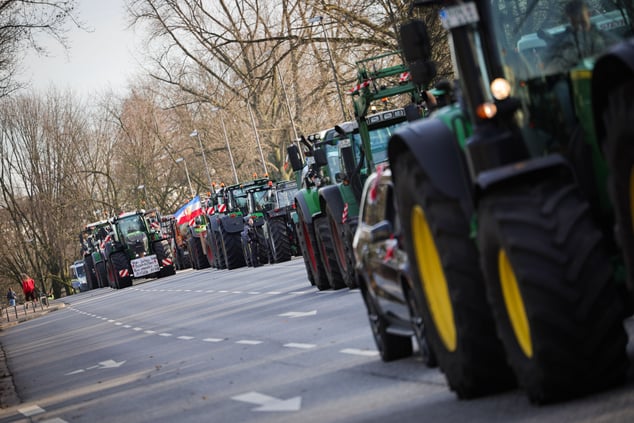
Weber directly connects the economic plight of farmers to broader issues of political stability. "Many farmers are on the verge of giving up. They work 70 hours a week, see seeds dry up and rain destroy harvests, and cannot even implement the detailed regulations," she describes. The widespread farmer protests seen across Germany and Europe, including the "Tractor-Blockade 2024 in Hamburg" cited in the original article, are, for Weber, a clear symptom of this systemic failure. "The farmer protests show that democratic parties are increasingly losing the rural population," she warns. A robust buffer stock system, providing price guarantees and reducing bureaucratic burdens, could offer a tangible solution to this alienation, fostering economic security and thereby reinforcing democratic allegiance.
The Road to Servitude or the Path to Resilience? Economics and Democracy
The question of state power versus market freedom inevitably leads to a philosophical debate, particularly in the context of authoritarian threats. The interviewer raises the concern, echoing Friedrich August von Hayek’s "The Road to Serfdom," that a state infrastructure controlling prices and supply could fall into "the wrong hands," citing Donald Trump as an example of someone who might exploit such powers for personal gain.
Weber directly confronts this Hayekian dilemma. "That is essentially Friedrich August von Hayek’s question: Is subordination to markets not better than subordination to the state?" she acknowledges. However, she argues that even market-based systems require a state to enforce them and often to mitigate their consequences through higher social spending. More profoundly, she challenges Hayek’s core premise: "Neoliberalism emerged in the 1940s as an explicitly anti-fascist ideology. That was Hayek’s core argument in ‘The Road to Serfdom.’ This promise was not fulfilled. The closer we got to the ideal, the stronger, in tendency, right-wing extremist forces became."

Weber identifies several "tipping points" in recent history where market-driven policies inadvertently fueled the rise of extremism:
- German Reunification: Described as "shock therapy straight from the textbook," with prices liberalized overnight, rapid privatization, and the immediate introduction of the D-Mark. The result was "unemployment on a scale we in the West cannot imagine," which laid fertile ground for right-wing movements in the East during the 1990s.
- The Financial and Euro Crisis: This period, she notes, directly led to the founding of the AfD, demonstrating how economic instability can catalyze the emergence of populist and extremist parties.
- The Energy and Inflation Crisis: The current crisis further exacerbates these vulnerabilities, threatening to push more people towards radical political alternatives.
While acknowledging that there isn’t a direct "one-to-one correlation" between financial worries and right-wing extremism, Weber emphasizes the insidious link. "But such experiences of devaluation make it attractive when someone says: You are worth something because you are white, because you are German. This revaluation then proceeds through the devaluation of others."
Trump, Economic Power, and the Erosion of State Structures
Weber uses Donald Trump’s political trajectory to further illustrate the dangers of economic power concentration and the deliberate weakening of state institutions. She observes "two things simultaneously" in the US. Firstly, "the destruction of state structures." Trump’s Department of Government Efficiency, for example, aimed to dismantle or incapacitate entire ministries and agencies. "Why do they do that? Because it enormously increases the state’s dependence on private corporations: on Palantir, on SpaceX, on a handful of companies and men who thus create a market with guaranteed demand." This, she argues, leads to a state captured by private interests, rather than serving the public good.

Secondly, "Trump uses his power in the most brutal way to enrich himself and those well-disposed towards him." His tariff policies, she points out, cause markets to "shoot up and down, and those who are informed in advance make enormous profits." Her conclusion is stark: "You don’t curb this by saying from the outset that the state should be incompetent." Instead, she implies, a strong, competent state is necessary to prevent such abuses of power and market manipulation.
Economists’ Responsibility: Dignity and Democracy
Weber explicitly connects economic policy failures to the current "resurgence of the threat of fascism," unparalleled since the 1930s. Her call for an "anti-fascist economic policy" is not to label current figures as fascists but to acknowledge the profound and urgent need for economic policies that prioritize human dignity. She harkens back to the CDU’s Ahlener Program, a foundational document of post-war German democracy, which stated: "The content and goal of this social and economic reordering can no longer be capitalist profit and power-seeking, but only the well-being of our people."
She identifies two critical factors contributing to the rise of extremism:

- Extreme Concentration of Economic Power: "In a growing number of sectors, a small number of companies divide entire markets among themselves, often globally." This, she argues, is incompatible with democracy, a lesson understood even by the Ordoliberals in the 1940s, as "economic power translates into political power." She highlights how quickly powerful elites rallied behind Trump upon his return to the political stage.
- Economic Uncertainty: When politicians laud democracy but simultaneously claim helplessness regarding the "affordability of your life," trust erodes. She criticizes the response to inflation, driven by essential goods shocks, with higher interest rates explicitly aimed at "cooling down the labor market," which means pushing people into unemployment. "I consider that extremely dangerous," she warns, as it deliberately increases economic insecurity.
While acknowledging that identity politics and fears of loss contribute to the rise of the AfD, Weber contends that these "fears of loss also have economic reasons." She points to recent regional elections where "more than 60 percent of people who assess their financial situation as bad voted for the AfD." Ultimately, she calls for greater accountability within her own profession: "We economic advisors bear a co-responsibility for the consequences of our recommendations for democracy."
For Weber, the path forward is clear: "Just then, affordability is the field where the state can concretely show that it can act. It is important that it becomes visible: the crisis is not inevitable. Democratic action can make our lives better again." Her vision is one where a proactive, interventionist state, guided by principles of justice and human dignity, actively shapes economic outcomes to build a more resilient democracy, capable of weathering both economic storms and the siren call of authoritarianism.
First published: October 16, 2026, 04:00 AM.