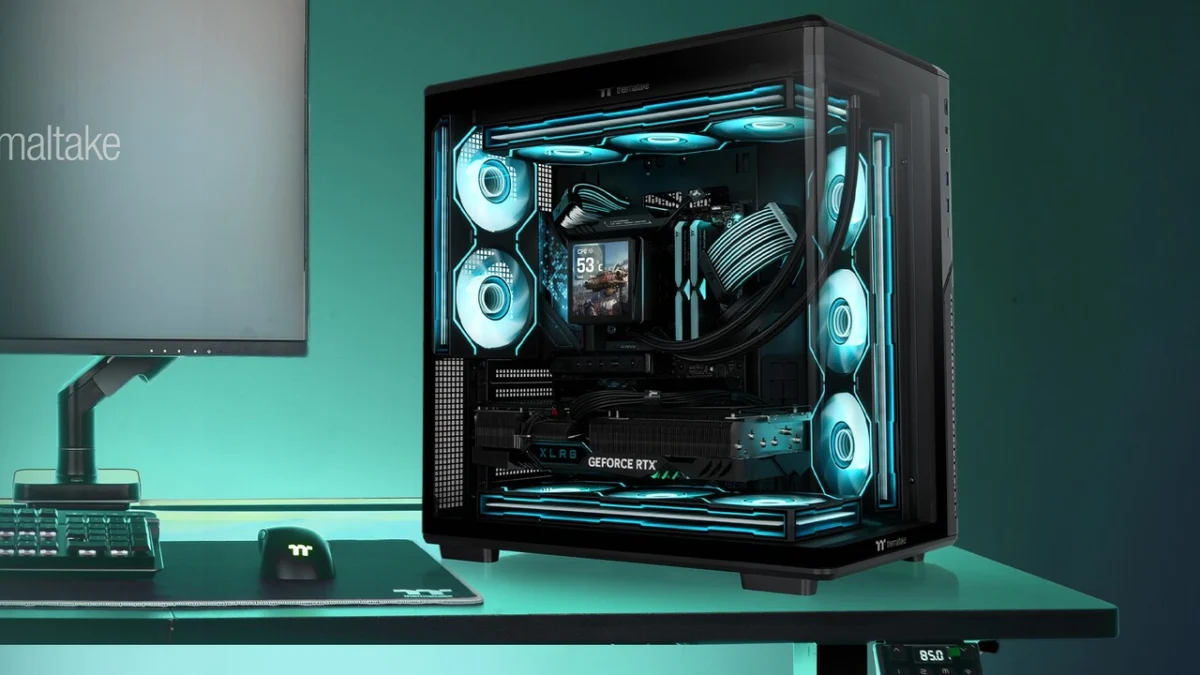
In the rapidly evolving landscape of PC enthusiast hardware, the "fish tank" or "glaskasten" (glass box) chassis design has moved from a niche aesthetic choice to the industry standard. Thermaltake, a long-standing titan in the case market, has once again pushed the boundaries of this design language with the launch of the View 590 TG ARGB. By integrating a distinctive angled corner, a panoramic L-shaped window, and a dual-chamber configuration, Thermaltake is attempting to reconcile the often-conflicting goals of maximum component visibility and high-performance thermal efficiency.
Main Facts: Architecture of the View 590
The View 590 TG ARGB is a testament to the modern trend of "showcase building." Its primary architectural feature is the seamless, wrap-around glass panel that creates an unobstructed view of the internal hardware. By separating the chassis into two distinct chambers, Thermaltake allows users to present their primary components—motherboard, GPU, and CPU cooler—in a pristine, cable-free environment, while relegating the "messy" elements like the power supply, storage drives, and cable management bulk to the secondary chamber behind the motherboard tray.
Technical Specifications at a Glance:
- Design Type: Dual-chamber mid-tower.
- Glass Configuration: Wraparound L-shaped panoramic window.
- Cooling Layout: Angled front corner intake with three 120mm inverted fans.
- Rear Exhaust: Dual 120mm exhaust fans.
- Radiator Support: Up to 360mm in the front corner and the top panel.
- GPU Clearance: Up to 350mm (with radiator installed).
- CPU Cooler Height: Max 165mm.
- Storage Flexibility: Three dedicated HDD/SSD mounting points (impacts PSU length).
Chronology: The Shift to Angled Airflow
To understand the significance of the View 590, one must look at the trajectory of PC case design over the last three years. Traditionally, "glass box" cases suffered from the "suffocation effect"—by placing glass directly in front of intake fans, airflow was severely restricted.
In 2024 and 2025, manufacturers began experimenting with side-intake designs, where fans were moved to the motherboard tray wall. However, this often resulted in a 90-degree turn for the air, which is aerodynamically inefficient.
The View 590’s "angled corner" represents the 2026 design philosophy. By shifting the intake fans to a 45-degree angle at the front-right corner, Thermaltake has shortened the path for fresh air to reach the GPU and CPU. This design choice effectively mitigates the "air-turn" resistance, allowing for a more direct, laminar flow of air across the hottest components. This evolution marks a transition from purely aesthetic designs to "performance-first" glass chassis.
Supporting Data and Thermal Dynamics
The thermal engineering of the View 590 is predicated on high-volume airflow. The three pre-installed 120mm fans at the angled intake operate at 1,500 RPM while maintaining a noise floor of approximately 24.9 dB(A). By utilizing inverted blades, these fans pull air into the main chamber without the need for an unsightly mesh front panel that would break the visual line of the glass.
The Exhaust Advantage
A notable deviation from standard chassis layouts is the inclusion of two dedicated exhaust fans at the rear. Most mid-towers in this class feature only one rear exhaust. By doubling this capacity (1,500 RPM at 21.8 dB(A)), Thermaltake ensures that the heat generated by modern, power-hungry GPUs—such as the hypothetical RTX 5090—is evacuated from the main chamber before it can heat-soak the glass panels.
Space Considerations
The inclusion of two rear fans necessitated an increase in the case’s vertical footprint. This "stretched" design is not merely for aesthetics; it provides the clearance required for a top-mounted 360mm radiator, a requirement for high-end liquid cooling loops. However, users should note the trade-offs:
- Storage vs. Power: If a user utilizes all three HDD mounting spots, the power supply length is strictly limited to 180mm.
- GPU Length: While 350mm of clearance is generous, installing a thick radiator in the front corner will reduce this capacity. For the average user, this remains a non-issue, but for those opting for the longest air-cooled flagship cards, planning is essential.
Official Positioning and Market Strategy
Thermaltake’s launch strategy for the View 590 has been unconventional. While the official MSRP on the manufacturer’s website is set at 169.99 Euro, the company notably initiated a "Sale" tag at launch, reducing the price by a symbolic nine cents to 169.90 Euro.

Industry analysts suggest this move was less about the monetary discount and more about triggering algorithmic pricing on third-party marketplaces. The tactic appears to have succeeded: retail pricing in the open market has already seen the case hovering around the 138 Euro mark. This aggressive pricing suggests that Thermaltake is positioning the View 590 as a high-volume, "mainstream enthusiast" product rather than a premium, limited-edition offering.
Implications for the DIY PC Market
The release of the Thermaltake View 590 carries several implications for the future of the DIY market:
1. The Death of the "Ugly" PC
The dual-chamber design is no longer a luxury feature. With the View 590 bringing this layout to the sub-150 Euro price bracket, the industry is signaling that a clean, professional aesthetic should be the standard for all PC builders. The "hidden" chamber for cabling and storage is becoming a mandatory requirement for consumer acceptance.
2. Airflow vs. Aesthetics
The industry has spent years struggling to balance the desire for glass with the necessity of airflow. The 45-degree angled intake is arguably the most successful solution to date. It preserves the "fish tank" aesthetic while providing enough intake surface area to cool high-TDP components. Expect to see competitors mimic this 45-degree geometry in the 2027 design cycle.
3. The Height of Hardware
As components continue to grow in size—particularly GPUs—the View 590’s decision to increase vertical chassis height is a prescient move. By designing for the "next generation" of oversized hardware, Thermaltake is ensuring the longevity of the chassis. A case that can house a massive RTX 5090 today will likely remain relevant for several years to come.
4. Sustainability and Modular Design
While the glass panels create a stunning visual, they also present challenges for shipping and manufacturing sustainability. The shift toward modular internal brackets (like those used for the HDDs) suggests that manufacturers are increasingly focused on making cases that can be adapted as storage technology changes.
Conclusion
The Thermaltake View 590 TG ARGB is a calculated move to dominate the mid-tower market by addressing the primary criticisms of previous-generation glass cases. By optimizing the intake angle, increasing the exhaust capacity, and maintaining a competitive price point, Thermaltake has created a chassis that does not force the user to choose between form and function.
For the builder looking to construct a high-end system that serves as a centerpiece of their workspace, the View 590 offers a compelling value proposition. It is a refinement of the "glaskasten" trend, proving that even as PC hardware becomes more powerful and physically demanding, the chassis can evolve to keep pace—without losing its aesthetic edge. As retail prices stabilize, the View 590 is well-positioned to become one of the most popular enclosures of the 2026/2027 season, setting a new benchmark for what enthusiasts should expect from a mid-tower case.