As the global technology sector finds itself at a critical crossroads, the debate over Artificial Intelligence (AI) has shifted from laboratory experiments to a high-stakes geopolitical and economic battleground. While industry titans, academic researchers, and regulatory bodies grapple with the existential risks of rapid AI advancement, former U.S. President Donald Trump has interjected with a characteristically combative and contrarian perspective. His recent intervention—delivered via a surprise phone call to Nvidia CEO Jensen Huang—has ignited a firestorm of discussion regarding the intersection of national power, economic growth, and the necessity of regulation.
The Core Conflict: Regulation vs. Acceleration
The central tension in the current AI landscape is between those calling for a "slowdown" or more stringent oversight and those who view such measures as a catastrophic surrender of competitive advantage. Industry leaders, including representatives from firms like OpenAI and Anthropic, have frequently voiced concerns about the existential risks posed by Artificial General Intelligence (AGI). They advocate for guardrails, safety testing, and, in some cases, international treaties to prevent a runaway scenario.
Donald Trump, however, rejects this narrative entirely. In a statement released on his social media platform, Truth Social, and reiterated during his call with Jensen Huang, the former president dismissed the calls for caution. "The only control that AI needs is a STRONG AND SMART (High IQ) President," Trump asserted. "And the United States has more than enough of those."
For Trump, the discourse surrounding "existential risk" is not a legitimate public safety concern, but rather a "hoax"—a term he frequently employs to describe narratives he views as politically motivated obstacles to progress.
Chronology of the Debate: From Tech Concerns to Political Rhetoric
To understand the current polarization, one must look at the recent timeline of the AI discourse:
- Mid-2023: Leading AI researchers and tech CEOs begin signing open letters warning of the "extinction risk" posed by advanced AI systems, comparing the threat to pandemics or nuclear war.
- Late 2023: Regulatory bodies in the U.S., EU, and China begin drafting legislative frameworks. The EU moves forward with the AI Act, while the Biden administration issues Executive Orders aimed at auditing large-scale model security.
- Early 2024: Public skepticism grows as large-scale data center construction faces local opposition due to energy consumption and environmental impact.
- Recent Weeks: Donald Trump intensifies his rhetoric, framing the "anti-AI" movement as a repeat of the climate change debate, suggesting that the same actors are behind both narratives to stifle economic development.
- The Nvidia Incident: In a high-profile display of support for the hardware industry, Trump joined a call with Nvidia CEO Jensen Huang, directly addressing the audience to label the concerns surrounding AI and data centers as a "hoax."
The "Hoax" Narrative: Economic Prosperity vs. Environmental Concern
A pivotal aspect of Trump’s argument is the economic utility of data centers. By drawing a parallel between the climate change movement and the current criticism of AI infrastructure, he frames the opposition as a "conspiracy" intended to weaken American industrial capacity.
"The people who claim that AI will destroy the world and that data centers are bad for the neighborhood are the same people who said not long ago that the world would end due to ‘climate change’," Trump stated.
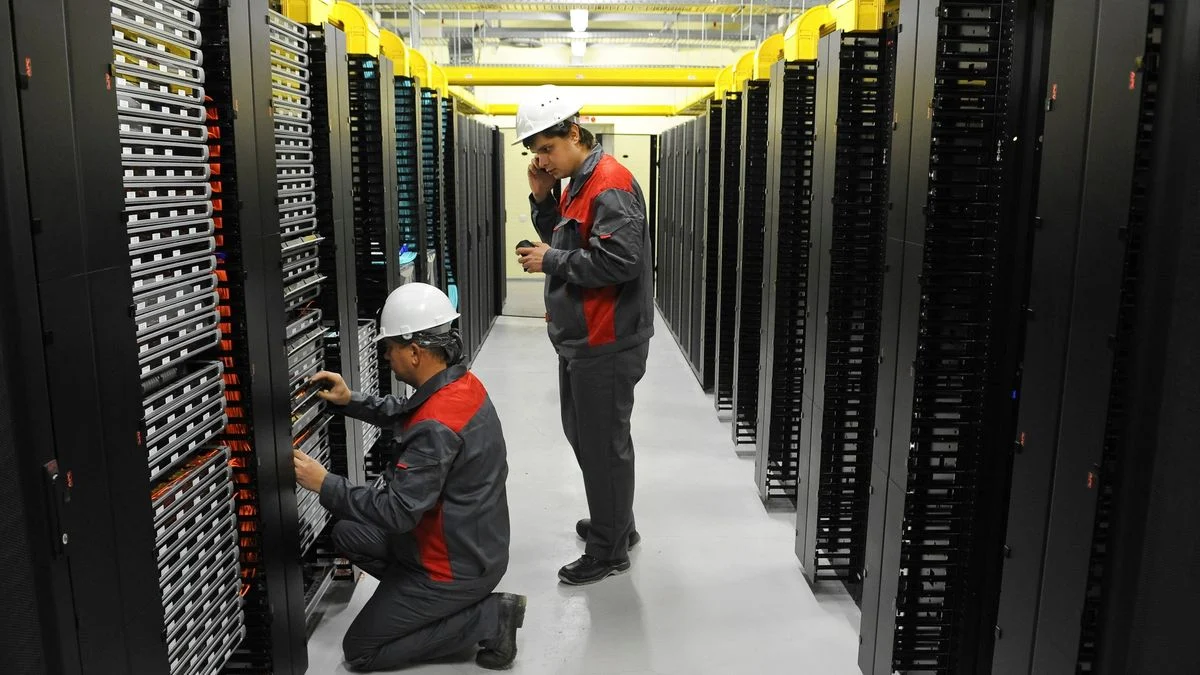
During his call with Huang, he elevated the status of data centers to the level of critical national infrastructure. "The data centers are great, they make people rich and they make states rich—they are the oil of the next 20 to 25 years." This perspective prioritizes immediate economic output and technological dominance over the precautionary principle that currently dominates the regulatory discourse in Washington and Brussels.
Supporting Data: The Stakes of the AI Arms Race
The urgency in Trump’s tone is driven by a deep-seated belief that AI development is a zero-sum game. He specifically highlighted that the "winner" of the AI race will effectively secure global dominance. This is a sentiment shared by many in the defense and intelligence communities, though often articulated with more nuance regarding safety protocols.
The China Factor
Trump’s rhetoric frequently points toward China as the primary beneficiary of American hesitation. By suggesting that China is "happiest" about the internal American "conspiracy" to slow down AI development, he is tapping into the bipartisan consensus that the U.S. must maintain a technological lead over Beijing. For Trump, every hour spent on safety audits is an hour ceded to competitors.
Economic Projections
The economic argument for data centers is undeniably strong. Large-scale AI infrastructure requires massive capital investment, creates thousands of high-paying jobs, and necessitates significant upgrades to regional energy grids. Critics, however, point to the "hidden costs": the immense water and electricity consumption that can strain local resources and increase carbon emissions—a point that Trump explicitly dismisses as alarmist.
Official Responses and the Regulatory Landscape
The divide between the industry and the political class remains wide. While the current U.S. administration emphasizes a "safety-first" approach, advocating for rigorous testing before model deployment, the Trump camp represents a growing faction that views such policies as "regulatory capture" or, more simply, a path to stagnation.
The debate has forced a reassessment of how government should interact with private tech firms:
- Liability: There is an ongoing push to make AI firms legally liable for the "products" they release, similar to the automotive or pharmaceutical industries.
- Infrastructure: Local governments are increasingly tasked with balancing the tax benefits of data centers against the infrastructure strain on local communities.
- National Security: The Department of Defense and intelligence agencies are caught in the middle, needing advanced AI for national security while simultaneously fearing the destabilizing effects of unconstrained proliferation.
Implications: A New Era of "Techno-Nationalism"
The implications of this discourse are profound. If the next U.S. administration adopts a hands-off, "accelerationist" approach to AI, it will likely trigger a global race to the bottom, where safety standards are abandoned in favor of speed. Conversely, if the regulatory push gains momentum, the U.S. risks creating a bifurcated landscape where domestic firms operate under strict constraints while international competitors—or rogue actors—operate in a legal vacuum.
The "Common Sense" Approach
Trump’s appeal to "common sense" and his reference to his family’s intellectual pedigree (notably his uncle, a professor at MIT) serve to position him as a pragmatist. By rejecting the "doomsday" scenarios of tech CEOs, he is positioning AI as a tool of national empowerment rather than an existential threat.
The Future of Data Centers
The battle over data centers is likely to become a defining local political issue. As AI models require more compute, the demand for power will grow, putting tech giants on a collision course with environmentalists and local residents. If the "pro-AI" faction wins the political argument, we may see a federal push to override local zoning and environmental objections to facilitate the construction of massive AI "super-hubs."
Conclusion
The debate over Artificial Intelligence is no longer confined to the halls of academia or the boardrooms of Silicon Valley. It has entered the arena of mass politics, where it is being shaped by slogans, geopolitical rivalries, and competing visions of the future. Whether one views Trump’s intervention as a necessary push for progress or a reckless dismissal of legitimate dangers, it is clear that the status quo is over.
As the U.S. prepares for future leadership decisions, the question remains: Can a nation balance the hunger for technological supremacy with the imperative to manage the risks of an increasingly autonomous world? The answer, according to the current debate, depends heavily on whether one defines AI as the "oil of the 21st century"—a resource to be extracted and utilized as quickly as possible—or as a Pandora’s box that requires a firm, guiding hand.
For now, the divide remains absolute. While technologists warn of the end of the world, the political sphere is focused on the end of the race, and in this environment, the pressure to accelerate only continues to mount.