For decades, the name Quentin Tarantino has been synonymous with the evolution of modern cinema. From the gritty, dialogue-heavy tension of Reservoir Dogs to the revisionist historical violence of Inglourious Basterds, the auteur has cultivated a career defined by singular vision, hyper-stylized action, and a devout reverence for the history of film. Now, as the industry holds its collective breath for his promised tenth and final motion picture, the 63-year-old director has announced a surprising detour. Before he closes the book on his filmography, Tarantino is stepping onto the stage.
The Announcement: A New Chapter in London’s West End
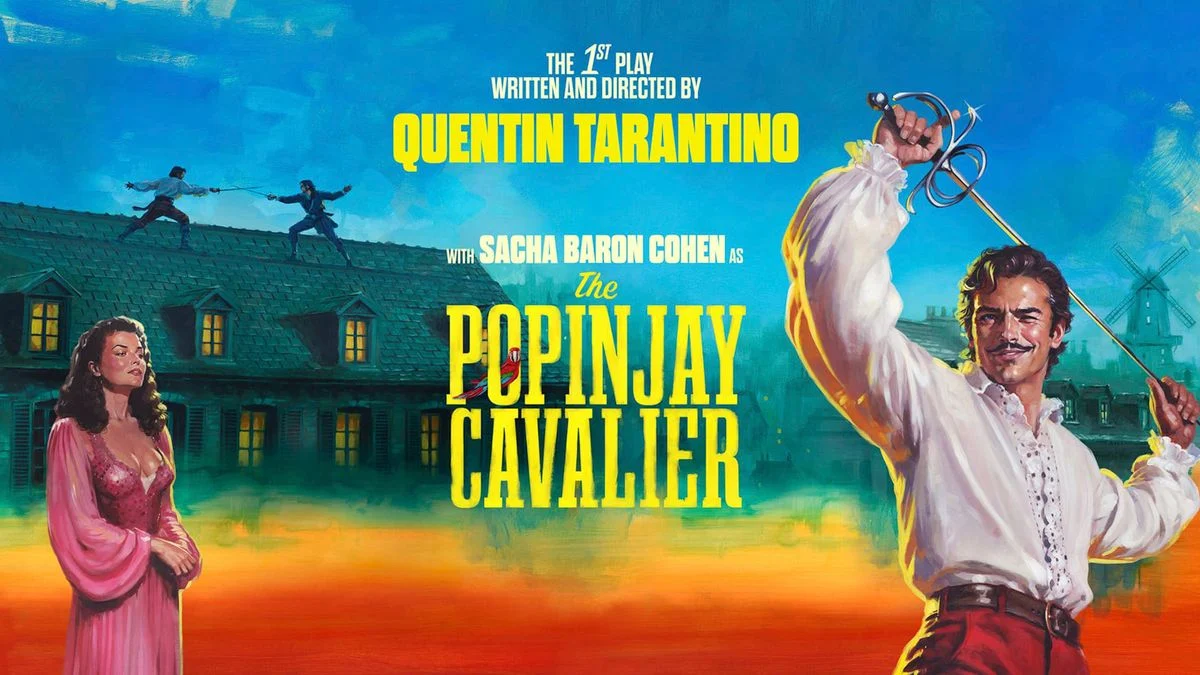
In a move that has sent ripples of excitement through both the theatrical and cinematic communities, Tarantino has confirmed that his next major project will be a stage play titled The Popinjay Cavalier. Set for a highly anticipated premiere in London’s prestigious West End in March 2027, the production will not only feature Tarantino’s debut as a playwright but will also see him taking the director’s chair—marking his first foray into live theater.
The project is described as a boisterous, high-energy comedy set in the 1830s. Drawing inspiration from the classic "cloak and dagger" epics of the 19th century, the play promises a narrative landscape rich in deception, elaborate disguises, and the sharp, rhythmic wit that has become the hallmark of the Tarantino canon.
The Cast: Sacha Baron Cohen Takes Center Stage
The most significant reveal accompanying the announcement is the casting of the lead role. Sacha Baron Cohen, the 54-year-old comedic genius behind Borat, Ali G, and The Dictator, has been tapped to star in the production.
The casting choice is, in many ways, inspired. Baron Cohen’s ability to inhabit bizarre, layered characters while maintaining a razor-sharp satirical edge aligns perfectly with the sensibilities required for a period-piece farce. Reflecting on the ease of the casting process, Baron Cohen provided a characteristic, anecdote-laden response:
"Quentin called, and I accepted before he could even get out his first ‘motherfucker,’" Baron Cohen joked, highlighting the mutual respect between the two icons. "When the best director in the world calls you with a script, you don’t ask questions. You simply clear your schedule and prepare to serve the vision."
A Chronology of a Legendary Career
To understand the weight of this transition, one must look back at the trajectory that brought Tarantino to this crossroads. His journey began in 1992 with Reservoir Dogs, a heist film that redefined independent cinema and established a blueprint for non-linear storytelling that would influence a generation of filmmakers.
Following the success of his debut, Tarantino solidified his status as a cultural phenomenon with Pulp Fiction (1994). Serving as writer, director, and even a supporting actor, the film secured him his first Academy Award for Best Original Screenplay. The decades that followed were marked by a relentless output of genre-bending projects:
- 1997: Jackie Brown, a love letter to the blaxploitation era.
- 2003–2004: Kill Bill: Vol. 1 & 2, a stylistic homage to martial arts cinema.
- 2007: Death Proof, a gritty tribute to the grindhouse era.
- 2009: Inglourious Basterds, a daring revision of World War II.
- 2012: Django Unchained, a Southern Gothic exploration of slavery and vengeance.
- 2015: The Hateful Eight, a claustrophobic, 70mm Western.
- 2019: Once Upon a Time in Hollywood, his most recent cinematic effort, serving as a love letter to the end of the Golden Age of Hollywood.
Each film has functioned as a stepping stone, refining his technical prowess and his unique ability to synthesize high art with pulp sensibilities. Now, The Popinjay Cavalier stands as the eleventh major project in a career that has arguably changed the face of American film.
The "Final Film" Dilemma: The Stakes of the Stage
Perhaps the most compelling element of the Popinjay Cavalier announcement is its potential role as the foundation for Tarantino’s swan song. For years, the director has maintained that he would retire after his tenth feature film, citing his desire to leave behind a body of work that is consistent in quality and "untainted" by the potential decline that often plagues long-tenured directors.
Tarantino has explicitly stated that the theatrical production is a litmus test for his final act. "If it’s a fiasco, then obviously I won’t make a film out of it," he remarked in an interview last year. "But what if it’s a massive hit? What if the audience reacts to the material in a way that feels like a natural evolution? Then, it could very well be the basis for my last film."
This creates a fascinating, high-stakes scenario. If the play is a success, the stage could bridge the gap to the screen, allowing Tarantino to adapt his own theatrical triumph into his final cinematic masterwork. If it fails, he remains in search of that elusive, definitive tenth film.
Behind the Scenes: The Directorial Pivot
Transitioning from the controlled environment of a film set—where shots can be retaken, lighting adjusted, and pacing refined in the editing suite—to the ephemeral, real-time nature of live theater is a significant challenge for any director.
For Tarantino, who is known for his obsessive attention to detail, the move to theater represents a shift in medium but not in philosophy. In film, the "cut" is his primary tool for manipulating time and space. In theater, he must rely on the blocking, the performance, and the physical interaction between the actors and the audience.
Industry analysts suggest that the 1830s setting of The Popinjay Cavalier is a tactical choice. By stepping back from the modern world, Tarantino avoids the common pitfalls of stage-to-screen adaptations that struggle with contemporary realism. Instead, he leans into the artifice of the period, allowing him to play with the tropes of theater just as he once played with the tropes of Westerns and Kung Fu movies.
Implications for the Future of Independent Film
The news of Tarantino’s move has broader implications for the current state of the industry. In an era dominated by franchise blockbusters and streaming algorithms, a director of Tarantino’s stature choosing to pivot toward the stage serves as a powerful statement on the importance of creative exploration.
Furthermore, it challenges the traditional boundaries between film and theater. By utilizing the stage as a laboratory for his potential final film, Tarantino is effectively treating the two mediums as complementary rather than competitive. If successful, this could inspire a new generation of filmmakers to seek out live performance as a legitimate, even necessary, step in the development of their creative voices.
The Cultural Weight of the "Popinjay"
The term "Popinjay" historically refers to a vain, conceited person, often one who dresses in an ostentatious or flamboyant manner. In the context of an 1830s-set comedy, one can expect a protagonist who embodies these traits—a character who is perhaps a master of artifice in a world of deception.
With Sacha Baron Cohen in the lead, the character will undoubtedly be infused with a layer of dark, subversive humor. The "cloak and dagger" element suggests that this will not be a lighthearted period comedy, but rather a sharp, biting social commentary wrapped in the guise of a costume drama.
Conclusion: A Curtain Call in the Making
As the clock ticks toward March 2027, the anticipation for The Popinjay Cavalier is palpable. It is a rare moment in modern entertainment: a legendary director stepping out of his comfort zone, a celebrated comedian taking on a role that promises to stretch his dramatic muscles, and a global audience waiting to see if this play will mark the beginning of the end for one of cinema’s most important careers.
Quentin Tarantino has spent over thirty years teaching the world how to watch movies. With this move to the West End, he is now asking us to listen, to witness, and to experience his craft in a medium that demands a different kind of intensity. Whether or not this becomes the foundation for his final film remains to be seen, but one thing is certain: the world will be watching when the curtain rises in London.
The path from the video store clerk to the auteur of the West End is a long one, marked by violence, dialogue, and a relentless passion for the art of storytelling. As he prepares to take his final bow, Tarantino continues to surprise, challenge, and captivate—proving that even after nine masterpieces, he is still capable of writing a new, unpredictable scene.