


Athens, Greece – October 11, 2026 – In a pivotal moment for European energy security, U.S. Secretary of State Marco Rubio’s recent visit to Athens underscored a significant pivot in the continent’s energy strategy. While discussions ranged from mass migration and terrorism to defense, the underlying current of his engagement, particularly with Greek officials, pointed towards a burgeoning alliance focused on reshaping the flow of energy across Southeastern Europe. At the heart of this geopolitical maneuver lies the ambitious "Vertical Corridor" – a sprawling network of pipelines designed to distribute gas across the continent and, crucially, to wean Europe off its long-standing reliance on Russian supplies. However, as the United States emerges as a dominant liquefied natural gas (LNG) exporter, a critical question looms: is Europe merely exchanging one dependency for another?
The Genesis of the Vertical Corridor: A Response to Russian Aggression
The impetus for the Vertical Corridor is deeply rooted in the geopolitical fallout from Russia’s full-scale invasion of Ukraine. The European Union, in a decisive move to sever its economic ties with Moscow and bolster its energy independence, has committed to ending Russian gas imports by November 2027. This ambitious target has triggered a scramble across the continent to secure alternative energy sources and establish robust distribution networks.
The Vertical Corridor, a complex web of existing and planned pipelines, is envisioned to transport gas, primarily sourced from Greece, through Bulgaria and Romania, ultimately reaching Ukraine. This initiative, supported by the United States, aims to create a more resilient and diversified energy infrastructure for Southeastern Europe. For Greece, the project represents a transformative opportunity, positioning it as a central player in the region’s energy landscape.
“I believe the visit confirmed the US government’s particular interest in the energy sector,” stated Ino Afentouli, a foreign policy expert at the Athens-based think tank Eliamep. “It’s about how the US intends to expand the transport and distribution of its own liquefied natural gas to Europe via the so-called Vertical Corridor.”
Greece’s Ascendance as an Energy Hub
Greece, historically situated on the periphery of Europe’s energy system, is now poised to become a critical gateway for liquefied natural gas (LNG) imports, with a significant portion originating from the United States. The nation already boasts two operational LNG terminals and has announced plans for four additional facilities, though the realization of all these projects remains uncertain.
This strategic expansion is being actively promoted by American energy interests. In a significant development, Greece is set to resume exploration for natural gas off its western coast for the first time in decades. Notably, the U.S. oil giant ExxonMobil is slated to participate in these exploration efforts. Furthermore, Chevron, another major American energy firm, is involved in planned drilling projects south of Crete, signaling a deepening U.S. commitment to the region’s energy future.
U.S. Ambassador to Greece, Kimberly Guilfoyle, has been a vocal proponent of these initiatives, embarking on tours across the region to advocate for deals with American companies. She has emphasized the significant U.S. interest in investing in Greece, highlighting the mutually beneficial nature of these energy collaborations.
A Network of Pipelines: More Than Just a Single Artery
The Vertical Corridor is not merely a single pipeline but a comprehensive system of interconnected pipelines, including upgrades to existing infrastructure, new pipeline sections, and crucial interconnections between countries. Michalis Mathioulakis, an energy expert at Eliamep, describes this as a "win-win situation," where European and American interests currently align. He argues that natural gas will remain essential for the foreseeable future, particularly as the energy transition is not yet sufficiently advanced, and Europe requires energy security.
The Greek government, under Prime Minister Kyriakos Mitsotakis, views this development as a strategic triumph. Mitsotakis has emphasized that Greece has achieved its goal of becoming a "central player in Southeastern Europe," a stark contrast to its previous position "on the edge of the energy system." This transformation is seen as crucial for ensuring regional energy stability and economic growth.
A Chronology of Shifting Alliances and Infrastructure Development
- Early 2020s: The escalating geopolitical tensions and the growing threat of Russian energy leverage begin to spur discussions about diversifying Europe’s energy sources.
- February 2022: Russia’s full-scale invasion of Ukraine intensifies the urgency for Europe to reduce its dependence on Russian gas.
- 2022-2023: The concept of the Vertical Corridor gains traction as a potential solution for distributing non-Russian gas across Southeastern Europe. Discussions intensify between Greece, Bulgaria, Romania, and Ukraine, with growing U.S. interest.
- Late 2023: U.S. energy companies, including ExxonMobil and Chevron, signal their intent to invest in exploration and infrastructure projects in Greece and the wider Eastern Mediterranean region.
- 2024: Greece announces plans for significant expansion of its LNG terminal capacity, aiming to become a major hub for LNG imports. U.S. diplomatic efforts, spearheaded by Ambassador Kimberly Guilfoyle, actively promote American investment in the region’s energy sector.
- October 2026: U.S. Secretary of State Marco Rubio visits Athens, publicly affirming U.S. support for the Vertical Corridor and the broader energy partnership with Greece. Discussions focus on the practical implementation and expansion of the pipeline network and LNG infrastructure.
Supporting Data: The Growing Dominance of U.S. LNG
The increasing role of U.S. LNG in the European market is quantifiable. Data from August and September of 2026 reveals that approximately 70% of all LNG imports into the European Union originated from the United States. This statistic highlights the significant shift in supply chains and raises concerns about the potential for a new form of energy dependency.
The visual evidence of this shift is also apparent. Ships like the "Bushu Maru" are regularly transporting liquefied natural gas from the U.S. to Europe, a trend that has dramatically accelerated since the onset of the Russian war against Ukraine. This growing reliance on U.S. LNG underscores the strategic importance of the Vertical Corridor in facilitating this trade.
Official Responses: A Unified Front, But Divergent Concerns
The Greek Government’s Perspective:
Greek officials, including Prime Minister Kyriakos Mitsotakis and Foreign Minister Giorgos Gerapetritis, have consistently championed the Vertical Corridor and the burgeoning energy alliance with the United States. They view the partnership as a cornerstone of their national security and economic strategy, emphasizing the benefits of diversification and increased regional influence.
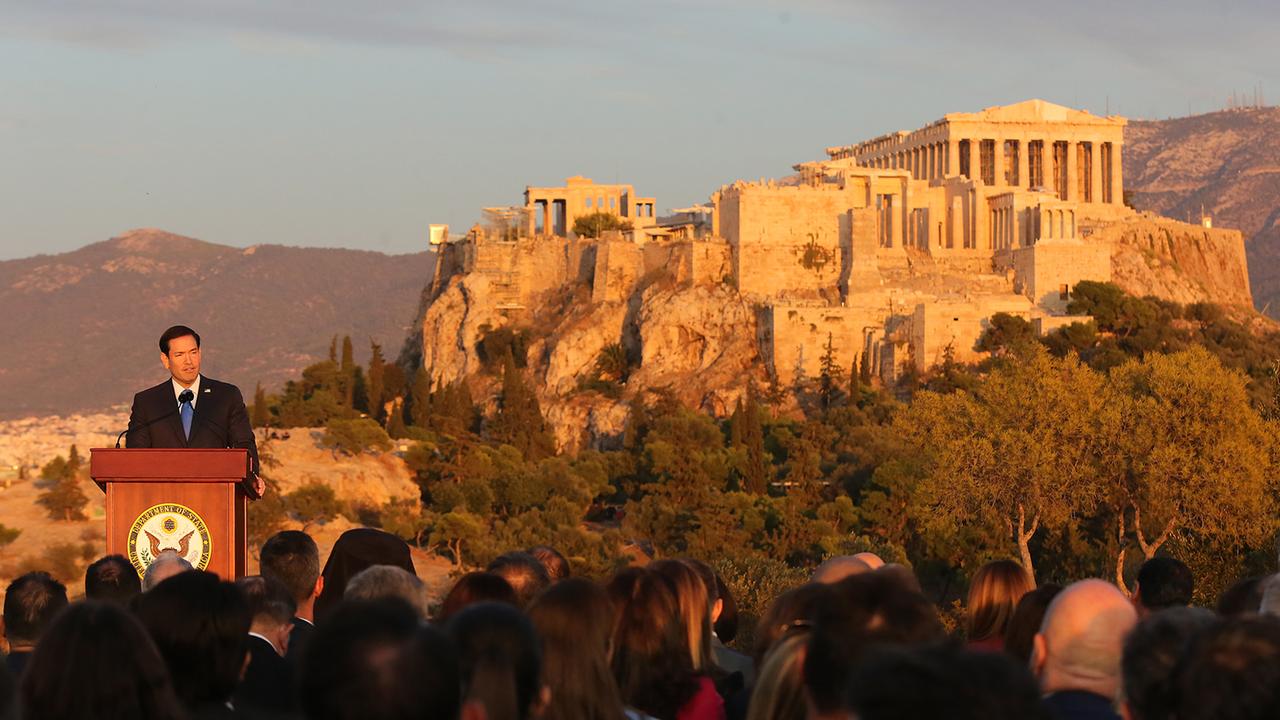
Foreign Minister Gerapetritis, alongside Secretary Rubio, articulated a vision of an "unprecedentedly strong, deep, and close" Greek-American partnership. This rhetoric underscores the political alignment and mutual trust that underpins these energy initiatives. The Greek government sees the development of its LNG infrastructure and its role in the Vertical Corridor as vital for ensuring its own energy security and for contributing to the broader European goal of energy independence.
The U.S. Government’s Stance:
The U.S. government, through its diplomatic engagements and the active participation of its energy companies, has made its strategic interest in the Eastern Mediterranean’s energy landscape abundantly clear. Secretary Rubio’s visit and Ambassador Guilfoyle’s advocacy reflect a concerted effort to solidify U.S. influence in the region and to promote its LNG exports.
The U.S. administration frames these initiatives as a crucial component of its commitment to European energy security and its broader geopolitical strategy to counter Russian influence. By supporting the development of alternative energy routes and infrastructure, the U.S. aims to bolster its allies and create a more stable and predictable energy market in Europe.
Critiques and Concerns from Think Tanks:
Despite the official optimism, a more cautious perspective emerges from independent energy think tanks.
-
Nikos Mantzaris, lead analyst at The Green Tank: Mantzaris critiques the Vertical Corridor as "oversized and expensive." He argues that the current plans for LNG terminals in Greece are excessive, suggesting that only one new terminal would be necessary to meet the entire demand created by the phasing out of Russian gas for all countries along the corridor. He expresses concern about a long-term decline in gas demand and the high cost of LNG. Mantzaris criticizes the Greek government’s plans as lacking transparency and a clear strategy, leading to what he terms "improvisation" that could ultimately prove detrimental to public interest and consumers. He also points out the potential conflict between these fossil fuel investments and EU climate goals.
-
Ana Maria Jaller-Makarewicz of the International Institute for Energy Economics and Financial Analysis: Jaller-Makarewicz advocates for investment in electrification and the regional integration of electricity grids, arguing that this represents the future of energy. She echoes the concern that Europe, by heavily relying on U.S. LNG, may be transitioning from one dependency to another.
Implications: The Double-Edged Sword of Energy Security
The development of the Vertical Corridor and the increasing reliance on U.S. LNG present a complex web of implications for Europe.
Positive Implications:
- Reduced Reliance on Russia: The primary objective of diversifying away from Russian gas is being met, significantly enhancing Europe’s geopolitical leverage and reducing its vulnerability to Russian energy blackmail.
- Enhanced Energy Security: The establishment of multiple import routes and diversified suppliers bolsters the overall energy security of Southeastern Europe and, by extension, the EU.
- Economic Opportunities: The development of new energy infrastructure creates jobs, stimulates investment, and positions countries like Greece as key energy hubs.
- Strengthened U.S.-Europe Ties: The energy partnership deepens the strategic alliance between the United States and European nations, fostering greater cooperation on security and economic matters.
Potential Negative Implications and Risks:
- New Dependency on the USA: The stark reality of U.S. LNG dominating EU imports raises the specter of replacing one geopolitical dependency with another. This could leave Europe vulnerable to U.S. foreign policy decisions and market fluctuations.
- Stranded Assets and Climate Concerns: Critics argue that significant investments in new fossil fuel infrastructure, such as pipelines and LNG terminals, could become stranded assets in the long term as the world transitions to renewable energy. This also poses a challenge to the EU’s ambitious climate goals.
- Cost Inefficiency: The argument that the Vertical Corridor might be oversized suggests potential for inefficient resource allocation and higher costs for consumers.
- Lack of Transparency and Strategic Clarity: Concerns about the transparency and strategic planning of these projects, as voiced by think tanks, could lead to suboptimal outcomes and unintended consequences.
- Geopolitical Leverage: While reducing reliance on Russia, a strong dependency on the U.S. could inadvertently shift geopolitical leverage, creating new vulnerabilities.
Conclusion: Navigating the Future of European Energy
The Vertical Corridor represents a bold and necessary response to Europe’s urgent need for energy diversification. The strategic partnership with the United States, driven by the imperative to move away from Russian gas, has opened new avenues for energy supply and infrastructure development. However, the narrative is not without its complexities. The significant reliance on U.S. LNG, while currently serving as a critical lifeline, necessitates careful consideration of long-term implications.
As Europe charts its course towards a more secure and sustainable energy future, a delicate balance must be struck. The pursuit of energy independence should not come at the cost of creating new, equally precarious dependencies. A clear and transparent strategy, one that prioritizes long-term sustainability, climate goals, and true diversification beyond a single dominant supplier, will be crucial in navigating the evolving energy landscape and ensuring that the gains in security do not come with unforeseen geopolitical or economic costs. The future of Europe’s energy security hinges on its ability to foster a truly diverse and resilient system, one that can withstand the shifting tides of global politics and technological advancement.






