In a poignant and sobering final address on the Day of German Unity, Federal President Frank-Walter Steinmeier has issued a clarion call for the defense of democracy, warning that the nation stands at a critical juncture where the very fabric of social cohesion is under threat from extremism, polarization, and political demagoguery.
On October 3, 2026, as Germany celebrated the 36th anniversary of reunification, the atmosphere in the capital was marked by a shift from traditional festivities to a solemn reflection on the state of the republic. Speaking at the central commemorative ceremony, President Steinmeier, who is set to vacate his office in March 2027, utilized his final National Day appearance to demand a rigorous, soul-searching assessment of Germany’s current political health.
The Core Challenge: A Republic Under Strain
Steinmeier’s speech was defined by a stark contrast between the historic joy of the 1990 reunification and the present-day reality of widespread political alienation. He did not mince words regarding the rise of extremist forces, which he characterized as having an "appetite for destruction."
"The intolerable political demagoguery of extremist forces, who revel in a lust for destruction and who mock and threaten other human beings, today threatens not only freedom and democracy; it threatens our unity," Steinmeier declared.
The President’s message was clear: the democratic experiment in Germany, which many had assumed to be a permanent and secured foundation, is being actively challenged. He acknowledged that his own perceptions of the stability of German democracy had been tested by the recent rise of populism and the erosion of civic discourse.
Chronology of a Crisis: From 1990 to 2026
To understand the weight of Steinmeier’s address, one must look at the trajectory of the post-reunification era.
- 1990: The formal accession of the German Democratic Republic (GDR) to the Federal Republic of Germany, fueled by the peaceful revolution of citizens who demanded liberty.
- 1990s–2010s: A period of massive structural investment and economic integration. Despite these efforts, a persistent "mental wall" remained, with many in the former East feeling marginalized by the political and economic structures of the West.
- 2017: Steinmeier begins his first term as Federal President, arriving at a time of rising political fragmentation and the emergence of radical right-wing populism.
- 2022: Re-elected for a second term, Steinmeier witnesses the deepening of societal rifts, exacerbated by the COVID-19 pandemic and the geopolitical shockwaves of the war in Ukraine.
- 2026: In his final speech, Steinmeier admits that the goal of "equal living conditions" remains incomplete and that a significant portion of the electorate has signaled a fundamental distrust in the democratic order.
Supporting Data and Societal Discontent
The President highlighted a chilling statistic: a quarter or more of the electorate is now actively turning away from the foundational values of the Federal Republic. This is not merely a protest vote; it is a fundamental shift in political alignment.
Steinmeier’s address pointed to several key drivers of this discontent:
- The "Mental Wall": Despite decades of material investment, the feeling of "second-class citizenship" persists in many parts of the East, a sentiment often exploited by anti-democratic actors.
- Digital Echo Chambers: The rise of social media has facilitated a "shrill emotionalization" of politics, where citizens struggle to differentiate between genuine human debate and AI-generated disinformation or algorithmic manipulation.
- The Crisis of Representation: Steinmeier noted that the political establishment has failed to adequately integrate East Germans into top-tier decision-making positions, creating a leadership vacuum that extremist parties have been quick to fill.
The Necessity of Self-Correction
In a rare moment of institutional humility, Steinmeier urged political leaders across the spectrum to engage in "self-criticism and reflection." He challenged the federal and state governments to examine their own failings over the last three and a half decades.
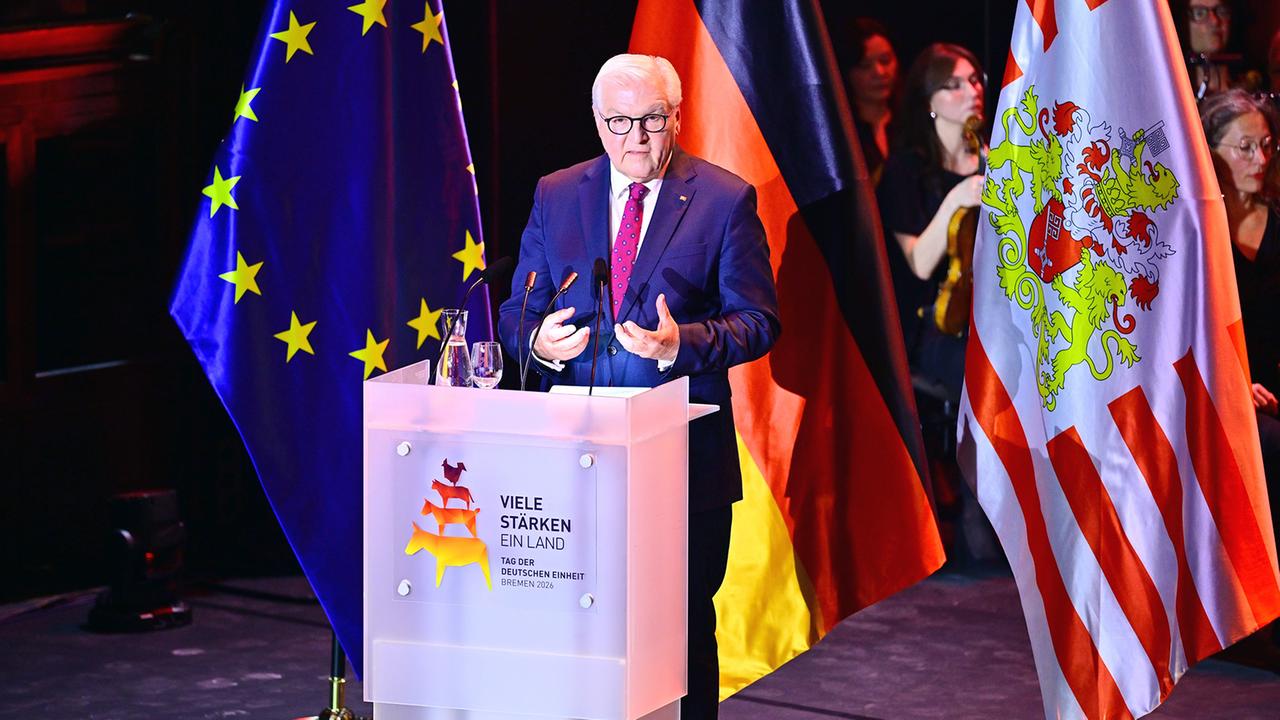
"We should ask ourselves, without being sparing, what governments at the federal and state levels have neglected to do, such that so many people have turned away and extremists find so much resonance," the President stated.
He explicitly called for a return to a "culture of debate," while setting a firm boundary: there can be no bridge between democracy and those who despise the rule of law. He condemned the rise of antisemitic sentiments, asserting that the safety of Jewish citizens is a non-negotiable benchmark of a civilized society.
Implications for the Future
As Steinmeier prepares to step down in March, his final speech serves as a roadmap for his successor. He warned that the office of the Federal President will become increasingly demanding as the task of maintaining social cohesion becomes more difficult.
The Mandate for Reform
Steinmeier argued that Germany cannot achieve new growth or stability by clinging to old routines. "We cannot win new growth if everything stays as it is," he stated. His vision for the future is one of "courageous renewal," where the government must be willing to take risks to maintain the hope of the citizenry.
A Call for Resilience
Despite the "headwinds" facing the nation, the President’s concluding remarks were an appeal for steadfastness. He urged the government to hold its course on necessary reforms, even when faced with "doomsday scenarios" promoted by political opponents.
"The key is the political will to abandon established routines," he noted. By emphasizing that reforms are a "risk taken for the sake of hope," Steinmeier sought to pivot the national narrative from one of decline to one of necessary, albeit painful, transformation.
Conclusion: The Self-Assertion of Democracy
The overarching theme of Steinmeier’s final address was the "self-assertion of democracy." In his view, democracy is not a passive state that maintains itself; it is a dynamic process that requires constant, conscious defense.
His legacy as President will be tied to this final warning: that the history of 1990—the moment of liberation and unity—must not be forgotten. For Steinmeier, "oblivion would be betrayal." By framing the current political crisis as a test of the nation’s character, the President has challenged the next generation of German leadership to move beyond the comfort of the status quo and engage in the hard, necessary work of renewing the democratic promise.
As the sun sets on his tenure, Steinmeier leaves behind a nation that is prosperous and unified in name, but deeply divided in spirit. His final plea—"Have courage for renewal"—echoes as both a testament to his own political journey and a stark warning for the road ahead. Whether Germany chooses to heed this call or continue down a path of fragmentation remains the defining question of the coming decade.