By International News Desk
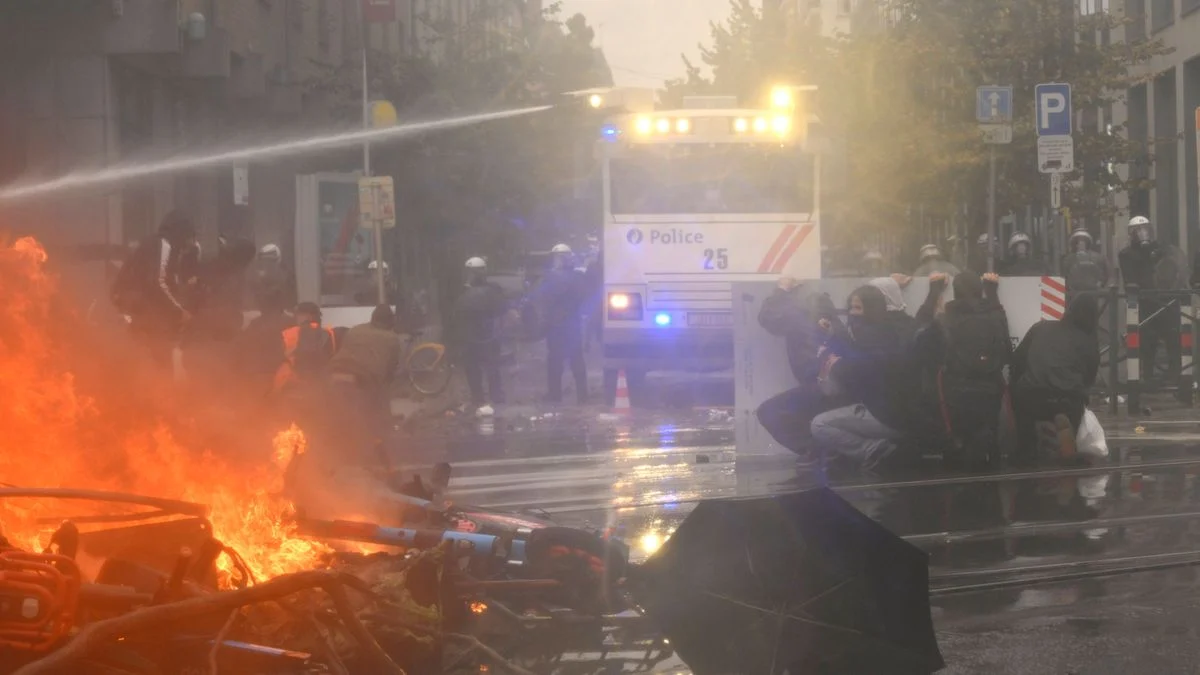
Brussels, the heart of the European Union, has become the latest flashpoint for widespread civil unrest as student-led demonstrations—inspired by a growing movement in neighboring France—have collided with massive labor union strikes. While the capital’s streets were filled with thousands of workers protesting government-mandated austerity measures, the atmosphere was marred by significant clashes between police and groups of youths, leading to the deployment of water cannons and tear gas in the city center.
The Context: A Convergence of Grievances
For days, the French-speaking community of Belgium has been gripped by a wave of student-led activism. The movement, which initially gained momentum as a reaction to systemic issues within the educational sector, has seen students take to the streets to protest against underfunded schools and proposed budget cuts. This sentiment of frustration was significantly bolstered by similar, ongoing movements in France, where students have been mobilizing against inadequate resources and perceived educational inequality.
However, the situation in Belgium shifted from a focused educational protest to a broader socio-political crisis this week. Belgian trade unions, already embroiled in a bitter dispute with the government over a comprehensive ten-billion-euro austerity package, called for a massive nationwide day of action. The convergence of these two distinct movements—the student protests and the organized labor strikes—created a volatile environment in the capital, testing the limits of public order and police containment strategies.

Chronology of the Brussels Unrest
The unrest in Brussels did not occur in a vacuum; it was the culmination of a week of mounting tension across the French-speaking regions of Belgium.
- Last Thursday: The initial wave of student protests began, marked by scattered demonstrations that caught authorities by surprise. These early gatherings, primarily focused on educational grievances, quickly escalated into localized incidents, including road blockades and minor vandalism.
- The Weekend in Liège: The city of Liège, located approximately 100 kilometers east of Brussels, became the primary epicenter of the friction. By Monday, reports from the Belgian news agency Belga indicated that over 20 police officers had sustained injuries during intense confrontations. Protesters in Liège were reported to have used stones and fireworks against law enforcement, signaling a dangerous shift in the nature of the protests.
- Tuesday’s Brussels Clashes: As the formal labor union demonstration drew an estimated 30,000 participants to the historic center of Brussels, the city’s security forces were stretched to their limits. While the primary march remained largely peaceful, a splinter group of several hundred individuals, described by authorities as largely composed of masked youths, initiated a series of violent confrontations with the police.
- The Climax: By early Tuesday afternoon, the police were forced to utilize specialized equipment, including water cannons and tear gas, to disperse the groups in the Marolles district, where makeshift barricades had been erected to obstruct the flow of traffic and impede police movement.
Official Responses and Security Assessments
The response from the Belgian authorities has been characterized by a sharp distinction between the organized labor demonstrations and the subsequent civil disturbances.
A spokesperson for the Brussels police force emphasized that the core of the union-led protest remained orderly and within the legal framework of the demonstration permit. However, the department was quick to condemn the actions of the youth groups, stating that these specific acts of violence had "no connection with the demands or the conduct of the organized rally."
The official narrative from the police is that the atmosphere in specific pockets of the city deteriorated gradually as groups of agitators, some of whom were reportedly not affiliated with the unions, infiltrated the peripheries of the event. The government, currently led by Prime Minister Bart De Wever, faces the difficult task of balancing the constitutional right to peaceful protest with the necessity of maintaining public safety in a climate of growing fiscal desperation.

The Economic Backdrop: Austerity and Its Discontents
The root cause of the current unrest lies in the severe economic measures proposed by the government of Prime Minister Bart De Wever. As Belgium grapples with significant public debt, the government has moved forward with a fiscal plan aimed at saving ten billion euros over the coming years.
For the unions, these cuts represent an existential threat to the social welfare state. For the students, the cuts to the educational budget are viewed as a direct attack on their future. The sense of grievance is compounded by the perception that the burden of these reforms is falling disproportionately on the working class and the younger generation.
The political atmosphere is further complicated by the influence of regional politics. In France, the unrest has even been co-opted by political figures like Jean-Luc Mélenchon, who has framed the student protests as a burgeoning "revolt" against the status quo. Belgian observers fear that if the government does not engage in meaningful dialogue, the protests could solidify into a long-term movement, mirroring the socio-political upheaval seen in France.
Implications for the Future of Belgian Stability
The events in Brussels and Liège have raised critical questions about the durability of the current governing coalition’s economic policies. With the frequency of strikes and demonstrations increasing over the past few months, the political cost of the austerity program is mounting.

1. Security and Policing Challenges
The use of water cannons and the injury of dozens of police officers suggest that the current tactical response is struggling to contain the violence. If the protests continue to attract opportunistic groups who favor physical confrontation, the police may be forced to adopt even more stringent containment measures, which in turn could lead to further escalation.
2. The Political Divide
The divide between the government’s fiscal imperative and the public’s demand for social investment is widening. Prime Minister De Wever’s administration is under immense pressure to maintain investor confidence while simultaneously preventing the country from sliding into a period of prolonged civil instability. The success of these protests—or their failure—will likely determine the legislative trajectory of the remainder of his term.
3. The "Generation" Factor
The involvement of students is perhaps the most significant development in this wave of unrest. Unlike professional union members, who are often bound by negotiated collective bargaining agreements, students and younger protesters are less beholden to established power structures. This makes the movement more difficult for the government to negotiate with, as their demands are often broader, more idealistic, and less prone to compromise.
Conclusion
As the smoke clears from the streets of Brussels, the underlying tensions that fueled the unrest remain largely unresolved. While the government maintains its commitment to fiscal reform, the streets reflect a citizenry that feels increasingly unheard. The coming weeks will be a litmus test for the Belgian state; whether it chooses the path of further confrontation or seeks a new, inclusive dialogue with the stakeholders in these protests remains the defining question of the current political cycle.

For now, the capital remains on high alert, with security forces monitoring the situation closely as the potential for renewed demonstrations persists. The convergence of student activism and labor unrest has transformed a series of isolated grievances into a unified expression of dissatisfaction that the Belgian government can no longer afford to ignore.