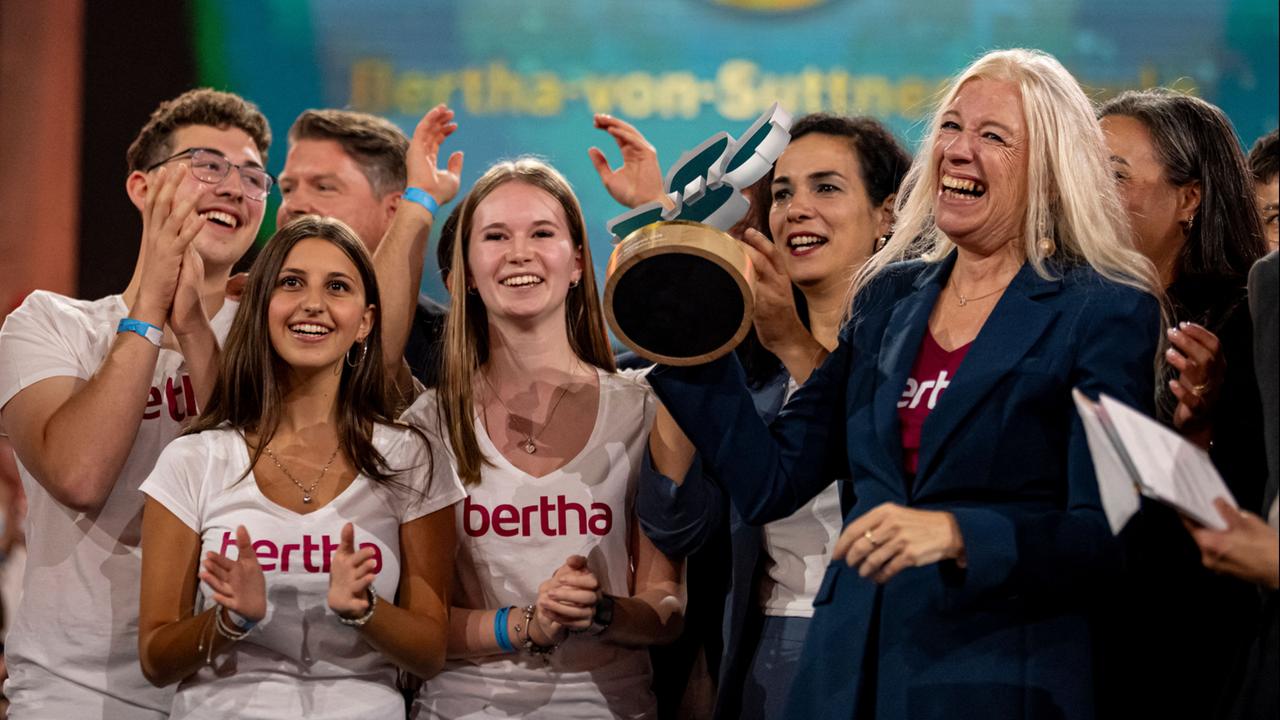
In a landmark moment for the German educational landscape, the Bertha-von-Suttner-Schule in Mörfelden-Walldorf has been crowned the winner of the prestigious German School Prize (Deutscher Schulpreis). The award, which carries a cash prize of 100,000 euros, recognizes the school’s exceptional commitment to innovative pedagogy, inclusive practices, and the fostering of a cohesive school community.
The announcement, made in Berlin on September 29, 2026, marks the 20th anniversary of the competition, an initiative co-sponsored by the Robert Bosch Stiftung and the Heidehof Stiftung. In a year defined by sobering data regarding student performance, the ceremony served as a critical platform to discuss the future of the German classroom.
A Blueprint for Modern Pedagogy
The Bertha-von-Suttner-Schule, located southwest of Frankfurt, impressed the jury by demonstrating how a massive student body—exceeding 2,000 pupils and supported by 250 teachers—can operate with a unified pedagogical vision. The jury particularly highlighted the school’s success in making "multiprofessional work" and "radical inclusion" the standard operating procedure rather than the exception.
The school’s ability to manage such a large population while maintaining a deeply personal, student-centered approach serves as a potential blueprint for other large-scale institutions struggling to balance administrative scale with individual student needs.
Chronology of the 20th Anniversary Gala
The ceremony in Berlin Adlershof was more than a celebratory event; it was a high-level forum on the state of the nation’s schools.
- Morning Session: Finalists from across Germany gathered for workshops and peer-to-peer exchanges, discussing their respective successes in navigating the post-pandemic academic landscape.
- Midday: The official award ceremony commenced. Six additional schools were recognized with runner-up prizes of 30,000 euros each, acknowledging their unique contributions to the education sector.
- Keynote: Bundeskanzler Friedrich Merz addressed the assembly, framing education as the primary challenge for the coming decade.
- Afternoon: Winners and jury members engaged in roundtable discussions regarding the scalability of the winning concepts, focusing on how these models could be exported to underperforming districts.
Supporting Data: Excellence Across the Republic
While the Bertha-von-Suttner-Schule took home the top prize, the breadth of excellence across the country was evident in the selection of the runners-up. The diversity of the winning schools reflects the varied challenges faced by German education:
- Ferdinand-von-Steinbeis-Schule (Tuttlingen, Baden-Württemberg): Recognized for excellence in vocational integration.
- Hans-Leipelt-Schule (Donauwörth, Bavaria): Earned acclaim for its shift away from the traditional, rigid hour-by-hour schedule. Students here engage in self-organized learning blocks where teachers act as "coaches" rather than lecturers, allowing students to seek guidance across disciplinary boundaries.
- Georg-Christoph-Lichtenberg-Oberstufengymnasium (Bruchköbel, Hesse): Honored for high-level academic standards in a secondary school environment.
- Oberschule Berenbostel (Garbsen, Lower Saxony): A testament to the power of community-based learning.
- Staatliche Grundschule Tannroda (Thuringia): Recognized for fostering strong foundations in primary education.
- Stadtteilschule Wilhelmsburg (Hamburg): Awarded the Jury Prize for Social Cohesion (30,000 euros). In a school where over 80 percent of the 1,200 students are bilingual, the institution has successfully transformed cultural and linguistic diversity into a pedagogical asset rather than a hurdle.
Nine additional finalists received recognition prizes of 5,000 euros each, ensuring that the innovative spirit of all short-listed schools is supported by the foundation.
Official Responses and the PISA Context
The 20th anniversary of the German School Prize took place against a backdrop of anxiety regarding the recent PISA study results. The study, released in early September, indicated that German students had reached a historic low in both mathematics and reading literacy.
Bundeskanzler Friedrich Merz, in his address to the educators, did not shy away from these figures. "Education is one of the most important, if not the most important, tasks of our society," Merz stated. He acknowledged that the recent PISA data serves as a stark documentation of the "great deficits in our education system."
Merz emphasized that the award-winning schools offer more than just prestige; they offer a roadmap. "The results of the study are a reason to do even more to ensure that education in Germany improves," the Chancellor remarked, suggesting that the federal government looks to these "beacon schools" to identify the structural changes necessary to reverse the trend of declining performance.
The Jury’s Criteria: Evaluating Quality
The selection process for the German School Prize is rigorous, involving a multi-stage evaluation by a jury comprised of educational researchers and active practitioners. Since 2006, the committee has refined a framework based on six core dimensions of school quality:
- Instructional Quality: How well teachers facilitate knowledge acquisition.
- Performance: The measurable outcomes and academic growth of students.
- Handling Diversity: How effectively a school supports students from varying socio-economic and cultural backgrounds.
- Responsibility: The development of civic engagement and student autonomy.
- School Life and Networking: The strength of the internal community and partnerships with the external local community.
- Learning School: The school’s capacity for self-reflection and continuous structural improvement.
By adhering to these six pillars, the German School Prize aims to move beyond simple test scores, looking instead at the "culture" of the school as a whole.
Implications for the Future of Education
The shift observed in this year’s winners—particularly at schools like the Hans-Leipelt-Schule and the Maria-Leo-Grundschule (last year’s winner)—suggests a growing consensus that the traditional, Prussian-style "clockwork" classroom is becoming obsolete.
The End of the Traditional Timetable?
The move toward flexible, self-organized learning environments is a recurring theme. By replacing rigid hourly schedules with "learning blocks" and shifting the teacher’s role to that of a mentor or coach, these schools are fostering independence. This transition is seen by many experts as vital for preparing students for a modern, digital-first workforce where self-management is more critical than rote memorization.
Addressing the Achievement Gap
The success of schools like the Stadtteilschule Wilhelmsburg offers a critical lesson in social policy. In an era of increased migration and social fragmentation, the school’s ability to treat diversity as a "foundational element" rather than a problem to be solved provides a template for other metropolitan areas.
The Road Ahead
The challenge for the German education system remains the "scaling" of these successes. While the German School Prize highlights individual stars, the systemic challenge remains: how to transplant these decentralized, highly personalized models into standard, under-resourced public schools.
As the German School Prize moves into its third decade, the focus is shifting from "identifying excellence" to "disseminating excellence." The collaboration between the media partners (ARD and ZEIT Verlagsgruppe) and the educational foundations is expected to expand, focusing on creating networks where these award-winning schools mentor struggling neighboring institutions.
In conclusion, the 2026 awards have underscored that while the PISA results provide a grim assessment of current standards, the pedagogical tools to improve the system already exist within the country’s borders. The Bertha-von-Suttner-Schule and its fellow winners prove that with the right balance of autonomy, inclusion, and community focus, the trajectory of German education can be corrected. The task now lies in the political and administrative will to implement these lessons on a national scale.