


By Emma Velasco Willems
Updated: August 1, 2026
In the hallowed, often quiet halls of Cologne’s Museum Ludwig, the atmosphere has been anything but reserved for the past several months. The walls have been vibrating with a relentless, rhythmic energy—a sea of vibrant polka dots, hypnotic mirrors, and immersive "Infinity Rooms" that have transformed the institution into a pilgrimage site for art lovers, social media influencers, and first-time museum-goers alike. As the blockbuster exhibition dedicated to the legendary Japanese artist Yayoi Kusama draws to a close, the numbers are in: the show is officially the most successful in the museum’s storied history.
With over 450,000 visitors passing through its doors, the exhibition has comfortably surpassed a record that had stood for over two decades. Previously, the title was held by the 2004/2005 Edward Hopper retrospective, which drew 380,000 visitors. The sheer scale of the Kusama attendance, however, represents a shift in how modern institutions engage with the public—marrying high-concept, existential art with the visceral, sensory-driven demands of the 21st-century audience.
The Anatomy of an Art World Blockbuster
The success of the Kusama exhibition cannot be attributed to a single factor. Instead, it is the result of a perfect storm: the artist’s status as a living icon, the visually arresting nature of her work that seems tailor-made for the digital age, and the profound, often harrowing backstory that anchors her whimsical aesthetic in reality.
For Museum Ludwig Director Yilmaz Dziewior, the figures are both gratifying and staggering. "We anticipated a major success, certainly," Dziewior remarked during a recent debriefing. "But the sheer scale of the turnout has exceeded our most optimistic projections. Seeing people travel from across the country, sometimes even arriving in costumes reflecting the artist’s signature motifs, has been a testament to the universal appeal of her vision."
The exhibition’s reach extended far beyond the traditional art-historical demographic. Through a strategic embrace of social media and a curation style that prioritizes "experiential" art, the museum successfully lowered the barrier to entry for casual observers. For many, this was their first visit to an art museum, a fact that the institution views as a triumph in its long-term mission to foster a broader cultural dialogue.
Chronology of a Cultural Milestone
The path to this record-breaking exhibition was years in the making, involving complex international logistics and a meticulous curation process.
- The Planning Phase (2023–2025): Negotiations for the tour began as the museum sought to bring the most comprehensive collection of Kusama’s work to Germany. The technical requirements—particularly for the "Infinity Rooms"—demanded months of architectural planning.
- The Opening (Spring 2026): The exhibition opened to immediate fanfare, with ticket portals crashing within hours as thousands vied for entry slots.
- The "Kusama Summer" (Mid-2026): By June, the museum was forced to implement extended hours, as demand showed no sign of tapering off. The exhibition became a cultural staple in Cologne, consistently dominating local media and regional tourism discussions.
- The Final Stretch (August 1–2, 2026): To accommodate the last wave of visitors, the museum announced a final, late-night marathon, keeping doors open until the early hours of the morning to ensure that those who had waited for months would not be left out.
- The Departure (August 2026): With the closing date finalized, the logistical behemoth of dismantling the show begins, preparing the works for their next home: the Stedelijk Museum in Amsterdam.
Supporting Data and Logistical Feats
The logistical requirements of hosting a Yayoi Kusama exhibition are equivalent to orchestrating a major industrial operation. The centerpieces of the show, the Infinity Mirror Rooms, are not merely art installations; they are complex technical environments.
The installation at the Museum Ludwig utilized the massive 400-square-meter DC Hall to accommodate tentacle-like, polka-dotted sculptures that create an illusion of infinite space. For each location on the tour, these rooms must be recalibrated. Height, width, walking paths, and lighting arrays are calculated down to the millimeter to ensure that the reflection and refraction of light maintain the "infinite" effect.
Moving the collection is equally daunting. The exhibition consists of nearly 300 individual pieces, ranging from delicate paintings to massive, floor-anchored sculptures. The transition to the Stedelijk Museum will require a fleet of twenty climate-controlled semi-trailers. Specialized handling is required for every item; in some cases, the museum must employ external cranes to remove large-scale sculptures from the roof, a delicate operation that requires precise wind and weather conditions.
The Artist: A Life Between Clinic and Canvas
To understand the mania surrounding the dots, one must look at the woman behind them. At 97 years old, Yayoi Kusama remains a figure of singular focus. Since 1977, she has lived voluntarily in a psychiatric hospital in Tokyo, a fact that she has never hidden and that defines much of her artistic output.
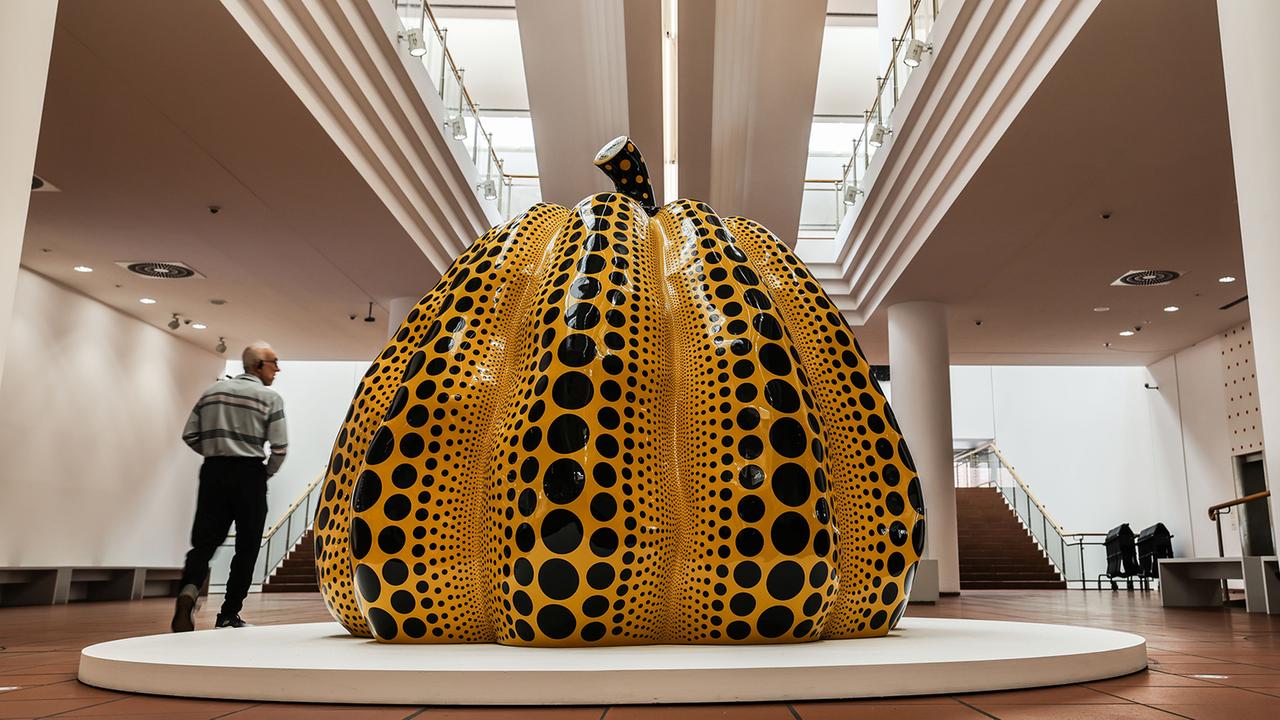
Kusama’s work is often categorized by its repetition—the dots, the nets, and the pumpkins that have become her trademark. These are not merely stylistic choices; they are the result of lifelong hallucinations that began in her childhood. She has described the sensation of being overwhelmed by these patterns as a form of "self-obliteration," where her identity dissolves into the infinite environment she creates.
Her journey from a rural seed farm in Japan to the avant-garde scene of 1950s New York is well-documented, but her resilience is what continues to captivate the public. Her art acts as a therapeutic survival strategy, a way to channel her depression and anxieties into something tangible, colorful, and—to the observer—deeply optimistic.
Official Responses and Museum Strategy
The success at Museum Ludwig serves as a template for other institutions facing the challenge of staying relevant in a digital-first world. Yilmaz Dziewior emphasizes that while the "selfie-friendly" nature of the installations is an undeniable draw, it is the museum’s role to contextualize that engagement.
"We saw people coming for the photo, but staying for the story," Dziewior explained. "The curation was designed to transition the visitor from the sensory experience of the Infinity Rooms into the more challenging, intimate work of her paintings and literature. We aren’t just selling a photo opportunity; we are providing a gateway to a life’s work that deals with the most profound questions of human existence: decay, beauty, and the nature of the self."
The museum’s outreach programs, which included workshops on Kusama’s techniques and lectures on the history of Japanese avant-garde art, saw unprecedented attendance. By leveraging the "Kusama Hype," the museum has successfully expanded its database of patrons, hoping that these new visitors will return for future, perhaps less "viral," exhibitions.
Implications: The Legacy of the Dots
As the exhibition prepares to vacate the halls of the Museum Ludwig, the question remains: what is the lasting impact of this surge in interest?
For the art world, the exhibition is a clear signal that the public is hungry for "total art"—environments that envelop the viewer rather than keeping them at a distance. It challenges the traditional model of the "white cube" gallery, where interaction is discouraged. Kusama’s work demands that the viewer be a participant, a component of the artwork itself.
Furthermore, the logistical success of this massive tour underscores the importance of international cooperation between museums. The movement of these works from Cologne to Amsterdam is a high-stakes endeavor, requiring the coordination of curators, conservators, and transport specialists across borders.
Finally, the emotional resonance of the exhibition is perhaps its most enduring legacy. In an era often characterized by cynicism and fragmentation, Kusama’s repetitive, joyous, and obsessively created art offers a sense of stability and collective wonder.
"Kusama leaves behind a great sense of optimism," says Dziewior. "When people leave these rooms, they aren’t just leaving a museum; they are carrying a piece of that experience with them. It’s an infectious form of joy that, I suspect, will echo in Cologne for a long time to come."
As the last of the crates are sealed and the final polka-dotted sculpture is lowered from the museum roof, the record-breaking success of the 2026 exhibition stands as a benchmark for what art can achieve when it balances deep, personal vulnerability with a universal, sensory-driven language. The dots may be leaving Cologne, but the conversation they ignited is only just beginning.