

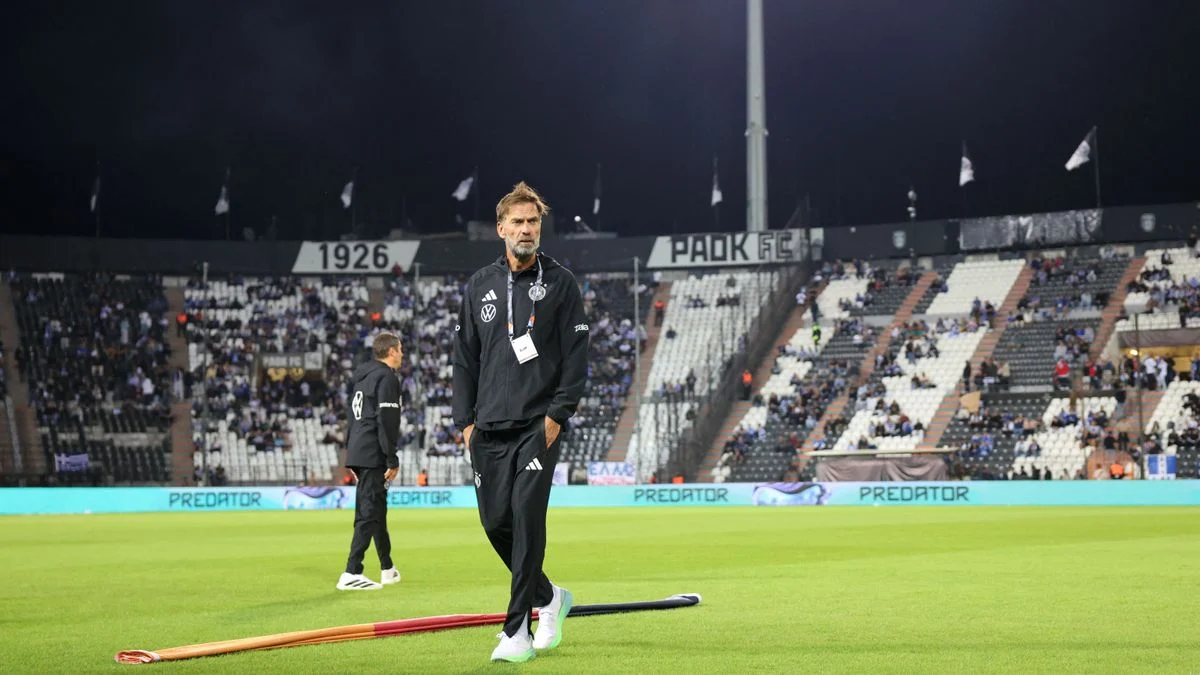
The honeymoon period, if there ever was one, is beginning to show signs of strain. Under the stewardship of Jürgen Klopp, the German national football team arrived in Thessaloniki with high expectations, hoping to cement their dominance in the UEFA Nations League. Instead, they departed with a frustrating 0:0 draw against a resilient Greek side—a result that has sent shockwaves through the European football media landscape and left pundits questioning whether Klopp’s high-octane philosophy is finding its footing on the international stage.
The Match in Perspective: A Tactical Stalemate
The encounter at the Toumba Stadium was supposed to be a statement of intent. Klopp, known for his "heavy metal" football, opted for a rotated squad, signaling his willingness to experiment during this Nations League cycle. However, what transpired on the pitch was a tactical stalemate that highlighted deep-seated issues in the current DFB setup.
Germany dominated the early exchanges, moving the ball with purpose and maintaining a high defensive line. Yet, as the minutes ticked by, the fluidity that defined Klopp’s tenure at Liverpool seemed absent. The German side struggled to break down a compact, disciplined Greek block. By the second half, the energy levels dropped, and the visitors appeared to run out of ideas. The final whistle was met with relief by the hosts and a sense of growing concern among the traveling German contingent.
Chronology of a Frustrating Evening
- Kick-off: Germany begins with intensity, pressing high and forcing Greece into defensive transitions.
- 15th – 30th Minute: The DFB team controls possession, but clear-cut chances remain elusive. The Greek defense, organized and disciplined, frustrates the German frontline.
- Half-Time: The score remains 0:0. Klopp’s halftime team talk focuses on widening the pitch and increasing the tempo.
- 55th – 70th Minute: Germany’s dominance wanes. Greece begins to find pockets of space on the counter-attack, forcing the German backline to remain cautious.
- 75th Minute: Klopp introduces Nick Woltemade, hoping to inject fresh impetus into the attack.
- Full-Time: A 0:0 stalemate is confirmed. The Greek crowd celebrates a point that keeps their quarter-final dreams alive, while the German players leave the field with heads bowed.
International Press: A Chorus of Doubt
The global reaction has been swift and, for the most part, critical. European newspapers, usually quick to laud the tactical brilliance of a Klopp-managed side, are now openly questioning the transition process.
The View from France and Spain
In France, the venerable L’Équipe was blunt in its assessment, noting that "Jürgen Klopp’s Germany lacked imagination." The report highlighted the dichotomy of the performance: "Dominant in the first half, but sluggish and pedestrian in the second." This sentiment was echoed in Spain, where Marca suggested that while Klopp’s desire to experiment is understandable, the results are simply not there. "Klopp emphasizes that now is the time for experimentation," the paper wrote, "but so far, his Germany is not really getting going." Mundo Deportivo added that despite a completely different lineup compared to the previous week, the strategic plan seemed to dissolve as the game progressed. As simply summarized the current sentiment with a headline that sent shivers down the spine of German fans: "The Klopp Era is not taking off."
The View from the Mediterranean and Beyond
For the hosts, the result was nothing short of a triumph. Greece’s Ta Nea hailed the result as "an important point for the national team," emphasizing their unbeaten run in the group and their growing belief in reaching the quarterfinals. Kathimerini echoed this, describing the 0:0 draw as a "valuable" result earned through grit and tactical discipline.
Meanwhile, the Swiss Blick captured the atmosphere of the struggle, noting that the "hard-as-nails" Greeks managed to annoy Klopp once again. "The Greeks sat back and defended against the DFB stars with everything they had," the paper reported. Across the border in Italy, Corriere dello Sport focused on the physical toll, observing that "Germany is running out of steam," while Austria’s Kronen Zeitung lamented the missed opportunity for the DFB-Elf to enact revenge on their Greek counterparts.
Supporting Data and Tactical Analysis
The statistics from the match paint a picture of a team that controls the ball but lacks the "killer instinct." Germany’s expected goals (xG) were significantly lower than in previous fixtures, suggesting that the possession was largely sterile. Klopp’s shift to a more experimental rotation has, thus far, failed to create a cohesive unit. The reliance on individual brilliance has been minimized, but the collective system has yet to reach the requisite level of synchronization to break down "low-block" defenses, a common challenge in international football.
Furthermore, the introduction of younger talents like Nick Woltemade highlights Klopp’s long-term vision, but it also reflects the current lack of a stable, veteran core. The fluidity that many expected from a Klopp-led team is currently being stifled by a lack of familiarity among players who are still learning the tactical nuances of his system.
Official Responses and the Road Ahead
In the post-match press conference, Klopp remained diplomatic but visibly frustrated. He acknowledged the difficulty of breaking down a team that puts ten men behind the ball, but he took full responsibility for the team’s inability to find a breakthrough.
"We are in a process," Klopp told reporters. "Results like this are part of the learning curve. We are trying to find the right balance between our tactical identity and the needs of the squad. I am not satisfied with the result, but I am satisfied with the effort to stick to our principles."
The German Football Association (DFB) has publicly backed the coach, emphasizing that this is a "transitional period." However, the pressure is mounting. The DFB is fully aware that international football is a results-driven business. While patience is the current narrative, the expectations surrounding a coach of Klopp’s caliber leave little room for prolonged periods of underperformance.
Implications for the Future
The implications of this result are significant for both the team’s standing in the Nations League and for the broader narrative surrounding the "Klopp Experiment."
- Tactical Re-evaluation: Klopp may be forced to abandon some of his more radical experiments in favor of a more stable, core-focused lineup to secure necessary points.
- Squad Depth Concerns: The match highlighted that while the depth of the German squad is impressive, the drop-off in quality between the starters and the second-string players remains a concern.
- Psychological Hurdles: The perception that "The Klopp Era is not taking off" can create a self-fulfilling prophecy. The German players need a convincing win to regain their confidence and silence the growing chorus of international critics.
- Qualification Pressure: Every point dropped in the Nations League complicates the path to the finals. Germany can no longer afford to treat these matches as mere laboratories for tactical testing.
As the team prepares for their next fixture, the question remains: Can Jürgen Klopp adapt his high-intensity style to the more rigid, defensive nature of international football, or is this a sign that his philosophy requires a level of consistency that international training schedules simply cannot provide? The world will be watching, and for now, the wait for the "Klopp machine" to truly ignite continues. The challenge for Germany is to turn this frustration into fuel, ensuring that the next time they face a defensive wall, they have the tools—and the conviction—to tear it down.











