By Historical Sports Analysis Desk
The modern Bundesliga is frequently lauded for its technical prowess, tactical innovation, and global marketing reach. Yet, beneath the polished veneer of current high-stakes football, there exists a darker, more visceral side to the sport that defines its very soul: the desperation of the relegation zone. As fans look ahead to a 34th matchday characterized by an unprecedented three-way tie at the precipice of the second division, the collective memory of German football is inevitably pulled back to a singular, seismic event: the 1998/99 Bundesliga finale.
While contemporary fans watch teams like St. Pauli, Wolfsburg, and Heidenheim sweat out the final minutes of a season, they are witnessing the echoes of a tragedy that transpired a quarter-century ago. The 1998/99 season stands as the undisputed "Mother of All Relegation Battles," a day when the 1. FC Nürnberg—a club steeped in history—plummeted into the abyss in a manner so cruel and unexpected that it remains a haunting cautionary tale for every team entering the final day of a campaign.
The Setting: A League on the Edge
In May 1999, the Bundesliga landscape was vastly different, yet the stakes were identical. As the 33rd matchday concluded, the table presented a scene of utter chaos. Borussia Mönchengladbach and VfL Bochum had already resigned themselves to the drop, but the battle to avoid the third and final relegation spot was a five-way scramble.
The mathematical configuration heading into the final weekend defied logic. Twelve teams were mathematically safe, but the gap between 12th place (1. FC Nürnberg) and 16th place (Eintracht Frankfurt) was a mere three points. The clubs involved—Nürnberg, Stuttgart, Freiburg, Rostock, and Frankfurt—were all separated by margins that could be erased by a single goal, a single refereeing decision, or a single lapse in concentration.
The pressure on the 1. FC Nürnberg, affectionately known as "Der Club," was immense. Having entered the final day in the most favorable position among the threatened teams, they held their destiny in their own hands. The fans, the players, and the city of Nuremberg expected survival. What they received was a lesson in the fragility of professional sport.
The Chronology of a Collapse
The final day, May 29, 1999, remains a fixture in the annals of German sports broadcasting, primarily due to the legendary radio commentary of Günther Koch. His voice, oscillating between hope and sheer panic, became the soundtrack of the afternoon.
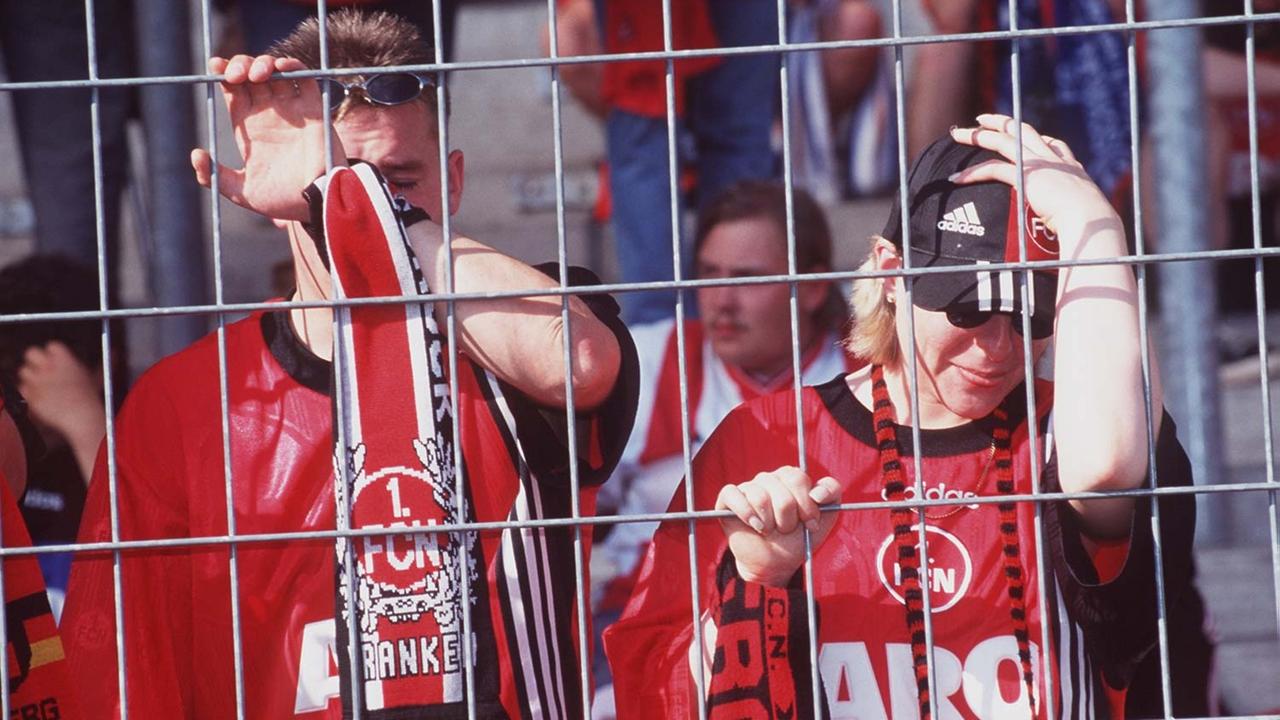
The tension was palpable from the opening whistle. As the parallel games unfolded across the country, the live table shifted with every goal. Nürnberg’s match against SC Freiburg was intended to be a routine defense of their league status. Instead, it became a nightmare. While Nürnberg trailed 1-2, news filtered through from other stadiums. Hansa Rostock had staged a dramatic late turnaround against Bochum, and Eintracht Frankfurt was beginning to find their rhythm against Kaiserslautern.
As the clock ticked toward the 90th minute, the unthinkable became reality. Nürnberg, despite their advantageous position at the start of the day, found themselves sliding into the relegation zone. The atmosphere in the stadium turned from nervous anticipation to a suffocating, heavy dread.
The "Abyss" and the Left Goalpost
The defining moment of the match—and perhaps the most painful image in the club’s history—occurred in the final minutes. With the score at 1-2, Nürnberg launched a desperate offensive. A strike from the home side rattled the left goalpost in front of the North Stand. The rebound fell perfectly to Frank Baumann, a stalwart of the defense and a future titan of German football.
From six meters out, with the goal gaping and the goalkeeper, Richard Golz, having already committed himself to a save, the ball was destined for the net. Instead, it stayed out. It was a miss of impossible proportions, a moment of tragic comedy that effectively sealed the club’s fate.
Günther Koch’s commentary during this sequence is etched into the minds of those who heard it live: "We are reporting from the abyss! Nürnberg 1-2. Just as Bayern lost in Barcelona because of the left goalpost, the ‘Club’ is relegated because of the left goalpost in front of the North Stand. It was not to be reached… the ball didn’t go in. Instead, it fell to the feet of Frank Baumann, who couldn’t put the ball in the net from six meters."
Supporting Data: The Mathematical Mirage
The complexity of the 1998/99 finale is best illustrated by the final table.
| Club | Points | Goal Difference | Goals Scored |
|---|---|---|---|
| SC Freiburg | 39 | -8 | 36 |
| Werder Bremen | 38 | -6 | 41 |
| Hansa Rostock | 38 | -9 | 49 |
| Eintracht Frankfurt | 37 | -10 | 44 |
| 1. FC Nürnberg | 37 | -10 | 40 |
The fine margins are staggering. Eintracht Frankfurt and 1. FC Nürnberg finished tied on 37 points. They also finished with an identical goal difference of -10. In the modern era, or with different tie-breaking rules, the result might have been different. However, under the regulations of the time, the tie-breaker was "goals scored."

Because Eintracht Frankfurt had scored 44 goals compared to Nürnberg’s 40, Frankfurt stayed up. A last-gasp 5-1 victory for Frankfurt over Kaiserslautern, punctuated by a dramatic late strike from Jan Åge Fjørtoft, was the final nail in Nürnberg’s coffin.
Official Responses and Emotional Fallout
The aftermath of the match was one of profound shock. The players left the pitch in tears, unable to comprehend how a team in 12th place could be relegated within the span of 90 minutes.
Frank Baumann, the "tragic hero" of the day, was inconsolable. For the fans, the reaction was a mixture of anger and disbelief. The club’s management faced an immediate crisis, as the financial and structural implications of a drop to the second division were severe. Günther Koch’s final broadcast words summarized the mood: "The ‘Club’ is relegated at this moment. The game here is over. Goodbye, dear friends. It is impossible to grasp what the ‘Club’ has put its fans through. The ‘Club’ has shown little composure… dear ‘Clubberer,’ I am sorry. It didn’t have to be this way."
Implications: The Long Shadow of ’99
The 1999 relegation served as a watershed moment for the Bundesliga. It underscored the volatility of the league’s bottom half and changed how clubs approached the "six-pointer" matches in the final weeks of the season.
For 1. FC Nürnberg, the journey back to relevance was long and arduous, marked by years of instability. For the Bundesliga, it provided a benchmark for drama that all subsequent relegation battles are measured against.
As the current generation of players approaches their own "final countdown," they do so in the shadow of 1999. The lesson of that year is clear: in football, safety is an illusion until the final whistle blows. The difference between survival and the "abyss" is often measured not in skill or tactical brilliance, but in the thickness of a goalpost, the timing of a late run, and the crushing weight of expectation.
Today, as we analyze the potential outcomes for the current relegation candidates, we look back at the 1998/99 season not just as a piece of history, but as a reminder. Football is a game of narratives, and the most enduring ones are often written in the ink of tragedy. The "Club" fell that day, but their story remains the ultimate reference point for anyone who dares to believe they are safe before the match is done.