

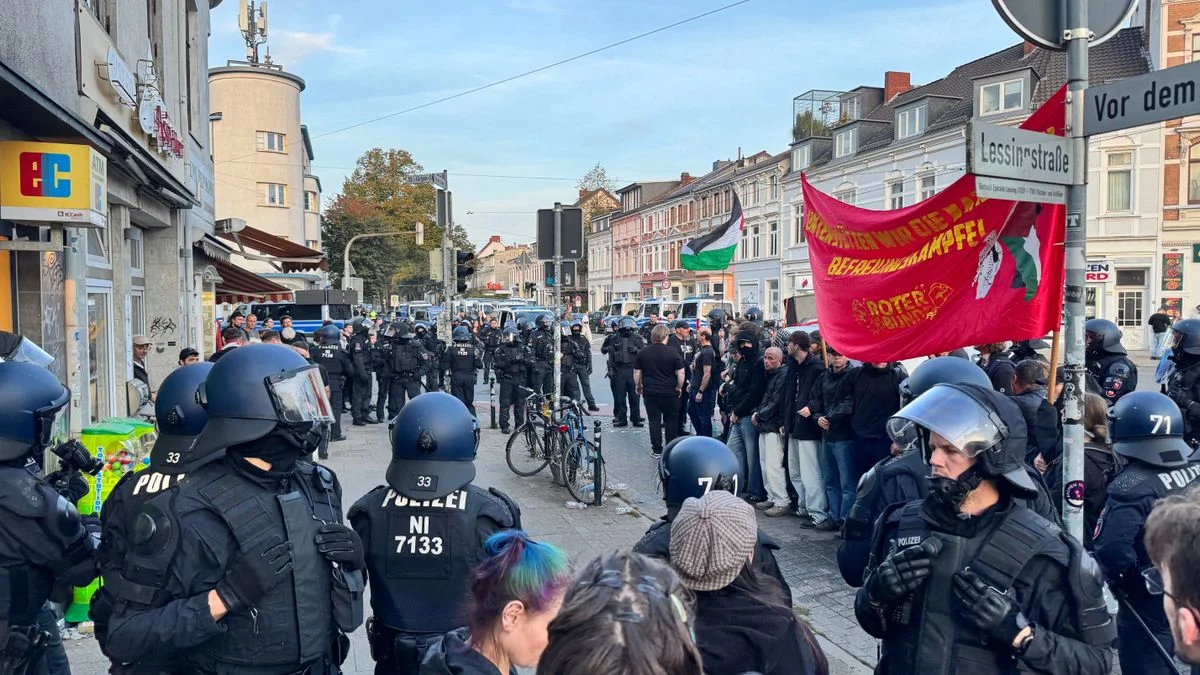
Main Facts: A City Divided
The city of Bremen has become a flashpoint for political dissent as the nation prepares to commemorate the Day of German Unity (Tag der Einheit). Over the past several days, the streets of the northern German port city have seen recurring demonstrations that have challenged the narrative of national celebration.
The most recent escalation occurred when a demonstration, organized under the banner of opposition to "militarism and warmongering," resulted in police intervention, the detention of multiple individuals, and the subsequent dissolution of the assembly. According to official police reports, the demonstrators are associated with the left-wing political spectrum. While the protest was initially registered as a lawful public gathering, the situation deteriorated, prompting law enforcement to maintain a significant presence in the city center long after the formal dispersal of the crowd.
This unrest follows a significant demonstration on Friday evening, where approximately 700 people gathered under the provocative slogan: "What you celebrate: Social cuts, militarization, anti-feminism!" This earlier protest, organized by the Basisgruppe Antifaschismus Bremen (Basic Group Antifascism Bremen), highlights a growing divide between mainstream state-sanctioned celebrations and grassroots movements that view the current socio-political trajectory of Germany with profound skepticism.
Chronology of Events: From Organized Protest to Police Intervention
The sequence of events leading to the current state of tension began late last week, as activists began mobilizing against the official celebrations of October 3rd.
Friday, September 29th: The Precursor
The initial catalyst for the weekend’s events was a large-scale demonstration organized by the Basisgruppe Antifaschismus Bremen. Roughly 700 participants gathered in the city center to vocalize their grievances against the federal government’s policies. The rally was not merely a protest against the concept of German Unity, but a rejection of the specific policies associated with the current administration—namely, what the organizers termed "social dismantling" and the perceived "militarization" of German foreign policy. The event remained largely within the bounds of a registered, orderly protest, though it set a tone of intense political friction that would persist through the weekend.
Saturday, September 30th – Sunday, October 1st: Escalation
As the weekend progressed, the tone of the protests shifted. Smaller, more militant splinter groups began to occupy public spaces, leading to increased friction with local law enforcement.
On the day of the most recent intervention, the protest was explicitly aimed at the themes of "militarism and warmongering." As the assembly progressed, police officials reported that the participants crossed legal thresholds, leading to the decision to declare the assembly dissolved. Officers moved in to enforce the order, resulting in multiple detentions. However, the mission remains ongoing. A spokesperson for the Bremen Police Department confirmed that the operation is far from concluded, with law enforcement continuing to patrol key areas to prevent further unauthorized gatherings or potential civil unrest.
Supporting Data: Contextualizing the Dissent
To understand the severity of these events, one must look at the socio-economic backdrop of Bremen. As a city-state, Bremen often experiences higher rates of poverty and social inequality compared to the German national average.
The slogans utilized by the protesters—"Social cuts," "Militarization," and "Anti-feminism"—are not random; they reflect a confluence of concerns held by various left-wing organizations.
- Militarization: Following the Russian invasion of Ukraine, the German government announced a Zeitenwende (historic turning point), pledging a €100 billion fund to modernize the Bundeswehr. Critics argue this move marks an end to Germany’s traditional post-war restraint and fear it will lead to an arms race.
- Social Cuts: With inflation and rising energy costs impacting low-income households, there is significant resentment regarding federal spending priorities. Protesters argue that the government has prioritized military spending over the maintenance of the social welfare state.
- Political Polarization: Data from the Federal Office for the Protection of the Constitution (BfV) indicates that Bremen has a robust and highly organized left-wing extremist scene. The ability to mobilize 700 people on a Friday evening suggests that these groups possess significant logistical capabilities and deep-seated community ties.
Official Responses: Law Enforcement and Government Stance
The response from the authorities has been characterized by a strict adherence to the maintenance of public order, balanced against the constitutional right to protest.
The Police Perspective
The Bremen Police have maintained a firm, if cautious, posture. A police spokesperson emphasized that while the right to assemble is protected under the German Basic Law (Grundgesetz), this right is not absolute. When assemblies violate local ordinances or result in criminal activity, the police are mandated to intervene.
Regarding the most recent arrests, the police have stated that those in custody were processed for various violations, though specific charges remain under investigation. The decision to keep the operation "open-ended" suggests that intelligence reports have indicated a risk of regrouping, particularly as the October 3rd anniversary approaches.
The Political Response
While local political figures have remained tight-lipped regarding the specific details of the arrests, the broader context of the German Unity Day celebrations has sparked a debate. Government officials have framed the Day of Unity as a moment for national reflection and cohesion. In contrast, critics argue that the current government is using the day to promote a specific, nationalistic agenda that ignores the concerns of those suffering from the current cost-of-living crisis.
Implications: The Future of German Unity Day
The events in Bremen have profound implications for the state of political discourse in Germany. As the nation grapples with the transition to a post-Cold War security architecture, the consensus that once underpinned national celebrations is fraying.
1. The Challenge to Public Order
The primary concern for local authorities is the potential for these protests to turn violent. The fact that the police operation in Bremen is "ongoing" indicates a high level of alert. If the protests persist, it could force local governments to reconsider the security architecture of future public celebrations, potentially leading to more restrictive policies on public assembly.
2. The Fragmentation of the Left
The protests also highlight a fragmentation within the German left. While the Basisgruppe Antifaschismus is organized and clear in its messaging, the broader movement is a patchwork of anti-militarist, feminist, and anti-capitalist groups. Whether this coalition can sustain its pressure on the government remains to be seen. If they fail to achieve political concessions, there is a risk that the movement could become more radicalized as more moderate voices become disillusioned with the lack of progress.
3. A Symbolic Defeat for the Establishment
For the political establishment, the optics of protests on German Unity Day are problematic. The day is designed to represent harmony and progress. When thousands take to the streets to claim that the state is promoting "social dismantling" and "militarization," it directly undermines the official message of unity. The government is currently caught in a dilemma: ignore the protests and appear detached, or engage with them and risk legitimizing groups that many in the mainstream political center find extreme.
4. Long-term Societal Fissures
Ultimately, the events in Bremen are a microcosm of the deeper fissures within German society. The Zeitenwende is not just a policy shift; it is a fundamental change in the German identity. For a generation raised on the values of pacifism and social welfare, the current government’s actions feel like a betrayal. Unless there is a concerted effort to address these concerns through policy, or at least through transparent communication, it is likely that future national celebrations will continue to be met with organized resistance.
Conclusion: A City on Edge
As Bremen prepares for the official commemorations, the air in the city is thick with tension. The arrests of protesters and the ongoing police operation serve as a stark reminder that unity is not a given in modern Germany. Instead, it is an ideal that is being actively contested in the streets.
The authorities, for their part, face the difficult task of balancing the need for public safety with the democratic necessity of allowing dissent. The protesters, meanwhile, show no signs of backing down. With the anniversary of German Unity only days away, all eyes will be on Bremen to see whether the city can navigate these turbulent waters without further escalation. The outcome of these protests will undoubtedly serve as a bellwether for the political stability of Germany in the years to come. Whether the government chooses to listen to the grievances of the streets or to enforce order through continued policing will define the narrative of the post-unity era for many years.























