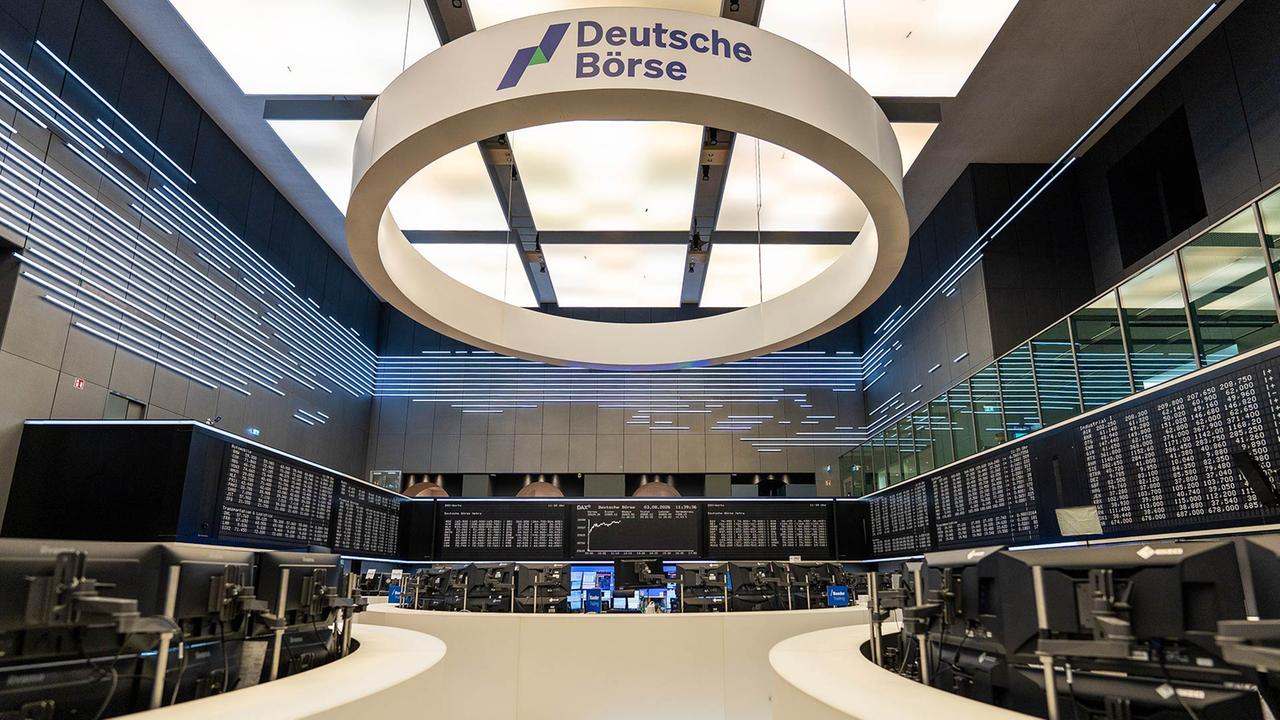
FRANKFURT – The German equity market faced renewed downward pressure on Thursday morning, as the DAX retreated below the psychologically significant threshold of 25,000 points. Investors are grappling with a persistent, toxic cocktail of macroeconomic risks, ranging from elevated bond yields and surging oil prices to deepening geopolitical instability and a growing reliance on corporate debt. As the trading session opened, the index shed one percent, settling at 24,854 points, underscoring a broader sense of fragility across international financial centers.
Main Facts: A Market Under Siege
The decline marks a continuation of the cooling sentiment that began on Wednesday. After a brief three-day relief rally, the DAX succumbed to selling pressure, dropping 1.35% to 25,104 points, while the MDAX mirrored the weakness with a 1.4% decline to 30,112 points.
The malaise is not confined to Germany. U.S. markets, which often act as a bellwether for global liquidity and risk appetite, have similarly struggled. The Dow Jones Industrial Average closed at 51,180 points (-0.7%), the S&P 500 hovered at 7,801 points (-0.2%), and the tech-heavy Nasdaq Composite saw a modest decline of 0.2% to 27,538 points. The synchronicity of these declines suggests that investors are not merely reacting to local German issues but are pricing in a systemic shift in the global risk environment.
Chronology of the Current Downturn
The current volatility represents the culmination of weeks of mounting apprehension.
- Early October: Initial optimism regarding potential interest rate stabilization was dampened by a sudden spike in long-term bond yields, which began attracting capital away from riskier equity markets.
- Mid-Week: The three-day winning streak on the DAX, fueled by hope for a "soft landing," evaporated on Wednesday as energy prices spiked and reports emerged regarding potential U.S. military maneuvers in the Middle East.
- Thursday Morning: The breach of the 25,000-point mark in Frankfurt signaled a breakdown in short-term support levels, triggering automated selling and forcing institutional investors to re-evaluate their exposure to cyclical stocks.
The High-Stakes Earnings Season
As the markets face this correction, the spotlight has shifted entirely to the upcoming quarterly earnings season. Expectations have reached a fever pitch, with analysts forecasting an average 25% growth in profits for the S&P 500 constituents.
However, market experts warn that the margin for error is razor-thin. "The market has effectively ‘priced in’ perfection," says Jochen Stanzl, Chief Market Analyst at Consorsbank. "These valuations in New York are only defensible if the projected 25% profit growth is met. Any cracks in the facade of the Artificial Intelligence (AI) narrative could significantly exacerbate correction risks."
The core question facing Wall Street and the DAX alike is whether the massive capital expenditures directed toward AI infrastructure will finally yield tangible, bottom-line returns. Investors are no longer content with promises; they are demanding proof of profitability.
Corporate Divergence: Successes and Struggles
The current reporting season offers a mixed bag, highlighting the disparity between hardware infrastructure and consumer-facing segments.
The Samsung Paradox
Samsung Electronics recently reported a nine-fold increase in operating profit, surpassing the 107 trillion won (approx. 70 billion euros) mark. This represents a fourth consecutive record quarter, driven by an insatiable global demand for high-bandwidth memory (HBM) chips required for AI applications.
Yet, the stock price fell. Why? Because while the chip division is booming, Samsung’s consumer electronics and smartphone divisions are suffering from squeezed margins and softening demand. The market is signaling that even record-breaking performance is not enough if the outlook for the wider, non-AI business remains gloomy.
Industrial Resilience
Conversely, the industrial sector provided some rare positive signals. Daimler Truck reported a robust 26% increase in third-quarter sales, with North America leading the charge with a 51% surge, while Europe saw a healthy 13% growth. Similarly, SüdZucker, the European sugar giant, posted a significant rise in operating profit—jumping from 189 million to 303 million euros—despite stagnant revenue figures. These companies demonstrate that traditional industrial players can still extract value through efficiency gains and strategic market positioning, even when the broader macro environment is challenging.
Implications: Oil Prices and Geopolitical Risks
The energy market remains the "wild card" in the current economic equation. Brent crude is trading above $102 per barrel, driven by a combination of geopolitical tensions and supply chain disruptions.
Reports from U.S. media suggesting potential military actions against Iran in the coming weeks have sent jitters through energy traders, who fear a supply shock. Compounding this, a severe tropical storm in the Gulf of Mexico has forced producers to throttle output, resulting in a temporary loss of 500,000 barrels per day—nearly 25% of the regional production capacity.
The International Energy Agency (IEA) has intervened, accelerating the release of emergency oil reserves, with a specific focus on diesel, which has become a bottleneck for industrial logistics. While these measures aim to stabilize prices, the market remains highly reactive to any escalation in the Middle East.
Official Economic Forecasts: A Cautious Optimism
Despite the energy price shock, the German government is expected to release updated economic growth forecasts later today. There is cautious optimism among policymakers, with some economists projecting a GDP growth estimate of 1.3%.
However, this optimism faces a reality check from trade data. The Federal Statistical Office recently reported a 0.8% drop in exports for August, defying expectations of a rebound. Carsten Brzeski, Chief Economist at ING for Germany and Austria, highlights the structural vulnerability: "Trade is Germany’s Achilles’ heel. While German exporters initially benefited from the supply chain disruptions affecting Asian competitors in the second quarter, the third quarter has proven to be a significant setback."
The Debt Trap: A Looming Macroeconomic Threat
Perhaps the most concerning trend for long-term investors is the surge in corporate indebtedness. Despite high interest rates, major corporations—including high-profile names like SpaceX and Oracle—are aggressively tapping the bond markets to fund growth initiatives, particularly in the AI space.
This creates a dangerous feedback loop. As companies issue more debt, they must service it at historically high interest rates. Nigel Green, CEO of the deVere Group, warns: "The AI revolution began with cash reserves, but it is increasingly running on credit. Debt changes the risk profile entirely. These companies must pay back these loans on schedule, regardless of whether the revenue streams materialize as planned. If the growth fails to manifest, we could see a wave of corporate distress that would ripple through the equity markets."
Conclusion: The Path Forward
The decline of the DAX below 25,000 points is more than a technical adjustment; it is a manifestation of investor anxiety regarding a global economy transitioning from a period of "cheap money" to one of high-cost capital and geopolitical volatility. As the market enters the heart of the earnings season, the focus will remain on whether corporate performance can justify current valuation levels.
For the average investor, the message is clear: the era of blind optimism is over. The coming weeks will be defined by a "show me" approach, where only those companies capable of demonstrating disciplined capital management and genuine productivity gains will likely survive the current market correction unscathed. As the global economy navigates the intersection of AI-fueled investment and restrictive interest rate policies, the volatility experienced this week is likely to remain the new normal.