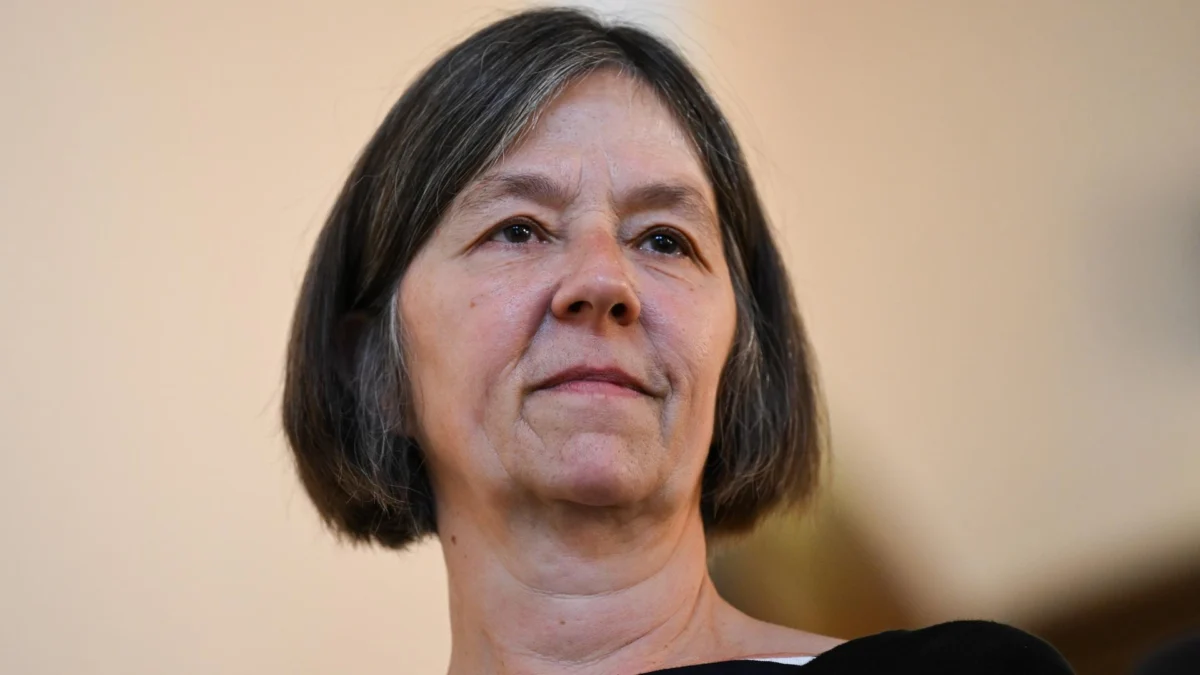
DARMSTADT, Germany – The German literary world turns its gaze to the city of Darmstadt today as the Deutsche Akademie für Sprache und Dichtung (German Academy for Language and Literature) hosts a grand ceremony to bestow the Georg Büchner Prize—the most prestigious literary award in the German-speaking world—upon the acclaimed author and translator Christine Wunnicke.
The ceremony, taking place this afternoon at the historic Staatstheater Darmstadt, marks a career milestone for the 59-year-old writer. Wunnicke, who splits her time between Munich and Berlin, is being recognized for a body of work that has been described by the jury as "brilliant art," characterized by a unique ability to weave historical detail with profound fictional exploration.
For those unable to attend the gala in person, the festivities are being broadcast live via a dedicated stream on hessenschau.de, allowing readers and literary enthusiasts worldwide to witness the presentation of the award, which carries a purse of €50,000.
The Weight of the Jury’s Decision
The decision to award Wunnicke the Georg Büchner Prize was announced earlier this summer, sending ripples of acclaim through the international literary community. In its official statement, the jury of the German Academy for Language and Literature lauded Wunnicke for her "unwavering work over the span of a quarter-century."
The academy noted that Wunnicke’s novels possess a rare quality: they make the fictional visible within the "supposedly historical." Her narrative technique is described as both "surprisingly inventive" and "sovereignly conceived," suggesting a level of craftsmanship that challenges the boundaries between biographical fact and literary imagination.
"Christine Wunnicke manages to breathe life into the archives," said a representative for the jury. "She does not merely recount history; she reconstructs the human psyche within those historical frames, forcing the reader to reconsider the nature of truth and narrative."

A Chronology of a Decorated Career
Wunnicke’s ascent to the peak of German literature was not a sudden burst of fame, but a steady, deliberate climb defined by intellectual rigor and linguistic precision.
- Early Beginnings: Establishing herself early on as a versatile writer, Wunnicke developed a reputation not just as a novelist, but as a skilled translator of Italian and English texts, a background that likely informed the rhythmic complexity of her own prose.
- 2015 – The Breakthrough: With the publication of Der Fuchs und Dr. Shimamura (The Fox and Dr. Shimamura), Wunnicke gained widespread critical attention. The novel, which explores the intersections of European and Japanese history, demonstrated her signature ability to blend cultural nuance with dark, existential humor.
- 2020 – Critical Acclaim: Die Dame mit der bemalten Hand (The Lady with the Painted Hand) solidified her status as a literary heavyweight, earning accolades for its atmospheric depth and intellectual playfulness.
- 2025 – Continued Excellence: Her latest work, Wachs (Wax), secured her a spot on the prestigious shortlist for the German Book Prize, further cementing her status as a vital voice in contemporary literature.
- October 2026 – The Pinnacle: Today’s ceremony in Darmstadt serves as the crowning achievement of a career that has already been decorated with the Wilhelm Raabe Literature Prize, the Jean-Paul-Preis, and the Literature Prize of the Darmstadt Jury.
The Legacy of the Georg Büchner Prize
To understand the magnitude of Wunnicke’s achievement, one must look at the history of the award itself. Established in 1951, the Georg Büchner Prize is named after the revolutionary dramatist and political activist Georg Büchner, best known for his unfinished masterpiece Woyzeck.
The prize is intended for authors who "distinguish themselves to a special degree" through their works and who have made a "significant contribution to the shaping of contemporary German cultural life." The funding for the prize is a testament to its importance, provided jointly by the German federal government, the State of Hesse, and the City of Darmstadt.
A Hall of Fame
The list of past laureates reads like a canon of 20th and 21st-century literature. It includes literary giants such as:
- Max Frisch (1958): Known for his existentialist explorations in Homo Faber.
- Günter Grass (1965): The Nobel laureate whose work defined the German post-war literary consciousness.
- Heinrich Böll (1967): A moral compass for the Federal Republic of Germany.
Wunnicke succeeds the acclaimed writer Ursula Krechel, who was honored in 2025. By joining this cohort, Wunnicke is not only receiving a financial reward but is being formally enshrined in the history of the German language.
Implications for Contemporary German Literature
The selection of Wunnicke signals a shift in what the academy values in the current era. In an age where digital media and rapid-fire content consumption threaten the space for long-form, historically grounded literature, Wunnicke’s success provides a powerful counter-narrative.

Her work highlights the ongoing relevance of the "historical novel" as a tool for political and social commentary. By revisiting the past, Wunnicke does not retreat from the present; rather, she uses historical distance to comment on contemporary issues of identity, power, and the nature of knowledge.
Furthermore, her role as a translator is an essential facet of her contribution. In a globalized world, the ability to bridge linguistic gaps is as critical as the ability to create original narratives. Her expertise in Italian and English literature allows her to import stylistic techniques that enrich the German literary landscape, making her a "European" author in the truest sense of the word.
Looking Forward
As the ceremony commences in Darmstadt, the literary community is already looking toward the impact of this award on Wunnicke’s future projects. The Georg Büchner Prize often acts as a catalyst for increased international interest in an author’s backlist, likely leading to more translations of her works into other languages.
For the readers who have followed her career, today is a celebration of intellectual integrity. For those who are new to her work, the award serves as a definitive recommendation to explore the complex, beautifully written, and deeply thoughtful world of Christine Wunnicke.
As the academy noted in its concluding remarks during the announcement of her win: "Wunnicke is an author who does not chase the trends of the day. She creates her own, and in doing so, she has provided us with a quarter-century of writing that will endure long after the current cultural cycle has turned."
The ceremony is expected to conclude with a keynote address by Wunnicke, which attendees and listeners alike await with bated breath, as she offers her own reflections on the state of the German language and the responsibility of the modern writer.