

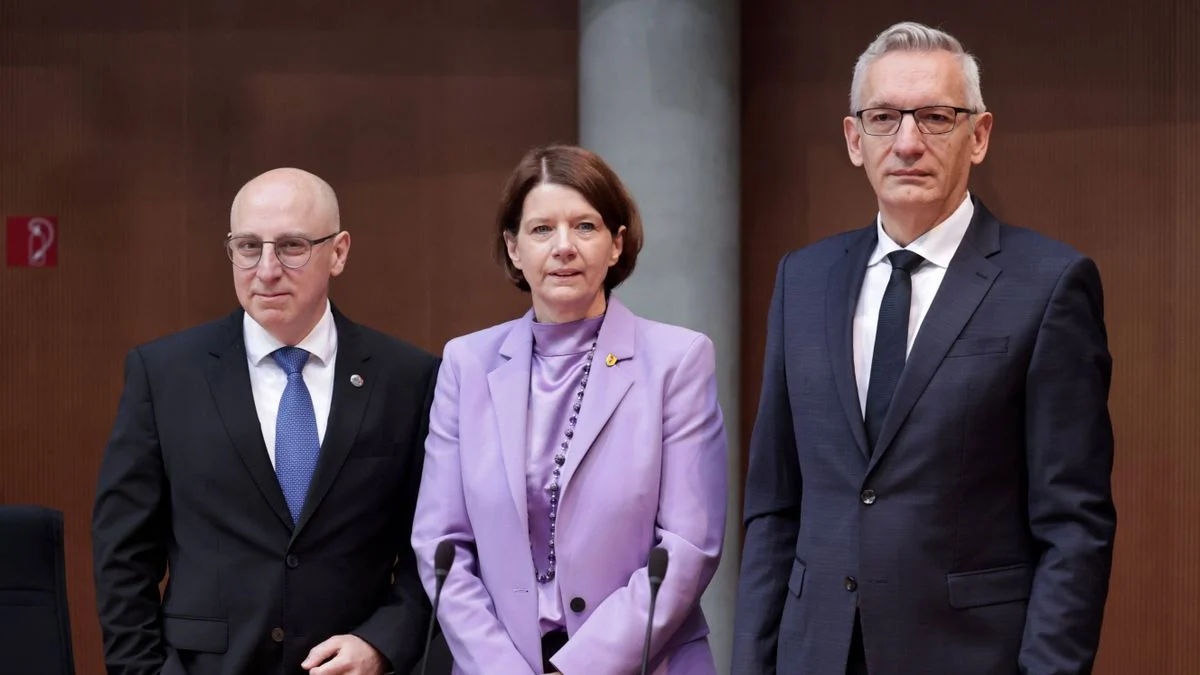
Berlin, Germany – Germany’s top intelligence officials have issued stark warnings about a rapidly evolving and increasingly perilous security landscape, characterized by the persistent and sophisticated aggression from Russia and the growing threat posed by interconnected extremist groups across the ideological spectrum. This dual challenge, described by intelligence chiefs as an existential threat to German democracy and societal cohesion, necessitates an unprecedented level of vigilance, strategic adaptation, and robust defense mechanisms. The pronouncements from the Federal Office for the Protection of the Constitution (BfV), the Federal Intelligence Service (BND), and the Military Counterintelligence Service (MAD) underscore a profound shift in Germany’s national security priorities, moving beyond traditional threats to confront a complex web of hybrid warfare, digital subversion, and domestic radicalization.
The warnings highlight Russia’s relentless pursuit of destabilization through espionage, cyberattacks, and disinformation campaigns, alongside the alarming expansion and networking capabilities of right-wing, left-wing, and Islamist extremist movements. These threats are not merely isolated phenomena but often intersect, with foreign actors sometimes exploiting domestic divisions and extremist narratives to further their own agendas. The security establishment’s assessment paints a picture of a nation under sustained pressure, requiring a comprehensive, multi-faceted response to safeguard its democratic institutions and the welfare of its citizens.
The Dual Axis of Threat: Russian Hybrid Warfare and Networked Extremism
The core message emanating from Germany’s intelligence community is unambiguous: the nation faces a two-pronged assault on its stability. On one flank is the resurgent and aggressive Russian state, employing a full spectrum of hybrid warfare tactics. This includes traditional espionage aimed at acquiring sensitive political, economic, and military intelligence, as well as more insidious methods like cyberattacks targeting critical infrastructure and government networks. Beyond overt digital incursions, Russian actors are adept at weaponizing information, disseminating propaganda, and amplifying divisive narratives to sow discord within German society and influence political discourse. The ultimate goal, according to intelligence analyses, is to undermine trust in democratic institutions, weaken Western alliances, and erode Germany’s resolve in the face of Moscow’s geopolitical ambitions.
On the other flank are Germany’s domestic and internationally linked extremist groups. The BfV, Germany’s domestic intelligence agency, has consistently highlighted the escalating danger from right-wing extremism, which remains the largest and most violent extremist threat. This includes traditional neo-Nazis, the "Reichsbürger" (Reich Citizens) movement – which denies the legitimacy of the Federal Republic of Germany – and parts of the "Querdenker" (Lateral Thinkers) movement, which emerged during the COVID-19 pandemic and has increasingly been infiltrated by conspiracy theorists and far-right ideologues. Left-wing extremism, though generally less violent in its most extreme manifestations, continues to pose a threat through property damage, clashes with law enforcement, and occasional acts of personal violence. Islamist extremism, while significantly curtailed in its organizational capacity following defeats in Syria and Iraq, remains a persistent danger, primarily from radicalized individuals, small cells, and returning foreign fighters capable of planning and executing terror attacks. The alarming trend across all these groups is their increasing ability to network, both online and offline, and to draw inspiration and sometimes direct support from international counterparts, amplifying their reach and potential for harm.
A Chronology of Escalation: From Complacency to Confrontation
Germany’s current security posture is a culmination of years of evolving threats and gradual recognition of their severity. For a period following the end of the Cold War, a sense of diminished external threat led to a certain degree of strategic complacency. The focus of intelligence agencies largely shifted towards combating international terrorism, particularly after the September 11, 2001 attacks.
The turning point for acknowledging renewed state-level threats, particularly from Russia, largely came in the mid-2010s. The illegal annexation of Crimea by Russia in 2014, followed by the conflict in eastern Ukraine, served as a stark awakening. This period saw a significant increase in Russian cyber activities targeting German institutions. A watershed moment was the 2015 cyberattack on the Bundestag, attributed to the Russian state-sponsored hacking group APT28 (also known as Fancy Bear). This sophisticated intrusion highlighted Germany’s vulnerability to state-sponsored digital espionage and sabotage. Subsequent years brought further evidence of Russian disinformation campaigns, particularly around the 2017 federal elections and the refugee crisis, aimed at polarizing public opinion and exploiting societal fault lines.
Concurrently, the domestic extremist landscape was undergoing its own dangerous evolution. The mid-2010s witnessed the rise of anti-immigrant and anti-establishment movements, some of which openly embraced far-right ideologies. The "Reichsbürger" movement, previously considered a fringe phenomenon, began to attract more adherents and demonstrate a willingness for violence, culminating in specific plots to destabilize the state. The BfV’s annual reports increasingly highlighted the growing membership and radicalization within right-wing extremist circles, noting a significant increase in politically motivated violence.
The early 2020s brought an intensification of these trends. The COVID-19 pandemic provided fertile ground for conspiracy theories, leading to the formation of the "Querdenker" movement, which quickly became a nexus for diverse groups, including anti-vaxxers, esoterics, and increasingly, right-wing extremists. The full-scale Russian invasion of Ukraine in February 2022 further exacerbated geopolitical tensions, leading to an intensified wave of Russian hybrid warfare efforts against Germany, including attempts to destabilize energy markets and further propaganda dissemination. Domestically, the "Reichsbürger" plot uncovered in December 2022, which aimed to overthrow the German government through violent means, served as a stark reminder of the concrete and immediate danger posed by networked extremist groups. This chronology illustrates a journey from underestimation to a clear-eyed recognition of persistent and multiplying threats.
Supporting Data and Concrete Examples
The warnings from German intelligence are not abstract but are grounded in extensive data and numerous concrete incidents. The BfV’s annual reports consistently document an alarming trend in right-wing extremism. For instance, the 2022 report cited approximately 38,800 individuals within the right-wing extremist milieu, with roughly 14,000 considered explicitly violent. This figure represents a significant increase over the past decade, underscoring the expanding threat. Specific incidents like the murder of Kassel district president Walter Lübcke in 2019 by a right-wing extremist, and the Halle synagogue attack in the same year, demonstrate the lethal potential of this ideology. The "Reichsbürger" network, estimated at around 23,000 individuals, has been responsible for numerous violent encounters with authorities and, as the December 2022 plot revealed, possesses a tangible capacity for large-scale subversive action.
Regarding Russian state activities, the BND and BfV report a steady escalation. Cybersecurity remains a primary concern. Beyond the 2015 Bundestag hack, German authorities have attributed numerous sophisticated cyberattacks on critical infrastructure, including energy providers and logistics companies, to Russian state-backed groups. The Federal Office for Information Security (BSI) has repeatedly issued warnings about advanced persistent threats (APTs) originating from Russia, noting their increasing sophistication and persistence. Counter-espionage efforts have also seen a surge, with several arrests of individuals suspected of working for Russian intelligence services. For example, in 2023, a former Bundeswehr officer was arrested on suspicion of passing secret information to Russia. Furthermore, reports indicate a significant number of Russian intelligence operatives, often operating under diplomatic cover, are active within Germany, making it a key battleground in the intelligence war.
Disinformation campaigns are another crucial element. During the COVID-19 pandemic, Russian state media and proxy accounts actively promoted anti-vaccine narratives and conspiracy theories, often aligning with domestic extremist rhetoric. Similarly, since the full-scale invasion of Ukraine, there has been a noticeable increase in Russian efforts to spread propaganda undermining German and European support for Ukraine, often through social media amplification and carefully crafted narratives designed to exploit existing societal grievances. This data collectively paints a grim picture, demonstrating a clear pattern of external aggression and internal radicalization converging to challenge the foundations of the German state.
Official Responses: A Multi-Layered Defense
In response to these escalating threats, the German government and its security agencies have implemented a multi-layered defense strategy, combining legislative reforms, enhanced operational capabilities, and increased international cooperation.
Legislatively, Germany has tightened laws against hate speech online, compelling social media platforms to remove illegal content swiftly. Powers for intelligence agencies have been incrementally expanded, particularly in areas of digital surveillance and data retention, though always subject to rigorous judicial oversight to balance security needs with civil liberties. Funding for all major security services – BfV, BND, MAD, and the Federal Criminal Police Office (BKA) – has been significantly increased to allow for greater personnel recruitment, technological upgrades, and training in specialized fields like cyber defense and counter-radicalization.
Operationally, counter-intelligence efforts have been ramped up, leading to more arrests and disruptions of espionage networks. The BSI plays a pivotal role in national cybersecurity, working to protect critical infrastructure through threat intelligence sharing, vulnerability assessments, and rapid incident response protocols. Public-private partnerships are being forged to enhance resilience across vital sectors. Deradicalization programs, such as those run by the BfV and various NGOs, aim to provide exit strategies for individuals seeking to leave extremist milieus, complemented by prevention initiatives focused on youth education and media literacy to counter radicalization online.
International cooperation is a cornerstone of Germany’s response. Close collaboration with NATO allies, particularly the United States and the United Kingdom, as well as European partners through agencies like EUROPOL and EUROJUST, is crucial for sharing intelligence on foreign state actors and transnational extremist networks. Germany actively participates in joint exercises and information-sharing platforms, recognizing that these complex threats transcend national borders and require a collective defense. This holistic approach seeks to not only react to immediate dangers but also to build long-term resilience within the state and society.
Implications for Germany and Beyond
The implications of these warnings extend far beyond the immediate security apparatus, touching upon the very fabric of German society, its economic stability, and its geopolitical standing.
Threat to Democracy: The most profound implication is the erosion of trust in democratic institutions. Disinformation campaigns and extremist narratives thrive on distrust, polarizing society and making it harder for citizens to distinguish fact from fiction. This can lead to political instability, undermine electoral processes, and ultimately weaken the democratic consensus that underpins the Federal Republic. The "Reichsbürger" plot, with its goal of violently overthrowing the state, serves as a chilling reminder of the direct threat to democratic order.
Societal Cohesion: The spread of extremist ideologies fosters division, intolerance, and fear. Minority groups are often targeted, leading to increased social fragmentation and a decline in overall societal cohesion. The psychological impact of living under the constant threat of foreign interference and domestic radicalization can also lead to increased anxiety and a sense of vulnerability among the populace.
Economic Impact: Cyberattacks can cause significant economic damage, disrupting critical services, leading to data breaches, and incurring substantial recovery costs. Beyond direct financial losses, the need for increased security measures, both physical and digital, represents a considerable ongoing expense for the state and private sector. Supply chain disruptions, often a target of state-sponsored cyber espionage, can have cascading economic effects.
Geopolitical Standing: Germany’s ability to effectively counter these threats has direct bearing on its credibility and influence within the European Union and NATO. As a leading economic and political power in Europe, Germany’s resilience against Russian aggression and its capacity to manage internal extremism are vital for maintaining regional stability and projecting a united front against revisionist powers. A weakened or internally fractured Germany would diminish the collective security of the Western alliance.
Future Challenges: The dynamic nature of these threats presents continuous challenges. The rapid evolution of technology, particularly in areas like artificial intelligence, deepfakes, and quantum computing, promises new tools for both attackers and defenders. Intelligence agencies face the constant pressure to adapt their methods, recruit specialized talent, and secure adequate resources. Balancing robust security measures with the protection of civil liberties will remain a delicate and ongoing political and legal challenge.
Ultimately, the warnings from Germany’s intelligence chiefs serve as a clarion call for sustained vigilance and collective action. They underscore that defending democracy in the 21st century requires not only a strong security apparatus but also a resilient society, well-informed citizens, and robust democratic institutions capable of withstanding both external pressure and internal subversion. The future of Germany’s security, and by extension, that of Europe, hinges on its ability to effectively navigate this complex and dangerous landscape.




















