By Editorial Staff | October 22, 2026
In the high-stakes arena of the UEFA Champions League, where fine margins dictate the trajectory of a season, Harry Kane has once again proven that he is far more than a traditional center-forward. During a pulsating 2-2 draw between FC Bayern Munich and Arsenal, the England captain delivered a performance that transcended the typical duties of a number nine. By operating as a hybrid playmaker, a deep-lying architect, and a clinical finisher, Kane left spectators and tactical experts alike searching for superlatives.
While the scoreboard reflected a stalemate, the narrative of the evening belonged to Kane, whose transformation into a "Bayern-Quarterback" has become the defining tactical evolution of Vincent Kompany’s side.
The Strategic Shift: A Performance Beyond the Box
The match against Arsenal was characterized by a high-intensity tactical chess match. Traditionally, Kane is viewed as the final piece of the attacking puzzle—the man who puts the ball into the net. However, at the Allianz Arena, the 33-year-old showcased a repertoire of passing and vision that seemed borrowed from the playbook of an NFL signal-caller.
Throughout the evening, Kane consistently dropped deep into the midfield, dragging Arsenal’s central defenders out of their disciplined defensive structure. By acting as a pivot, he created pockets of space for his teammates, most notably Alphonso Davies. This maneuver was not an act of desperation but a calculated, pre-planned strategy that dismantled Arsenal’s defensive cohesion.
The Anatomy of the "Quarterback" Role
The comparison to an NFL quarterback is not merely hyperbolic. Kane’s ability to survey the field, identify the rapid movement of his teammates, and execute 50-yard diagonal passes with pinpoint accuracy—all while under pressure—is a rare gift in modern football.
The most striking example occurred in the first half. Following a scramble in the penalty area, Manuel Neuer displayed remarkable awareness, quickly initiating a counter-attack. The ball found Kane in the center circle. With a singular, fluid motion, he bypassed the entire Arsenal midfield with a long-range delivery that set Davies into a one-on-one scenario. While the play did not result in a goal, it served as a warning shot: Kane had become the primary creative engine of the Bayern attack.
Chronology of a Tactical Masterclass
The match unfolded in distinct phases, each highlighted by Kane’s influence on the game’s tempo.
- The Opening Phase: Arsenal arrived with a clear intent to press, but Bayern’s tactical fluidity—led by Kane’s movement—caused immediate confusion. By dropping between the lines, Kane prevented Arsenal’s holding midfielders from setting a steady defensive rhythm.
- The 35th Minute Turning Point: Following a seemingly innocuous throw-in, Kane received the ball in the midfield. Observing the high line maintained by the Londoners, he executed a perfectly weighted, curling pass that bypassed Jurrien Timber and landed squarely at the feet of an onrushing Alphonso Davies. The goal that followed was a testament to the symbiotic relationship between Kane’s vision and his teammates’ speed.
- The Second Half Adjustment: As Arsenal tightened their defensive lines, Kane shifted his focus to drawing fouls and creating chaos. His composure in earning and converting a crucial penalty highlighted his enduring status as the club’s most reliable finisher.
Supporting Data and Tactical Analysis
Statistically, Kane’s performance was an outlier. He recorded the highest number of successful long-range passes for any forward in the Champions League this season. Furthermore, his "Expected Assists" (xA) metric surpassed his "Expected Goals" (xG) for the first time in a high-profile European tie, illustrating the shift in his offensive contribution.
Peer and Expert Reaction
The awe surrounding his performance was universal. Young Bayern prospect Tom Bischof, speaking with DAZN after the match, was visibly stunned by the quality of the service provided by the veteran. "The ball [to Davies] was unbelievable—it was genius," he noted.
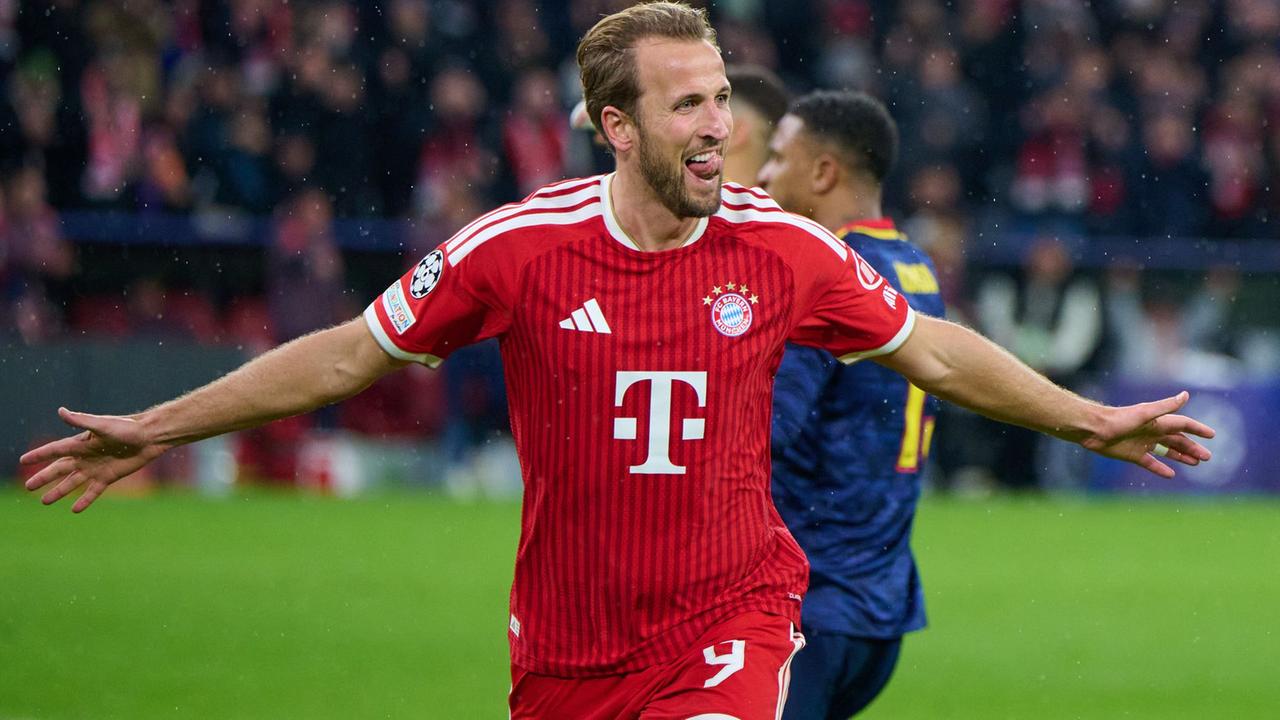
Coach Vincent Kompany, while maintaining his characteristic reserve, acknowledged the unique nature of the performance. "He makes the assist, he earns the penalty, he is everywhere," Kompany stated. "He is making the right decisions at the right time. He understands the rhythm of the game better than anyone else on the pitch."
The Klopp Conundrum: A Clash of Philosophies
Perhaps the most intriguing subplot of the evening was the presence of former Liverpool manager and current Germany head coach, Jürgen Klopp, in the stands. Known for his "Gegenpressing" philosophy, Klopp appeared visibly perplexed by the tactical fluidity of the Bayern side.
"I have not yet fully understood what Bayern is doing against the ball," Klopp remarked in a half-time interview. "At times they are playing a hybrid system, then it is man-to-man, then it is zonal. I am still learning, watching how they adjust."
This confusion highlights the difficulty of defending against a team that utilizes Kane as a "false-ten" and a "true-nine" simultaneously. When asked about Klopp’s comments during the post-match press conference, Vincent Kompany remained dismissive, offering a curt, "Next question."
Kane himself admitted that the tactical complexity was a work in progress. "It wasn’t always clear who we were pressing," the Englishman conceded. "The movement from Arsenal caused us some confusion, and I had to drop deeper than intended to help organize our transition play."
Implications: The Road Ahead for Bayern Munich
The performance against Arsenal serves as a blueprint for the remainder of the season. If Bayern can harness Kane’s dual-threat ability—as both a finisher and a playmaker—they become a significantly harder side to neutralize.
The Contractual Shadow
Despite the brilliance on the pitch, the administrative side of the club remains a point of speculation. Sport Executive Max Eberl faced immediate questions regarding a potential contract extension for Kane. In his usual fashion, Eberl shut down the rumors, stating, "Not today."
However, the analogy to elite American sports persists. Much like NFL superstars such as Patrick Mahomes, who define the success of their franchises through both leadership and elite execution, Kane is the face of this Bayern era. The pressure on the front office to secure his long-term future will only intensify as he continues to produce "geisteskrank" (insane/genius) performances that defy his age.
Final Assessment
As the dust settles on the 2-2 draw, the takeaway is clear: Harry Kane is undergoing a metamorphosis. He is no longer just a goal-scoring machine; he is a tactical weapon capable of controlling the pace of the game from anywhere on the pitch. For opponents, the challenge is no longer just how to stop Kane from shooting, but how to track a man who, at any given moment, might be the most dangerous passer in the stadium.
Bayern Munich may not have walked away with three points, but they confirmed a tactical identity that centers around one of the most versatile forwards to ever grace the game. Whether this evolution leads to European glory remains to be seen, but for now, the footballing world can only watch and admire the man who has turned the role of a striker into a masterclass of orchestration.