In a striking visual campaign that has captured the imagination of the Swiss public, the nation’s most venerable bronze figures underwent an unexpected transformation this past weekend. From the quiet gardens of Bern to the bustling urban centers of Zurich and Basel, iconic historical statues were found adorned with pink baby carriers and plastic dolls, repositioning the country’s most celebrated male historical figures as modern, involved caregivers.
The mastermind behind this clandestine operation is Operation Libero, a prominent liberal political movement known for its unconventional approach to civic discourse. By integrating the mundane realities of modern parenting into the rigid, stoic world of public monuments, the group aimed to force a conversation about the division of labor in the Swiss family unit.
The Morning Surprise: A Chronology of the Intervention
The initiative, which took place in the early hours of Sunday morning, was executed with military-like precision across multiple Swiss cantons.
The Preparation: According to Simon Stüdeli, co-managing director of Operation Libero, the campaign was the result of weeks of planning. The goal was to reach the statues under the cover of darkness to create a "daybreak effect," ensuring that citizens heading to bakeries or morning strolls would encounter the altered reality of their public spaces immediately upon sunrise.
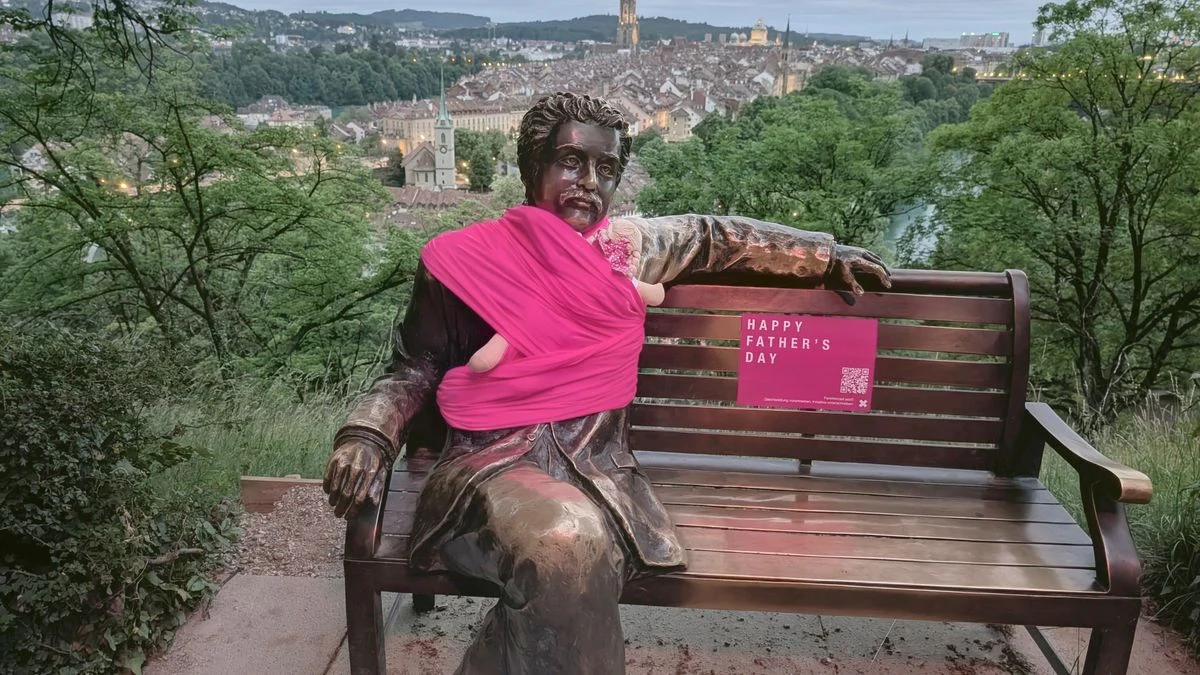
The Execution: Activists mobilized across Bern, Basel, Zurich, and Aarau. In Bern’s picturesque Rosengarten, the statue of Albert Einstein—arguably the city’s most famous former resident—was found seated on his familiar bench, but with a significant addition: a bright pink baby carrier strapped across his chest, complete with a doll representing a child. Similar scenes played out across the country, turning public squares into stages for a social experiment.
The Public Reaction: By Sunday morning, social media platforms were flooded with images of the "Modern Daddies." While some traditionalists expressed concern over the "vandalism" of public art, the overwhelming majority of the response was one of amusement, curiosity, and reflection. By mid-morning, the images had gone viral, forcing the topic of paternal responsibility into the national news cycle.
Supporting Data: The Reality of Swiss Parenting
The visual impact of the Einstein statue serves as a poignant contrast to the current sociological data regarding gender roles in Switzerland. Despite being a highly developed nation, Switzerland continues to struggle with outdated structures regarding childcare and career progression for women.
The Statistics of Inequality
Recent data from the Swiss Federal Statistical Office reveals that while the landscape is shifting, the burden of childcare remains disproportionately weighted toward mothers.
- Part-time work: A significantly higher percentage of Swiss women work part-time compared to their male counterparts, often citing childcare obligations as the primary driver.
- The "Care Gap": Despite the push for equality, men in Switzerland still contribute fewer hours to unpaid care work than women, a trend that activists like Operation Libero are eager to dismantle.
- Economic Impact: The gender pay gap in Switzerland remains a persistent issue, and economists argue that the lack of equitable childcare distribution is a major contributing factor, as it prevents women from pursuing full-time, high-level professional opportunities with the same flexibility as men.
Albert Einstein: From Relativity to Paternity
The choice of Albert Einstein as the face of this campaign is both clever and symbolically heavy. Einstein, who lived in Bern from 1902 to 1909 and developed his theory of special relativity while working at the city’s patent office, represents the pinnacle of intellectual achievement.
By draping the father of modern physics in the domestic regalia of a caregiver, Operation Libero is attempting to challenge the notion that "genius" or "professional success" is mutually exclusive with active, hands-on fatherhood. It is a subversion of the "Great Man" theory of history—suggesting that the next generation of genius is nurtured in the home, not just in the laboratory.
Official Responses and Legal Scrutiny
The legality of the intervention has been a subject of minor debate, though it has not reached the level of a formal legal crisis.
"There is no property damage," Simon Stüdeli stated firmly in an interview with the German press agency dpa. "Our intention was never to harm the monuments, but to spark a dialogue. The materials used were temporary and easily removable, leaving the statues in their original state."
Authorities in Bern and Zurich have generally adopted a "wait and see" approach. Because the statues were not permanently altered, defaced, or damaged, police departments have indicated that no active criminal investigations are currently being pursued. This lenient response suggests a tacit recognition that the protest, while unorthodox, was peaceful and intended as a contribution to the public sphere rather than an act of malice.
The Implications: A Shift in Social Policy
The Operation Libero campaign is not merely a stunt; it is a strategic attempt to influence the legislative agenda. Switzerland is currently navigating several debates regarding family policy, including:
- Paternity Leave Reform: While Switzerland recently introduced a federal paternity leave scheme, advocates argue that it remains significantly shorter than those in neighboring European countries, reinforcing the idea that the father’s role is secondary to the mother’s.
- Childcare Infrastructure: The debate over subsidized, high-quality childcare continues to polarize the Swiss parliament. Supporters of the movement argue that if the government wants to promote economic growth, it must make it as easy for a father to take his child to the doctor as it is for a mother.
- Cultural Norms: Perhaps the most difficult hurdle is the cultural "default" setting. Switzerland remains, in many ways, a conservative society where traditional gender roles are deeply ingrained. By putting pink baby carriers on the most masculine, historical symbols of the nation, the activists are attempting to "normalize" the sight of a father performing care duties.
The Long-Term Goal
The long-term goal of the movement is to move beyond the aesthetic shock of the statues and into a structural re-evaluation of the Swiss workforce. If the "Modern Papi" becomes a standard fixture of the social landscape, the argument follows, the economic and social barriers preventing women from full participation in the workforce will eventually collapse.
Conclusion: The Legacy of the Pink Carriers
As the baby carriers are removed from the bronze shoulders of Switzerland’s historical figures, the resonance of the campaign remains. The images of Einstein, holding a doll, will likely linger in the public consciousness as a symbol of a country in transition.
Operation Libero has succeeded in doing what many political pamphlets fail to do: they have brought the abstract concept of gender equality into the everyday lives of the citizens. Whether this leads to concrete legislative change remains to be seen, but the dialogue has been firmly shifted.
In the heart of Bern, the Rosengarten remains quiet, and the bronze Einstein sits as he always has—contemplative, stoic, and brilliant. But for those who walked past him this weekend, the statue now represents something more than just a man who understood the universe; it represents a man who, in the eyes of a new generation, should also have been capable of understanding the delicate, essential, and demanding work of raising the future. The message is clear: the era of the "absent father" is being challenged, and in Switzerland, the statues themselves are leading the way.