

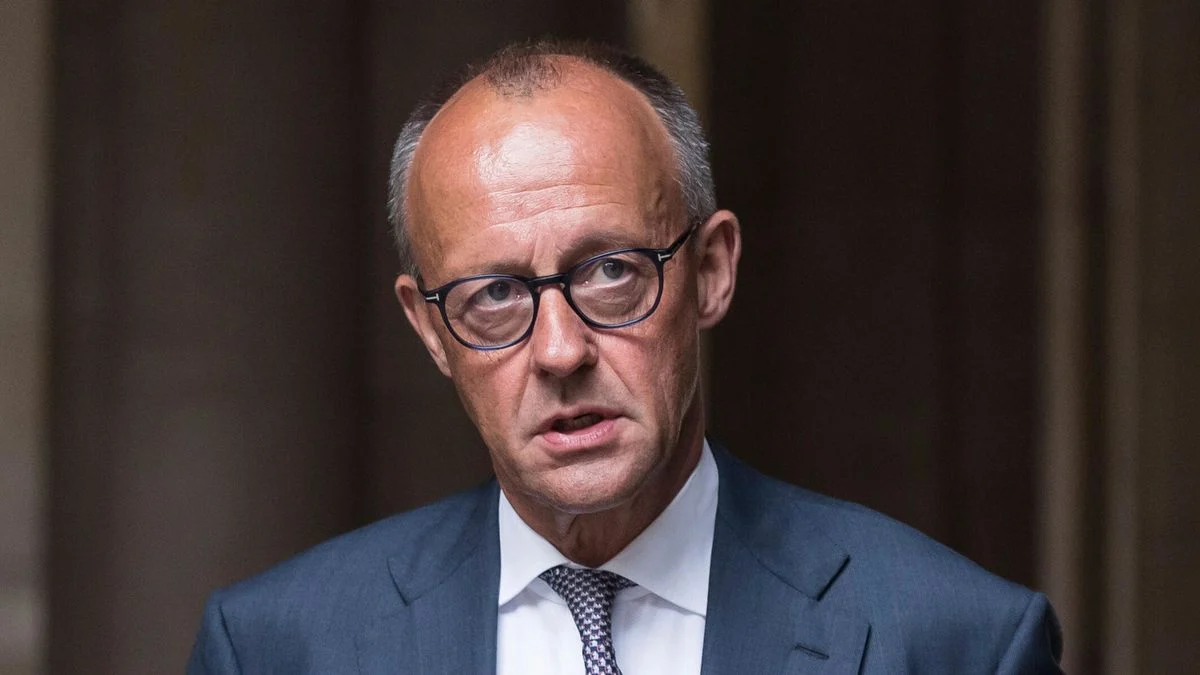
Berlin, Germany – In a significant intervention into regional politics, German Chancellor Friedrich Merz (CDU) has issued an emphatic plea to the Social Democratic Party (SPD) and the Greens in Berlin to refrain from forming a coalition government with Die Linke (The Left Party). Merz’s stern warning, delivered on October 7, 2026, a date laden with profound historical resonance, underscored a deep-seated concern over the potential implications of a left-leaning alliance for Germany’s fundamental values, particularly its unwavering commitment to Israel and the fight against rising antisemitism.
The Chancellor’s remarks come amidst ongoing exploratory talks in the German capital following the Berlin House of Representatives election on September 20, 2026, which saw Die Linke emerge unexpectedly as the strongest party. Merz’s direct appeal highlights the growing tensions between federal political leadership and regional coalition dynamics, raising questions about the boundaries of party autonomy and the integrity of national democratic principles.
Federal Intervention in State Politics
Chancellor Merz’s intervention is far from a routine political statement. As head of the federal government and leader of the Christian Democratic Union, his direct plea to the SPD and Greens in Berlin to reject a potential partnership with Die Linke signals a rare and forceful assertion of federal concern over state-level political formations. While it is common for national party leaders to express preferences, Merz’s language – characterized by its urgency and reference to "unnegotiable principles" – elevates the discussion beyond mere partisan maneuvering.
His admonition was delivered during the high-profile "Deutschland-Gipfel" (Germany Summit) organized by Handelsblatt and WirtschaftsWoche, a platform that grants his words national attention and significance. By choosing this forum, Merz ensured his message resonated across political and economic spheres, amplifying the perceived gravity of the situation. The Chancellor’s stance places considerable pressure on Berlin’s SPD and Green negotiators, who must now navigate both local political realities and the strong admonitions from the federal level.
The Nexus of Berlin’s Future and National Principles
At the heart of Merz’s argument lies a profound concern that a red-green-red coalition (SPD, Greens, Die Linke) in Berlin could undermine core democratic tenets and Germany’s international commitments. The capital, as a symbol of Germany’s democratic rebirth and a vibrant international hub, holds a unique position. The ideological leanings of its government are often viewed as reflective of the nation’s broader political trajectory.
Merz articulated his fears by directly linking the ongoing coalition talks to the solemn remembrance of the October 7th terrorist attack against Israel, stating: "Precisely today, on October 7th, we commemorate the terrible terrorist attack against Israel. We affirm Israel’s right to exist, and that is unshakeable. We stand firm against growing antisemitism in Germany." He then directly questioned the propriety of negotiating "these unnegotiable principles of our community" for a government alliance "right in the middle of our capital" on such a significant day. This rhetorical move powerfully connects Die Linke’s historical and contemporary positions on Israel and foreign policy to the broader national conscience, particularly in a country grappling with its historical responsibility.
A Deep Dive into the Political Landscape and Recent Events
The political landscape of Berlin has been unusually turbulent in recent years, marked by a repeat election in 2023 due to irregularities and a subsequent shift in power dynamics. The election on September 20, 2026, was therefore keenly watched, not just within Berlin but across Germany, as it offered a glimpse into the evolving preferences of a major urban electorate.
Berlin’s Pivotal Election Results: Die Linke’s Ascent
The September 20, 2026 election for the Berlin House of Representatives yielded a surprising outcome, with Die Linke emerging as the strongest political force, securing 25.7% of the vote. This result positions Die Linke in a powerful, albeit controversial, negotiating position, as they now lead the charge in advocating for a red-green-red coalition. While the CDU, SPD, and Greens also collectively hold a majority, Die Linke’s unexpected success has undeniably complicated the post-election landscape.
Historically, Berlin has been a stronghold for left-leaning parties, and Die Linke has participated in various coalitions in the city-state in the past, though rarely as the leading party. Their recent electoral success reflects a complex interplay of factors, including voter dissatisfaction with established parties, concerns over housing, social inequality, and perhaps a desire for more radical policy solutions in a rapidly changing urban environment. The party’s platform typically emphasizes social justice, rent control, public services, and a critical stance on foreign policy, often diverging significantly from mainstream consensus on international relations and security.
The Weight of October 7th: A Day of Remembrance and Political Scrutiny
Chancellor Merz’s decision to deliver his warning on October 7th was highly calculated and deeply symbolic. This date has become etched into the collective memory as the anniversary of the devastating Hamas terrorist attack on Israel in 2023. For Germany, a nation acutely aware of its historical responsibility towards Israel and Jewish life, this date carries immense moral and political weight.

The aftermath of the 2023 attack saw a significant rise in antisemitic incidents across Germany, sparking intense public debate and calls for stronger governmental action. Political parties, including Die Linke, have faced scrutiny over their responses to the conflict and their perceived solidarity (or lack thereof) with Israel. Merz’s invocation of this anniversary directly links Die Linke’s historical and sometimes ambivalent positions on the Israeli-Palestinian conflict, as well as broader issues of antisemitism, to the present-day coalition negotiations. He implicitly suggests that any party wishing to govern in Germany’s capital must unequivocally align with the nation’s fundamental commitment to Israel’s security and the robust fight against all forms of antisemitism.
Exploratory Talks Under Federal Shadow
Following the election, exploratory talks ("Vorsondierungen") commenced between Die Linke, the SPD, and the Greens. These initial discussions are designed to ascertain common ground and identify potential obstacles before formal coalition negotiations can begin. The stated objectives for the third round of these talks, scheduled for the very day of Merz’s statement, focused on critical issues: antisemitism, racism, and organized crime.
This agenda itself underscores the sensitive nature of partnering with Die Linke, a party whose internal debates on these topics have often drawn criticism from centrist and conservative parties. Merz’s federal intervention casts a long shadow over these talks, potentially forcing the SPD and Greens to reconsider the political cost and public perception of aligning with a party that faces such strong federal disapproval on issues deemed "unnegotiable principles." The question now is whether the Berlin parties will prioritize local political feasibility or yield to national moral and political pressure.
The Core of Merz’s Argument: Unwavering Principles and Geopolitical Stance
Chancellor Merz’s impassioned appeal is rooted in what he perceives as fundamental, non-negotiable principles that must guide any governing coalition in Germany, especially in its capital. His arguments are multi-layered, addressing both Germany’s international obligations and its internal democratic consensus.
Commitment to Israel’s Existence and the Fight Against Antisemitism
Merz’s most potent argument is Germany’s "unshakeable" commitment to Israel’s right to exist and the imperative to combat "growing antisemitism in Germany." This commitment is a cornerstone of Germany’s post-Holocaust foreign policy and national identity, transcending partisan politics for most mainstream parties. Merz implicitly questions whether Die Linke fully shares this commitment to a degree compatible with governing the capital.
Die Linke, while formally rejecting antisemitism, has faced criticism for some of its members’ stances on the Israeli-Palestinian conflict, which are often perceived as overly critical of Israel or sympathetic to Palestinian militant groups. The party also grapples with internal factions, some of which are seen as more aligned with a broader anti-imperialist narrative that can, at times, intersect with anti-Zionist sentiments. For Merz, these nuances are unacceptable, particularly in the current global climate and given the rise of antisemitism following recent conflicts. He views any perceived ambiguity or divergence on this issue as a fundamental threat to Germany’s moral compass and international credibility.
Questioning Die Linke’s Compatibility with Democratic Consensus
Beyond the issue of Israel, Merz’s broader concern touches upon Die Linke’s overall compatibility with the "unnegotiable principles of our community" – implicitly referring to the rule of law, democratic values, and perhaps even Germany’s foundational commitment to NATO and the European Union. While Die Linke operates within Germany’s democratic framework, its historical roots in the Party of Democratic Socialism (PDS), the successor to East Germany’s ruling Socialist Unity Party (SED), continue to draw suspicion from conservative quarters. Critics often point to certain aspects of Die Linke’s program – such as calls for Germany’s withdrawal from NATO or its more radical economic policies – as being outside the mainstream democratic consensus.
Merz’s rhetorical question, "Are these unnegotiable principles of our community to be seriously negotiated in parts, to be put at stake for a government alliance right in the middle of our capital?" implies that a coalition with Die Linke could compromise these foundational values. He suggests that the very act of negotiating these issues with Die Linke for the sake of forming a government is a dangerous precedent, potentially eroding the bedrock of Germany’s democratic state.
An Alternative Path: The Call for a Coalition of the Center
As a constructive counter-proposal, Merz highlighted that the CDU, Greens, and SPD together also command a majority in the Berlin House of Representatives. He explicitly appealed to the "political center" to "live up to their responsibility to prevent a Leftist Governing Mayor in our capital with the majority that exists."
This suggestion for a "grand coalition" or "Germany coalition" (black-red-green) serves multiple purposes. Firstly, it offers a politically viable alternative to the red-green-red alliance, demonstrating that there are other pathways to government formation. Secondly, it frames the issue as a matter of "responsibility" for the political center, urging them to prioritize national principles over perceived ideological alignments or the immediate gratification of forming a government with Die Linke. Merz’s "very serious" warning that he "cannot imagine" such a coalition underscores his profound opposition and suggests that the federal government would view a red-green-red alliance in Berlin with extreme disfavor.

Echoes from Across the Political Spectrum: The "Berlin Appeal for Responsibility"
Chancellor Merz’s federal intervention is not an isolated voice. His concerns are amplified by a significant cross-party initiative, the "Berlin Appeal for Responsibility," which had already warned against a coalition with Die Linke days before Merz’s public statement. This appeal lends substantial weight to the arguments against a red-green-red government, demonstrating a broad consensus among established political figures and civil society.
A Unified Voice Against Red-Green-Red
On Tuesday, preceding Merz’s remarks, dozens of prominent individuals from politics and civil society published the "Berlin Appeal for Responsibility." This initiative serves as a powerful testament to the widespread unease regarding Die Linke’s potential entry into Berlin’s government. The appeal explicitly cautions against a red-green-red coalition, articulating concerns that resonate strongly with Merz’s federal-level warnings. The fact that such a diverse group felt compelled to issue a public warning underscores the depth of the apprehension felt across the political spectrum about Die Linke’s suitability as a governing partner in the capital.
Prominent Signatories and Their Concerns
The appeal boasts an impressive list of approximately 80 initial signatories, representing a significant cross-section of German political life. These include highly respected figures from the very parties Die Linke seeks to partner with, as well as from the CDU:
- Wolfgang Thierse (SPD): Former President of the Bundestag, a figure known for his moral authority and experience, particularly concerning Germany’s Eastern history. His signature from within the SPD camp is particularly impactful.
- Joschka Fischer (Greens): Former Vice Chancellor and Foreign Minister, a towering figure in German foreign policy, whose signature signals deep concern from the Green party’s pragmatic, pro-Western wing.
- Peter Altmaier (CDU): Former Chief of Staff of the Chancellery, representing the CDU’s seasoned political leadership.
- Volker Beck: President of the German-Israeli Society and a former Green MP, a tireless advocate against antisemitism. His involvement directly links the appeal to the crucial issue of Israel and Jewish life in Germany.
- Marianne Birthler: Former Federal Commissioner for the Stasi Records, bringing a perspective rooted in the experiences of communist dictatorship and the importance of democratic accountability.
- Martin Hikel: Former SPD state chairman, indicating concern from within Berlin’s own SPD structures.
- Several other former city senators and representatives of the Jewish community further underscore the broad base of support and the specific concerns about antisemitism and democratic values.
The participation of such high-profile figures, many of whom have held significant positions of power and responsibility, signals that the opposition to a red-green-red coalition is not merely partisan but rooted in a profound sense of civic duty and concern for the future direction of Berlin and, by extension, Germany.
The Appeal’s Core Message: Rule of Law and Shared Democratic Values
The "Berlin Appeal for Responsibility" articulates its core message with clarity: "A government majority must be sought that reflects the interests of the broadest possible parts of society and that has common fundamental convictions regarding the rule of law and democracy. We do not see this as given in a red-green-red government."
This statement directly challenges the ideological compatibility of Die Linke with the SPD and Greens on fundamental issues. It suggests that while policy compromises are always part of coalition building, there are certain non-negotiable "fundamental convictions" regarding the rule of law and democracy that must be shared. The appeal implies that Die Linke’s positions, particularly on foreign policy, security, and perhaps even historical memory, deviate too significantly from these shared convictions, making a stable and principled government alliance problematic. The document, published on "berlinerappell.de," thus serves as a powerful call to conscience for the SPD and Greens.
Historical Context and Die Linke’s Position
To fully understand the intensity of the debate surrounding Die Linke, it is crucial to delve into the party’s historical trajectory and its contemporary political positions. Its origins and evolution continue to shape perceptions and criticisms.
The Legacy of the Party of Democratic Socialism (PDS)
Die Linke’s historical baggage is perhaps its most significant challenge. The party emerged from the Party of Democratic Socialism (PDS), which itself was the successor to the Socialist Unity Party of Germany (SED), the ruling communist party of East Germany (GDR). Despite efforts to reform and distance itself from its authoritarian past, this legacy continues to fuel skepticism, particularly among those who experienced life under the GDR regime or whose families suffered under it.
Critics often point to lingering elements within Die Linke that are perceived as downplaying the injustices of the GDR or maintaining an overly critical stance towards Western democracies. While the party has formally acknowledged the wrongs of the GDR and committed to democratic principles, the ghost of the SED remains a potent rhetorical weapon for its opponents, especially in a city like Berlin, which was at the heart of the Cold War division. For many, the idea of a party with such a lineage governing the capital of a reunited Germany is still deeply unsettling.
Die Linke’s Stance on Foreign Policy and Internal Divisions
Beyond its historical origins, Die Linke’s contemporary foreign policy positions are a frequent source of contention. The party generally advocates for a pacifist foreign policy, a critical stance on NATO, and often expresses solidarity with movements that are critical of Western foreign policy. While these positions are legitimate within a democratic discourse, they often clash with the foreign policy consensus of mainstream German parties, particularly regarding NATO membership, military interventions, and Germany’s role in international security.

On the issue of Israel, Die Linke has a complex and often internally divisive history. While condemning antisemitism, some party members and factions have been accused of employing anti-Zionist rhetoric that verges on antisemitism, or of failing to adequately condemn attacks on Israel. These internal debates and perceived ambiguities contribute to the concerns voiced by Chancellor Merz and the signatories of the "Berlin Appeal." For critics, these positions make Die Linke an unsuitable partner for governing, especially when the nation’s capital is expected to project an unambiguous commitment to core democratic and international values.
Responding to Criticisms: Die Linke’s Path Forward in Negotiations
In response to these criticisms and the mounting pressure, Die Linke has consistently asserted its commitment to democratic principles and its fight against antisemitism, racism, and organized crime. The fact that the third round of exploratory talks specifically focused on these issues suggests that Die Linke is acutely aware of the need to address these concerns head-on to gain the trust of potential coalition partners.
Die Linke’s strategy in these negotiations will likely involve emphasizing its concrete policy proposals for Berlin – such as affordable housing, social welfare, and climate protection – which resonate with many voters in the city. They will also likely reiterate their condemnation of antisemitism and racism, framing their approach as one rooted in a broader anti-fascist and anti-discriminatory stance. However, navigating the historical baggage and the more radical elements within its own ranks while simultaneously reassuring the SPD and Greens will be a formidable challenge. The party’s ability to convincingly demonstrate its alignment with Germany’s "unnegotiable principles" will be crucial for its future as a potential governing force.
Official Responses and the Road Ahead for Berlin
The political chess game in Berlin has intensified, with federal pressure now a major factor. The reactions, or lack thereof, from the key players will shape the city’s future government.
The Silence and Anticipation from SPD and Greens
Following Chancellor Merz’s unequivocal statement and the "Berlin Appeal," the SPD and Greens in Berlin find themselves in a delicate position. Publicly, there has been no immediate, direct rebuttal or affirmation from the Berlin leadership of these parties. This silence is likely strategic, as they weigh the implications of Merz’s intervention and the appeal’s broad support.
For the Berlin SPD and Greens, the decision is multi-faceted. On one hand, they have local mandates and are engaged in talks to form a stable government based on the election results. Dismissing Die Linke outright could be seen as ignoring the will of a significant portion of the electorate and might complicate future political alliances. On the other hand, ignoring the federal Chancellor and a broad cross-party appeal on issues of national principle carries significant political risk. It could lead to accusations of being out of touch with national values or even jeopardize federal-state relations, especially if their federal counterparts (in a potential traffic-light coalition) are pressured to distance themselves. The Berlin SPD and Greens will need to articulate a nuanced position that addresses both local political exigencies and the weighty national concerns raised.
Die Linke’s Strategy in the Face of Opposition
Die Linke, as the target of these warnings, faces an uphill battle to legitimize its position as a governing partner. Their strategy will likely involve:
- Reiterating their commitment to fighting antisemitism and racism: They will emphasize their own efforts and programs aimed at combating these issues, perhaps distinguishing their approach from that of other parties.
- Highlighting their electoral mandate: As the strongest party, they will argue that their voters deserve representation in government and that denying them a role would be undemocratic.
- Focusing on policy commonalities: They will continue to emphasize shared policy goals with the SPD and Greens, particularly on social issues, housing, and climate, to build bridges.
- Framing the opposition as politically motivated: They might accuse Merz and the appeal signatories of partisan maneuvering designed to exclude a democratically elected party, rather than genuinely upholding principles.
The ongoing exploratory talks, particularly those focusing on antisemitism and organized crime, will be critical tests of Die Linke’s ability to assuage concerns and demonstrate its alignment with foundational democratic principles.
The Delicate Balance of State Autonomy and Federal Influence
Merz’s intervention also brings to the fore the delicate balance between state autonomy ("Länderhoheit") and federal influence in Germany’s decentralized political system. While states have considerable autonomy in forming their governments, the federal government often exerts moral or political pressure, especially when issues deemed of national importance are at stake.
In this case, the national significance of Berlin as the capital, coupled with the highly sensitive nature of the issues (Israel, antisemitism, democratic values), has empowered Merz to make such a strong statement. His intervention can be seen as an attempt to define the boundaries of acceptable coalition partners within the German democratic framework, even at the state level. The outcome in Berlin will therefore set a precedent for how such federal-state dynamics play out in future coalition negotiations across Germany.

Broader Implications for German Politics
The Berlin coalition debate, ignited by Chancellor Merz’s warning, extends far beyond the city limits, carrying significant implications for Germany’s broader political landscape, its democratic culture, and its international standing.
The Federal-State Dynamic and Coalition Building
Merz’s forceful intervention into Berlin’s state-level coalition talks underscores the intricate federal-state dynamic in German politics. While state governments are largely autonomous, this incident demonstrates that federal leaders are willing to exert significant pressure when they perceive fundamental national principles to be at stake. This could set a precedent, potentially leading to increased federal oversight or commentary on state-level coalition formations, especially in politically sensitive regions or when ideologically extreme parties are involved.
Furthermore, the Berlin situation could influence coalition building at the federal level in the future. If the SPD and Greens in Berlin decide to ignore Merz’s warnings and form a red-green-red coalition, it could strain relations with the CDU and potentially impact future cooperation in other contexts. Conversely, if they heed the warnings, it could strengthen the hand of the CDU in advocating for broader "center-left" or "center-right" alliances across the country, potentially isolating Die Linke further.
Reshaping the Political Discourse on Acceptable Partners
The debate is fundamentally reshaping the discourse on what constitutes an "acceptable" coalition partner in Germany. For decades, the CDU has largely maintained a "firewall" against Die Linke, particularly due to its SED legacy and foreign policy stances. While the SPD and Greens have been more open to cooperation at the state level, Merz’s intervention, coupled with the cross-party "Berlin Appeal," seeks to reinforce and perhaps even broaden this firewall.
The discussion centers on the idea of a "democratic consensus" and whether all parties operating within the democratic system are equally legitimate partners for government. Critics of Die Linke argue that certain ideological positions – especially regarding Israel, NATO, and the historical assessment of the GDR – place the party outside this consensus for governing partnerships, even if they are democratically elected. This debate is crucial for defining the boundaries of the political mainstream in Germany and the conditions under which parties are deemed fit to govern.
The Enduring Significance of Antisemitism in German Political Debate
Perhaps the most profound implication of this debate is the reaffirmation of antisemitism as a paramount issue in German political discourse. Merz’s deliberate invocation of October 7th and his emphasis on Israel’s right to exist underscore that for Germany, the fight against antisemitism is not merely a policy plank but a foundational pillar of its post-war identity. Any perceived ambiguity or ideological alignment that could be construed as weakening this commitment becomes a major political liability.
The rising antisemitism in Germany, particularly in the wake of recent international events, has made this issue even more acute. The Berlin debate serves as a stark reminder that political parties are held to an exceptionally high standard on this front, and any governing coalition must demonstrate an unequivocal and robust stance against all forms of antisemitism. The outcome in Berlin will send a powerful signal about how seriously German political parties collectively uphold this fundamental national responsibility.
Conclusion: Berlin’s Future at a Crossroads
The ongoing political machinations in Berlin are far more than a local power struggle. They represent a critical juncture for German politics, touching upon core national values, the delicate balance of federal-state relations, and the evolving landscape of coalition politics. Chancellor Friedrich Merz’s forceful warning, amplified by a broad-based appeal from prominent figures across the political spectrum, has cast a long shadow over the exploratory talks between Die Linke, the SPD, and the Greens.
The central question remains whether the Berlin SPD and Greens will prioritize local political expediency and the mandate of Die Linke as the strongest party, or yield to the powerful federal and cross-party pressure to uphold what are deemed "unnegotiable principles" of German democracy and its commitment to Israel. The decision made in the coming weeks will not only determine the future governance of Germany’s capital but will also send a profound message about the boundaries of political cooperation, the enduring significance of historical memory, and the nation’s unwavering stance against antisemitism in a complex and challenging global environment. Berlin stands at a crossroads, and its chosen path will resonate far beyond its city limits.




















