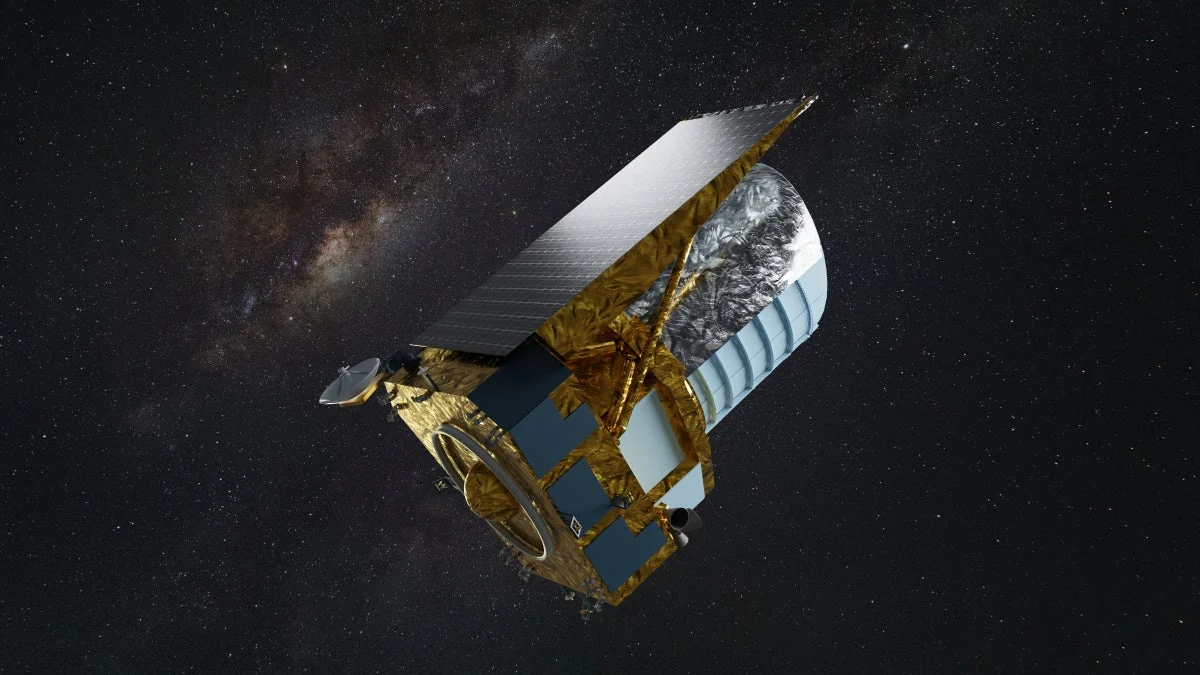
While the primary mission of the European Space Agency’s (ESA) Euclid space telescope is to map the dark side of the universe—specifically dark matter and dark energy—the sophisticated observatory has proven it has an eye for the unexpected. In a remarkable demonstration of how specialized software can transform raw astronomical data, Euclid has identified a previously unknown comet, marking a significant milestone in "serendipitous" space science.
The Mission: A 3D Map of the Cosmos
To understand the significance of this discovery, one must first appreciate the scale of Euclid’s mandate. Launched in July 2023, Euclid was engineered to create a high-resolution, three-dimensional map of the cosmos by observing billions of galaxies across more than a third of the sky. By analyzing the shapes and distribution of these galaxies, cosmologists hope to decipher the influence of "Dark Energy"—the mysterious force accelerating the expansion of the universe—and "Dark Matter," the invisible scaffolding that holds galaxies together.
Since its deployment, Euclid has been delivering data at an unprecedented rate. Earlier in 2026, the mission made headlines by releasing a stunning mosaic of the Milky Way’s center, capturing over 60 million individual stars in breathtaking detail. Yet, even with such a massive scientific focus, the telescope’s sensitive sensors are capable of recording objects much closer to home.
The Mechanism of Discovery: The "Step-and-Stare" Challenge
The discovery of the comet, officially designated C/2026 S1 (Euclid), was not a result of manual observation, but rather the ingenuity of modern data science.
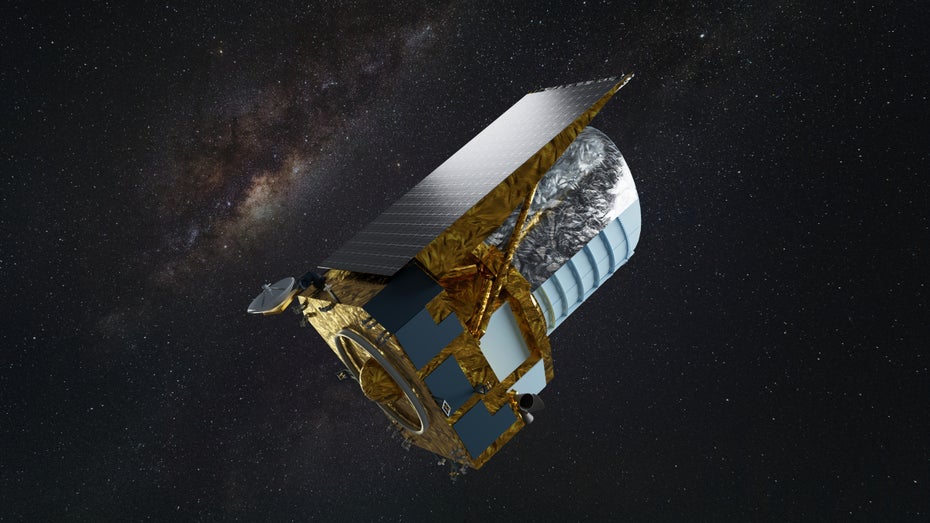
Euclid operates using a "step-and-stare" method. The telescope locks onto a specific patch of the sky for an extended period to allow for long-exposure imaging, then pivots to the next section. Because the mission is designed to capture static celestial objects—galaxies and stars located millions or billions of light-years away—it is not optimized to track objects within our own solar system.
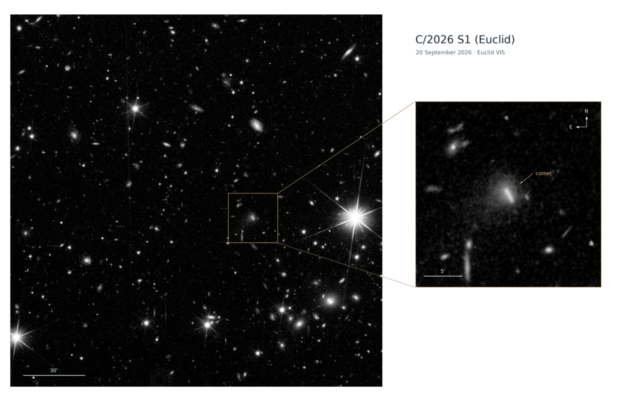
When a comet passes through the field of view, it doesn’t appear as a sharp point of light. Instead, because of the telescope’s long exposure times and the comet’s rapid relative movement, it manifests as a blurred, streaky trail of light. To a standard galaxy-mapping algorithm, these streaks are often dismissed as noise or artifacts to be filtered out.
The Software Breakthrough: Identifying the "Blurred Streaks"
The success of this detection lies in the work of Mikko Pöntinen from the University of Helsinki. Recognizing that Euclid’s massive data stream was a goldmine for solar system objects, Pöntinen developed a specialized algorithm designed specifically to flag "moving" artifacts in the telescope’s imagery.
"I was thrilled when my software marked a smeared strip across multiple images—the result of a fast-moving object," Pöntinen explained in an official ESA statement. By calculating the potential trajectory of the object based on its movement in initial frames, the research team was able to cross-reference the data and identify the object across five separate image sets. This confirms the power of "data mining" in large-scale space missions: turning potential waste data into a new scientific discovery.

Chronology of the Comet C/2026 S1 (Euclid)
The identification process for the new comet unfolded rapidly once the algorithms were deployed:
- September 2026: The software flags an anomalous, "smeared" streak in a series of deep-space images captured by Euclid.
- Verification: Researchers at the University of Helsinki and the ESA team cross-reference the data with multiple image sets to confirm the object is not a sensor glitch or cosmic ray hit.
- Orbital Mapping: Preliminary calculations determine the object is approximately 1.3 billion kilometers from Earth.
- Designation: The International Astronomical Union confirms the discovery, assigning the name C/2026 S1 (Euclid).
- Trajectory Analysis: Astronomers realize the comet is on a highly inclined orbit, meaning it travels "above" the ecliptic plane where most planets reside.
Supporting Data: Understanding the Comet’s Path
The comet C/2026 S1 (Euclid) is currently situated in the frigid outer reaches of our solar system, roughly 1.3 billion kilometers from Earth. Unlike the planets, which orbit the sun on a relatively flat plane, this comet’s orbit is steeply inclined. This suggests a long-period orbit, meaning the comet likely spends thousands of years completing a single journey around the sun.
Because it is located so far away, it is currently faint, yet the ability of Euclid to spot it at this distance underscores the sensitivity of its VIS (Visible Instrument) and NISP (Near-Infrared Spectrometer and Photometer) sensors.
Official Perspectives and Scientific Implications
The discovery is being hailed by the European Space Agency as a "proof of concept" for future multi-mission collaborations. ESA officials have noted that the techniques used to identify C/2026 S1 will be integrated into the data-processing pipelines for Euclid’s entire mission duration.
A Testbed for the "Comet Interceptor"
Perhaps the most exciting implication of this discovery relates to the upcoming "Comet Interceptor" mission. The Comet Interceptor is designed to be the first mission to visit a "long-period" comet or an interstellar object—essentially a primitive relic of the early solar system.
To succeed, the Comet Interceptor needs a target that is identified as early as possible. Euclid, by acting as a wide-field, high-sensitivity sentinel, could become the primary "scout" for such missions. If Euclid can detect these objects while they are still billions of kilometers away, it provides mission controllers with the lead time necessary to plan a close-range interception.
The Future of "Serendipitous Science"
This incident serves as a poignant reminder that modern space exploration is as much about computation as it is about hardware. As telescopes grow more powerful, the bottleneck shifts from data collection to data interpretation. By applying specialized algorithms to the "leftover" data from flagship missions, astronomers are effectively doubling the scientific return of taxpayer-funded projects.
"This is not just about finding a comet," one project researcher noted. "It is about teaching our machines to see the universe in the same way we do—by recognizing that what looks like a mistake might actually be a new world waiting to be explored."
As Euclid continues its five-year mission to map the dark universe, the scientific community now watches with bated breath—not only for the maps of dark energy, but for the next "accidental" visitor that the telescope might snag in its high-resolution gaze. The universe, it seems, is far more crowded than we once thought, and our tools are finally becoming sharp enough to see the hidden objects moving through the dark.