

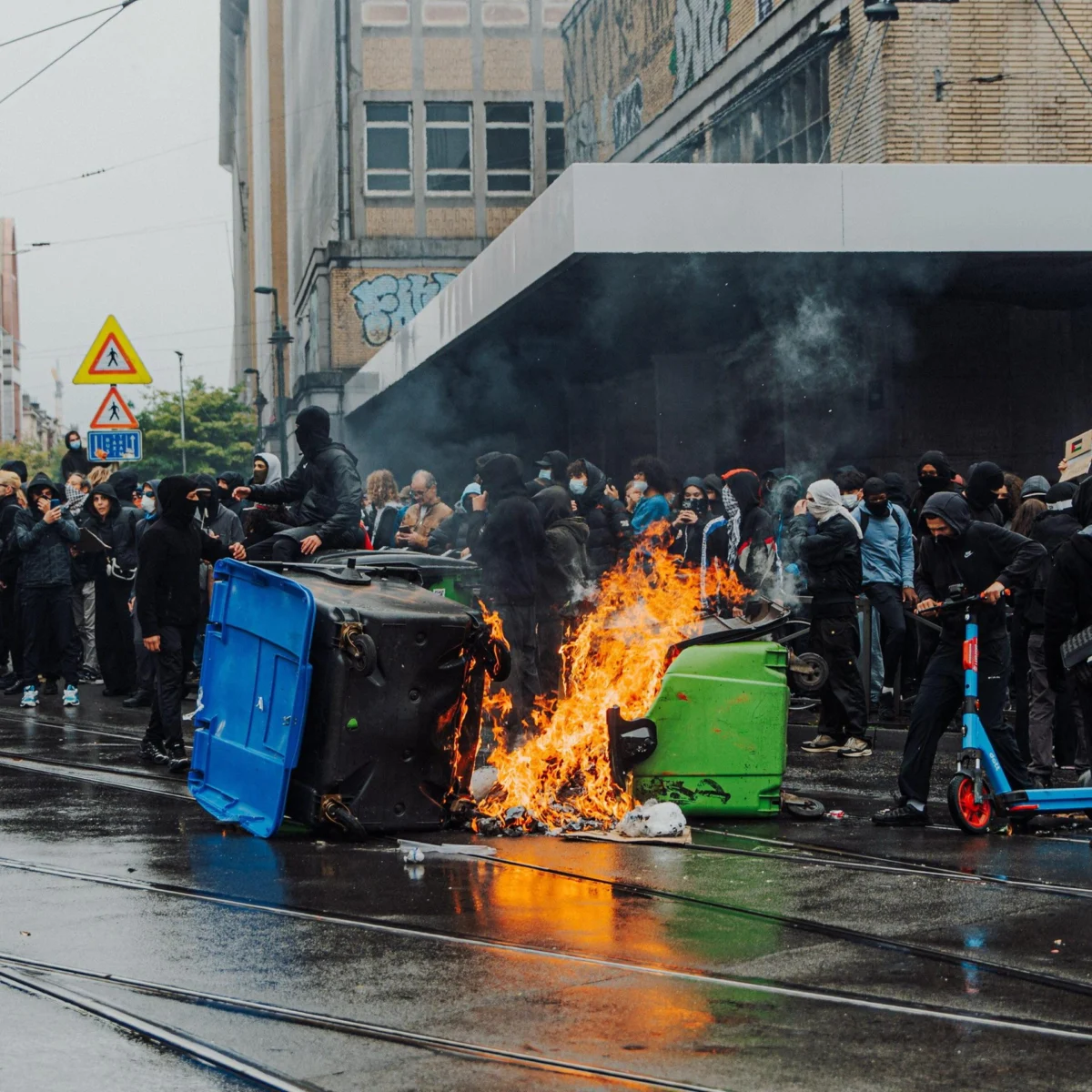
Brussels, Belgium – October 9, 2026 – A nationwide general strike and a massive demonstration in Brussels today brought Belgium to a standstill, as more than 30,000 citizens took to the streets to voice their vehement opposition to the government’s proposed budget reforms. While the vast majority of the protest remained peaceful, the day concluded with scenes of significant unrest, as clashes erupted between hundreds of youths and riot police, underscoring deep-seated societal anxieties over austerity measures.
The planned reforms, aimed at shoring up the nation’s finances, have ignited widespread fear among the populace, particularly regarding potential cuts to pensions and vital social benefits. Belgium’s powerful trade unions, instrumental in organizing both the strike and the demonstration, have vowed to resist any measures they believe will disproportionately burden ordinary citizens and erode the country’s social safety net.
The day’s events highlight a growing chasm between the government’s fiscal imperatives and the public’s demand for social protection, set against a backdrop of increasing economic uncertainty and a perceived erosion of living standards. The violent periphery of an otherwise orderly protest serves as a stark reminder of the volatile potential within contemporary European societies facing similar economic pressures.
Main Facts
Escalation in Brussels: A Day of Mass Protest and Unrest
October 9, 2026, marked a critical juncture in Belgium’s ongoing debate over fiscal policy, as the capital city of Brussels became the epicentre of a monumental display of public discontent. Over 30,000 individuals, representing a broad spectrum of Belgian society – from retirees and public sector workers to students and families – converged to participate in a demonstration against the federal government’s contentious budget reforms. This mass mobilization was coupled with a general strike, orchestrated by the country’s influential trade union confederations, which severely impacted public services, transportation, and various sectors of the economy across the nation.
The primary objective of the protestors and striking workers was to exert maximum pressure on the government to abandon or significantly revise its austerity package. The core grievances articulated by the demonstrators revolved around profound anxieties concerning the potential for substantial reductions in crucial social provisions. Foremost among these fears were the prospective cuts to state pensions, which many view as a fundamental right and a cornerstone of social security, alongside anticipated curtailment of other essential social benefits, including healthcare subsidies, unemployment support, and family allowances. Union leaders repeatedly warned that such measures would disproportionately affect vulnerable populations, exacerbate social inequality, and undermine the quality of life for millions of Belgians.
The day in Brussels presented a duality: a largely orderly and spirited demonstration that showcased the organized power of the union movement and the collective will of its participants, juxtaposed with sporadic but intense outbreaks of violence on its fringes. As the main procession wound down in the late afternoon, a segment of the crowd, identified predominantly as younger individuals, engaged in direct confrontation with law enforcement. This confrontation involved the throwing of various projectiles, including glass bottles and pyrotechnic devices, at police lines. In response, authorities deployed water cannons and tear gas to disperse the agitators, leading to several arrests and a palpable sense of tension permeating the city center. This unfortunate turn of events, while limited to a minority of participants, cast a shadow over the otherwise peaceful expression of democratic dissent.
A Day in Chronology: From Peaceful March to Confrontation
The events of October 9, 2026, unfolded in a predictable yet ultimately volatile sequence, illustrating the trajectory from organized civil action to an eruption of street-level conflict.
Morning: Gathering and Initial Mobilization
As dawn broke over Brussels, the city began to stir with an unusual energy. From early morning, thousands of individuals started converging at designated assembly points across the capital, notably around the Gare du Nord and other strategic locations. Union representatives, distinguishable by their coloured vests (red for FGTB/ABVV, green for CSC/ACV, blue for CGSLB/ACLVB), directed the streams of protestors. The atmosphere, initially chilly, was quickly warmed by the collective spirit. Banners unfurled, bearing slogans in both French and Dutch such as "Pas touche à nos pensions!" (Don’t touch our pensions!), "Geen besparingen op kap van de sociale zekerheid!" (No cuts at the expense of social security!), and "Leve de Sociale Zekerheid!" (Long live social security!). Whistles, vuvuzelas, and drums created a cacophony that, while loud, was largely celebratory and determined.
The sheer scale of the mobilization was immediately apparent. Buses, trains, and carpools from all corners of Belgium disgorged their passengers, testament to the unions’ extensive organizational capacity and the widespread public concern. Families with children, elderly citizens, and young professionals marched alongside seasoned activists, highlighting the broad demographic impact of the proposed reforms. The air was thick with anticipation, a mix of solidarity and apprehension about the government’s unyielding stance.
Midday: The March Through Brussels
By late morning, the various contingents had consolidated into a massive river of humanity, beginning its march through the heart of Brussels. The chosen route often strategically encompassed key governmental and European institutions, symbolically bringing the people’s message directly to the centres of power. The procession moved past the Royal Palace, through the city centre’s main boulevards, and towards the European Quarter, where many of Belgium’s fiscal decisions are influenced by broader EU economic directives.
Throughout the march, the core demands were articulated with unwavering clarity. Speakers, including prominent union leaders such as Miranda De Clercq (FGTB) and Philippe Dubois (CSC), addressed the crowds at various intervals. Their speeches resonated with themes of social justice, historical struggle, and the defence of the Belgian social model, warning that austerity measures threatened to dismantle decades of hard-won social protections. They called for alternative solutions, such as increased taxation on corporate profits and high earners, and a more robust fight against tax evasion, rather than cuts to the public purse. The mood remained overwhelmingly peaceful, with marshals working diligently to ensure order and prevent any deviations from the planned route. The vast majority of participants were engaged in chanting, carrying placards, and expressing their democratic right to protest without incident.
Afternoon: The Shift to Confrontation
As the main demonstration began to disperse in the mid-afternoon, particularly in the vicinity of the Parc de Bruxelles and Rue Royale, a distinct change in atmosphere became evident. A smaller, more agitated group, estimated to be in the low hundreds and composed primarily of younger individuals, began to separate from the main body of protestors. These individuals, many dressed in dark clothing and with faces partially obscured, showed clear signs of a different agenda. They began to converge on specific points, particularly intersections and areas closer to police cordons established around government buildings.
The initial provocations quickly escalated into open conflict. Projectiles, including glass bottles, cobblestones, and flares, were hurled towards police lines. Makeshift barricades, constructed from overturned bins and street furniture, briefly appeared in some side streets. The sounds of breaking glass and exploding pyrotechnics replaced the earlier chants. Riot police, who had maintained a visible but largely passive presence throughout the peaceful march, were forced to respond decisively. Water cannons were deployed, unleashing powerful jets of water to push back the aggressive elements, followed by volleys of tear gas canisters, which quickly filled the air with a stinging, choking haze.
The clashes were intense but relatively localized, confined to the fringes of the protest area. Several individuals were seen being apprehended by police officers, while others received minor injuries from the projectiles or the effects of tear gas. The abrupt shift from a mass, peaceful demonstration to pockets of violent confrontation underscored the volatile undercurrents present within such large-scale mobilizations, where legitimate grievances can sometimes be co-opted or overshadowed by destructive elements.
Supporting Data and Broader Context
The Economic Landscape: Belgium’s Austerity Imperative
Belgium’s government finds itself in a precarious economic position, prompting the current push for stringent budget reforms. Like many European nations, Belgium faces significant fiscal challenges exacerbated by a confluence of factors. The national debt, a persistent concern, has been amplified by the economic fallout from the COVID-19 pandemic, which necessitated massive public spending on healthcare, social support, and economic recovery packages. Furthermore, the ongoing energy crisis, triggered by geopolitical events, has led to soaring inflation, impacting household budgets and increasing the cost of public services.
The European Union’s revised fiscal rules, which encourage member states to reduce their debt-to-GDP ratios and budget deficits, exert considerable external pressure on Brussels. Belgium’s debt-to-GDP ratio currently hovers around 105-108%, significantly above the EU’s nominal 60% target, while its annual deficit also remains a concern. The government argues that without substantial structural reforms, the country risks facing sanctions and jeopardizing its long-term economic stability.
The proposed reforms primarily target public expenditure. Key areas under scrutiny include the pension system, where an aging population places increasing strain on state finances. Potential measures range from raising the official retirement age, revising pension calculation methods, to indexing pensions differently against inflation. Cuts to social benefits could encompass stricter eligibility criteria for unemployment benefits, reduced family allowances, and rationalization of healthcare expenditures. The government also eyes potential reforms in the public sector, including wage freezes or reductions in staffing levels, and a re-evaluation of various subsidies. These proposals, while deemed necessary by fiscal conservatives, are precisely what have ignited the fierce public backlash.
The Role of Trade Unions and Civil Society
Belgium boasts a deeply entrenched and historically powerful trade union movement, often referred to as the "social partners," playing a crucial role in the country’s socio-economic fabric. The three main confederations – the General Federation of Belgian Labour (FGTB/ABVV), the Confederation of Christian Trade Unions (CSC/ACV), and the General Liberal Trade Union of Belgium (CGSLB/ACLVB) – collectively represent a significant portion of the workforce and wield considerable influence in national policy-making.
For decades, these unions have been central to negotiating collective labour agreements, safeguarding workers’ rights, and defending the welfare state. Their decision to call a general strike and a national demonstration is not taken lightly; it represents a maximalist form of pressure, reserved for issues they deem fundamental to the well-being of their members and society at large. In this instance, the unions argue that the government’s austerity plans are ideologically driven and economically short-sighted. They propose alternative fiscal strategies, such as strengthening progressive taxation, increasing the tax on capital gains, combating corporate tax avoidance more rigorously, and investing in public services and green technologies to stimulate sustainable growth rather than cutting benefits.
The general strike had a profound impact. Public transport, including buses, trams, and trains, was severely disrupted or halted entirely. Many schools, hospitals (though emergency services were maintained), and government offices operated with minimal staff or closed. Industrial sectors, from ports to manufacturing plants, experienced significant slowdowns or complete shutdowns. The aim was to demonstrate the indispensable role of the workforce and the potential paralysis that could result if their demands are ignored.
A Pattern of Discontent: Pre-existing Social Tensions
The unrest witnessed on October 9th is not an isolated incident but rather indicative of deeper, pre-existing social tensions bubbling beneath the surface of Belgian society. The official news report briefly mentioned "prior riots in parts of Belgium during student protests against poor learning conditions." This earlier unrest, which occurred in the months leading up to the general strike, signals a growing disillusionment among youth. Students had protested against underfunding of education, overcrowded classrooms, dilapidated infrastructure, and a perceived decline in the quality of public universities and schools. These protests, too, occasionally devolved into clashes with police, particularly in urban centres like Liège and Antwerp.
This youth discontent can be linked to broader anxieties about future opportunities, a struggling job market for graduates, and a sense that their generation will bear the brunt of economic challenges without adequate social support. The confluence of student protests and the broader general strike against austerity measures suggests a collective societal concern about the trajectory of public services and the welfare state. Furthermore, while the article focuses on economic grievances, Belgium is also a nation with complex linguistic and regional dynamics, and socio-economic policies can sometimes exacerbate or intersect with these existing cleavages, although the current protests appear to be nationally unified around fiscal policy. The perception of declining public services, whether in education or social welfare, contributes to a general atmosphere of frustration and can lower the threshold for confrontational forms of protest.
Official Responses and Political Repercussions
Government’s Stance: Balancing Fiscal Responsibility and Social Cohesion
In the immediate aftermath of the protests and clashes, the Belgian federal government found itself in a challenging position, caught between its commitment to fiscal consolidation and the imperative to maintain social cohesion. Prime Minister Alexander De Croo, speaking from his official residence, expressed regret over the violence that marred the end of the demonstration, stating, "While the right to protest is fundamental in our democracy, violence and destruction are absolutely unacceptable and will not be tolerated." He acknowledged the legitimate concerns of the protestors but firmly defended the proposed budget reforms as "necessary, responsible, and unavoidable" for Belgium’s long-term economic health.
The Prime Minister emphasized that the government was acting out of a sense of duty to future generations, stressing the need to control public debt and ensure the sustainability of social services in the face of an aging population and international economic pressures. Finance Minister Vincent Van Peteghem echoed these sentiments, highlighting the "rigorous analysis" that underpinned the reform proposals and reiterating the government’s openness to dialogue, but within the framework of fiscal prudence. He suggested that alternatives proposed by unions often lacked concrete financial viability. The government’s message was clear: while it lamented the unrest, it remained steadfast in its core objectives, framing the reforms as a bitter but essential medicine for the nation.
Opposition and Union Rebuttals
Union leaders, however, swiftly rejected the government’s narrative. Miranda De Clercq of the FGTB, while condemning the violence, redirected blame towards the government’s "intransigence and deafness to the legitimate concerns of the working people." She argued that the government’s insistence on austerity without exploring alternative revenue streams was provoking social unrest. "They speak of responsibility," she declared, "but what about their responsibility to protect our citizens from poverty and precarity? Our proposals for fair taxation are met with silence, while our pensions are threatened."
Philippe Dubois of the CSC reinforced this sentiment, stating that the general strike was a "clear and unequivocal message" that the population would not accept a dismantling of the social safety net. He called for genuine negotiation rather than a unilateral imposition of reforms. Opposition political parties, particularly those on the left, seized on the opportunity to criticize the ruling coalition. Paul Magnette, leader of the Socialist Party (PS), accused the government of "driving a wedge through society" and neglecting the social impact of its policies. He called for a parliamentary debate on alternative budget proposals and a re-evaluation of the government’s approach to social dialogue. The political rhetoric sharpened considerably, indicating a period of heightened confrontation between the government and its social and political adversaries.
Police and Judicial Responses
The Brussels police force issued an official statement outlining their response to the clashes. They reported several officers sustained minor injuries from projectiles and confirmed the arrest of over a dozen individuals during the afternoon’s unrest. Charges were expected to range from public disturbance and property damage to assault on law enforcement officers. Police spokesperson Annelies Verheyen reiterated that the police had acted "proportionately and decisively" to restore public order, emphasizing the use of water cannons and tear gas only after other methods of de-escalation had failed and officers were under direct attack.
Judicial authorities confirmed that investigations into the incidents were underway, with those arrested facing potential prosecution. The swift judicial response aimed to send a clear message that violent acts would not be tolerated, irrespective of the broader context of protest. However, human rights organizations and some civil liberties advocates called for transparency regarding the arrests and the use of force by police, ensuring that due process was followed and that the vast majority of peaceful protestors were not unfairly targeted. The legal ramifications for those involved in the violence will be closely watched as the broader political debate continues.
Implications for Belgium and Beyond
Short-Term Impact: Economic Disruption and Political Pressure
The immediate aftermath of the general strike and protests will undoubtedly see a period of significant economic disruption. The widespread cessation of work across key sectors means lost productivity, delays in supply chains, and a direct financial cost to the Belgian economy. While difficult to quantify precisely, such national strikes typically result in millions of euros in lost output. Public transport will take time to fully normalize, and businesses affected by closures or reduced custom will feel the pinch.
Politically, the government faces intensified pressure. The sheer scale of the protest, coupled with the symbolic weight of a general strike, makes it difficult for the ruling coalition to simply dismiss the public’s concerns. While they have reaffirmed their commitment to the reforms, the possibility of significant modifications or concessions, particularly in areas like pension reform or specific social benefit cuts, cannot be entirely ruled out. The coming weeks are likely to be characterized by heightened political manoeuvring, intense backroom negotiations between government and union representatives, and potentially further protest actions if no common ground is found. The government’s capacity to maintain unity within its multi-party coalition will also be tested, as different parties may have varying degrees of tolerance for public dissent and austerity measures.
Long-Term Outlook: The Future of Belgium’s Social Model
The events of October 9, 2026, represent more than just a momentary outburst; they signify a crucial juncture for the future of Belgium’s cherished social model. The fundamental challenge confronting the nation is how to reconcile the demands of a comprehensive welfare state with the realities of fiscal sustainability in the 21st century. This tension is not unique to Belgium, mirroring debates in other European countries grappling with aging populations, global economic competition, and the legacy of increased public spending.
The ongoing struggle will test the resilience of Belgium’s traditional tripartite social dialogue, where government, employers, and unions typically negotiate major policy changes. If the government proceeds with reforms perceived as draconian by the unions, it risks permanently eroding public trust in institutions and creating a more confrontational political landscape. Conversely, if the government falters in its fiscal consolidation efforts, it could face a loss of credibility on international markets and potentially more severe economic consequences down the line.
The incidents of violence, though confined to a minority, also pose a long-term risk. They threaten to overshadow the legitimate grievances of the peaceful protestors and could be used by some to discredit the entire movement. There is a delicate balance to be struck between upholding democratic rights to protest and maintaining public order. The challenge for Belgium, therefore, is not just to balance its books, but to do so in a way that preserves social cohesion, fosters a sense of fairness, and avoids the deeper societal fragmentation witnessed in other European nations that have undergone similar periods of severe austerity. The path forward for Belgium will undoubtedly shape its social contract for decades to come.
















