The Allianz Arena played host to a captivating tactical battle on Wednesday night as FC Bayern Munich and Arsenal FC fought to a pulsating 2-2 draw. In a match defined by high-intensity transitions, moments of individual brilliance, and tactical adjustments from the bench, both European giants proved they are among the continent’s elite, even if the result leaves both sides with lingering questions about their defensive vulnerabilities.
The stalemate at the Allianz leaves Bayern Munich in a precarious position within the expanded Champions League table. With five points from their opening three fixtures, the Bavarian giants find themselves in the mid-table pack, far from the automatic qualification spots they crave. For Arsenal, the point represents a hard-earned success, keeping them well-positioned with seven points and cementing their reputation as a formidable force on the road.
The Tactical Context and Lineup Surprises
The narrative leading up to this showdown was dominated by personnel concerns. Vincent Kompany, returning to the touchline after a personal bereavement, faced the daunting task of navigating the match without the influential Joshua Kimmich and the suspended creative spark, Michael Olise. These absences necessitated a reshuffling of the pack.
Kompany opted for Tom Bischof in midfield, tasking him with the unenviable job of dictating tempo against Arsenal’s high-pressing engine. Serge Gnabry was drafted into the starting XI to provide width, while the return of Manuel Neuer in goal provided a much-needed boost to the backline’s confidence. Conversely, Mikel Arteta’s Arsenal arrived with a clear game plan: control the space, utilize the flanks, and isolate the Bayern fullbacks.
Chronology of a High-Octane Encounter
A Shaky Start and the Saka Setback
The match began with a sobering moment for the visitors. Bukayo Saka, Arsenal’s talisman, collapsed without contact in the opening minutes. The grimace on his face was immediate, signaling a muscular injury that forced Arteta to turn to Eberechi Eze much earlier than anticipated.
Initially, the disruption favored Arsenal. The "Gunners" dictated play with nearly 70% possession in the opening quarter, systematically probing the Bayern defense. Josip Stanisic, deployed as an inverted fullback, found himself under constant pressure as Arsenal’s right-side overload sought to bypass the German press.
The Breakthrough and the Counter-Punch
The deadlock was broken in the 25th minute through a moment of pure quality from the Arsenal captain, Martin Ødegaard. From the center circle, he delivered a perfectly weighted diagonal ball that exploited the space behind Stanisic. Eberechi Eze, finding himself in acres of space, controlled the ball expertly and fired a clinical strike into the bottom corner, leaving Manuel Neuer helpless.
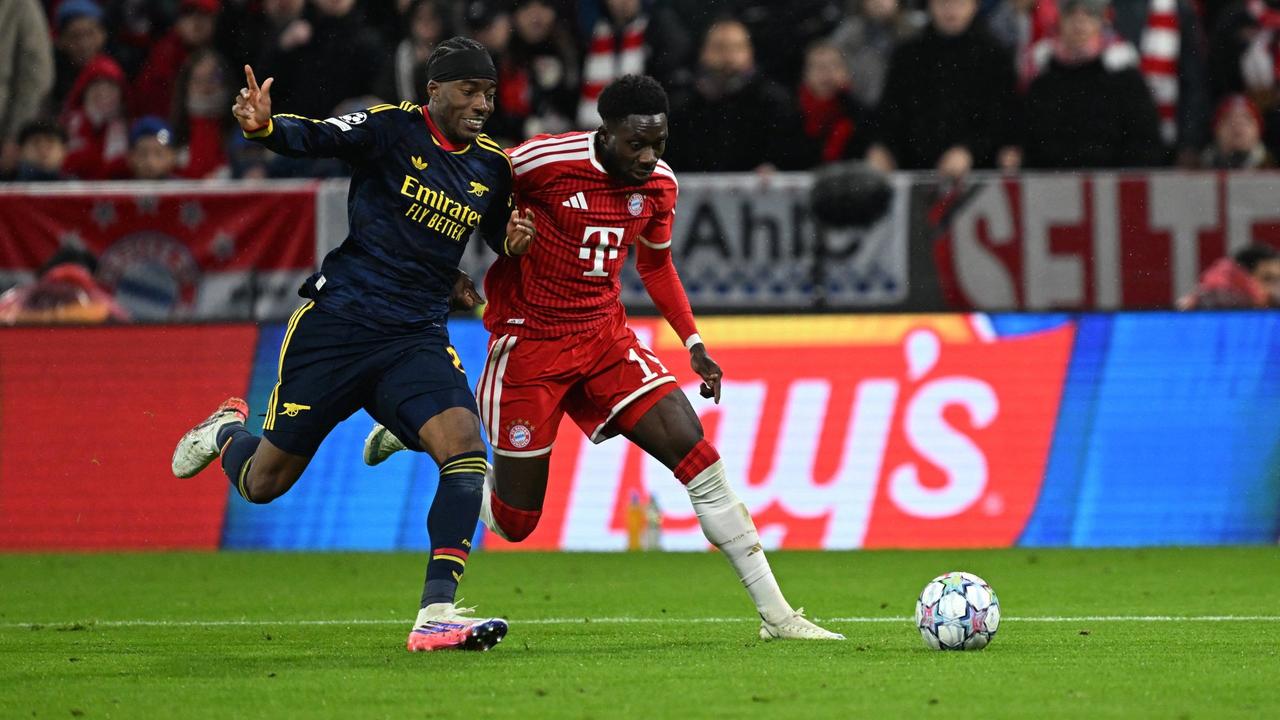
However, the nature of this contest was defined by its volatility. Bayern, stung by the goal, abandoned their cautious approach. In the 35th minute, Harry Kane mirrored Ødegaard’s vision. His exquisite, low-driven pass cut through the Arsenal midfield, finding Alphonso Davies on the left flank. The Canadian international showcased his blistering pace, outstripping his marker and coolly slotting the ball past David Raya to restore parity.
A Second-Half Fireworks Display
If the first half was a chess match, the second was an all-out assault on the senses. Within five minutes of the restart, the match transformed into a back-and-forth thriller. Manuel Neuer made a miraculous reflex save to deny a Bruno Guimaraes header, while at the other end, David Raya produced a stunning flying stop to thwart a thunderous Dayot Upamecanos header.
The decisive moment for Bayern came in the 61st minute. Jurrien Timber, in an attempt to block a strike from Kane, handled the ball inside the penalty area. Referee Davide Massa pointed to the spot without hesitation. Harry Kane, reliable as ever, stepped up and buried the penalty into the bottom left corner. It was a goal that reflected Bayern’s improved tenacity and focus following the interval.
The Rice Resurgence
As the game entered the final ten minutes, the energy levels in the stadium reached a fever pitch. Arteta threw on Viktor Gyökeres to inject pace into the attack, a move that paid dividends. In the 82nd minute, a slick combination play saw Gyökeres hold off Jonathan Tah with his back to goal, laying the ball into the path of the surging Declan Rice. The England midfielder smashed the ball home, silencing the Allianz Arena and securing a deserved point for the North London side.
Supporting Data and Statistical Breakdown
The statistics from the evening reflect the neck-and-neck nature of the contest. While Arsenal dominated early possession, Bayern’s efficiency in transition kept them competitive throughout.
- Possession: Arsenal 54% – 46% Bayern
- Shots on Target: Bayern 6 – 5 Arsenal
- Pass Accuracy: Both sides hovered around 85%, indicating the high technical quality of the midfield battle.
- Key Defensive Actions: Upamecano and Saliba both recorded high interception counts, highlighting the dangerous nature of the vertical passes employed by both managers.
The game was characterized by "verticality." Both teams were intent on breaking lines as quickly as possible, leading to a high frequency of "transition moments"—a tactical phase that has become the hallmark of modern European football.
Official Post-Match Perspectives
The mood in the aftermath was one of measured frustration for the hosts. Harry Kane, speaking to DAZN, provided a candid assessment of the evening:
"Overall, a draw is probably a fair result. I think we should have been more clinical in the final third. At this level, every small detail counts. We simply didn’t do enough right in those crucial moments to warrant the win."
Kane also touched upon the physical toll of the final 20 minutes, noting, "We had the momentum, but as the game stretched, we struggled to maintain our shape against a deep-lying opponent. We failed to hold the ball when it mattered most, and that invited the pressure that led to their equalizer."
From the Arsenal camp, there was a palpable sense of relief and pride. Arteta, while frustrated by the injury to Saka, praised the resilience of his squad: "To come to Munich, go behind, and fight back against a team of this caliber shows the maturity of this group. We played with courage, and in the end, we got what we came for."
The Implications: Where Do They Go From Here?
This draw leaves both clubs at a crossroads. For Bayern, the focus must shift to consistency. While the individual quality of players like Kane and Davies is undeniable, the team’s lack of a defensive "safety net" without Kimmich’s tactical discipline was evident. Kompany faces a selection headache with the upcoming Bundesliga fixtures, needing to integrate his squad better to ensure that leads are protected.
For Arsenal, the result is a statement of intent. Securing a point at the Allianz is rarely achieved by visitors, and doing so while overcoming an early injury to their star man speaks volumes about the squad depth Arteta has cultivated. They remain in the driver’s seat for qualification, with the added confidence that they can compete—and score—against the best defensive structures in Europe.
As the Champions League moves into its second half of the league phase, the "Group of Death" scenarios are starting to crystallize. Both Bayern and Arsenal have shown they are capable of deep runs, but both have also shown cracks that elite opponents will look to exploit. The path to the knockout stages remains wide open, and for these two giants, the next matchday will be about proving that Wednesday’s intense 2-2 draw was a foundation for growth rather than a missed opportunity.