

Introduction: An Abrupt End to a High-Stakes Duel
In a sport defined by precision, composure, and the rigorous discipline of the mind, the professional tennis circuit witnessed an unsettling rupture of decorum this week in Beijing. What was shaping up to be a tactical masterclass between two of the game’s titans—Novak Djokovic and Daniil Medvedev—concluded not with a match point or a handshake at the net, but with a dramatic disqualification that has left the tennis community reeling.
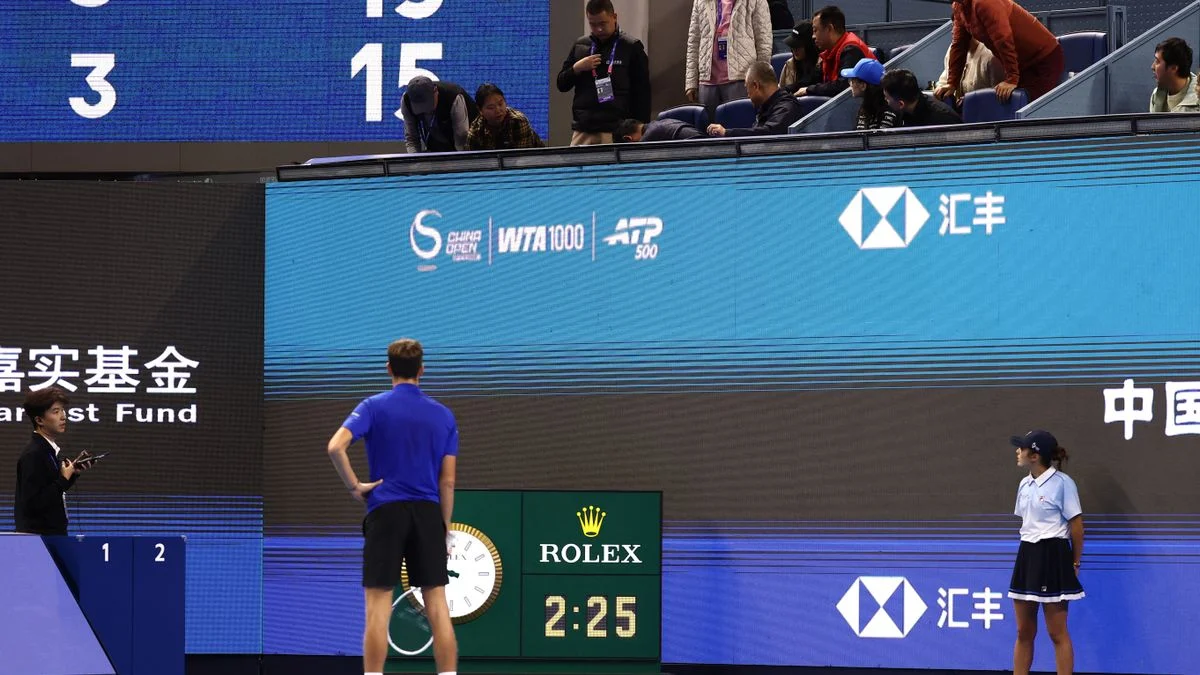
The semi-final clash, which carried significant weight for both competitors, ended prematurely at 7:5, 5:3, 15:15 in favor of Djokovic. The abrupt termination was triggered by a lapse in judgment from the Russian star, Daniil Medvedev, whose frustration boiled over in a manner that led to a spectator being struck by a ball. As the dust settles in the Chinese capital, the incident serves as a stark reminder of the volatility inherent in elite sport and the heavy burden of responsibility carried by those who play under the global spotlight.
The Chronology of the Incident
The match had been a grueling, high-intensity affair from the first serve. Both Djokovic and Medvedev had entered the arena with the clear intent of dominating the baseline rallies. The first set alone was a testament to their endurance, lasting an exhausting one hour and 19 minutes. Djokovic, currently riding a wave of formidable form after his victory over Alexander Zverev in the quarter-finals, managed to edge out the opening set 7:5, demonstrating the mental fortitude that has come to define his legendary career.
The second set continued in much the same vein, with neither player willing to yield an inch of ground. As the clock approached the two-and-a-half-hour mark, the tension on the court was palpable. Medvedev, known for his fiery temperament and unorthodox style, appeared visibly frustrated as he struggled to find a way past the Serbian’s defensive wall.
Following a lost point at 15:15, the pressure finally reached a breaking point. In a reflexive display of anger, Medvedev struck the ball toward the crowd in frustration. The ball sailed into the stands and struck a spectator directly in the face. The impact was immediate and alarming. Witnesses observed the individual in obvious pain, clutching their face as stadium officials and medical staff rushed to the scene. The injured visitor had to be escorted from the stands for further medical assessment.
Given the strict regulations governing player conduct and the safety of attendees, the chair umpire had little choice but to intervene. After a brief consultation with tournament officials, the umpire declared the match over, resulting in an automatic disqualification for the Russian.
Supporting Data and Historical Context
Novak Djokovic’s progression to the final marks his 33rd consecutive victory in Beijing, a city that has effectively become his fortress. The 39-year-old Serbian, who has yet to experience a defeat on these courts, now moves on to face the Australian standout Alex de Minaur.
However, the shadow of the incident looms large over the tournament. For Djokovic, the scenario was one he knows all too well. In 2020, at the US Open, Djokovic himself was disqualified under strikingly similar circumstances. During a match against Pablo Carreño Busta, Djokovic hit a ball in frustration that struck a line judge, leading to his immediate ejection from the tournament. This historical parallel provided the Serbian with a unique perspective on the evening’s events, coloring his post-match commentary with both empathy and a sense of gravity.
Official Responses and Player Perspectives
In the immediate aftermath, the atmosphere in the arena was somber. Despite his victory, Djokovic was visibly shaken by the turn of events. Speaking to the media, the world number one expressed genuine concern for the spectator and a palpable sense of sympathy for his opponent.
"I am a bit shocked," Djokovic stated during his press conference. "It is truly unfortunate for the person involved, and I sincerely hope they are not seriously injured. My thoughts are with them. I also feel for Daniil. Having been in that position before, I know exactly what it feels like to be disqualified for an incident like that. It is a harsh lesson, but one that is necessary for the integrity of the sport."
The incident has reignited debates regarding the "zero-tolerance" policies enforced by tennis governing bodies. While the primary objective of these rules is the safety of fans and officials, they also highlight the immense psychological pressure players operate under. For Medvedev, who is known for his occasionally erratic on-court persona, this moment represents a significant hurdle in his professional development. Whether this incident will result in further disciplinary action or fines from the ATP remains to be seen, but the tournament organizers have made it clear that player conduct remains a paramount concern.
The Broader Implications: Discipline and Mental Fortitude
The events in Beijing raise important questions about the mental health and emotional regulation of professional athletes. Tennis, often referred to as "the lonely sport," demands an extraordinary level of emotional stability. Players are isolated on the court, subjected to the scrutiny of thousands, and expected to maintain a stoic demeanor even when facing extreme physical and mental fatigue.
The Evolution of Conduct Rules
Over the past decade, the ATP and WTA have significantly tightened the rules surrounding ball abuse and racquet smashing. While these actions were once viewed as "part of the game" and manifestations of competitive fire, the increasing frequency of incidents involving ball kids, linespeople, and spectators has necessitated a more rigid approach. The move toward automated officiating—such as the Hawk-Eye Live system—is partly an effort to remove human error and potential friction points from the court, but it cannot solve the issue of player-to-spectator interactions.
The "Djokovic Precedent"
Djokovic’s 2020 disqualification remains a watershed moment in modern tennis history. It proved that even the greatest players in the world are not immune to the consequences of a lapse in self-control. By speaking out in support of Medvedev, Djokovic is attempting to bridge the gap between the competitive instinct to release frustration and the professional requirement to remain in control. His reaction highlights a shift in the veteran’s persona—moving from a player who once struggled with his own temper to a statesman of the sport who understands the wider impact of such incidents.
Future Challenges for Medvedev
For Daniil Medvedev, the path forward is complex. He has established himself as one of the most formidable hard-court players of his generation, but his public outbursts have occasionally overshadowed his tactical brilliance. The coming weeks will be critical for the Russian. He must reconcile his competitive nature with the demands of professional conduct if he is to avoid further incidents that could jeopardize his standing in the sport. Support teams and sports psychologists will likely play a key role in helping him manage the intense pressure that led to this unfortunate event.
Conclusion: Looking Toward the Final
As the tournament moves into its final phase, the focus must inevitably shift back to the tennis. Alex de Minaur, the young Australian challenger, now finds himself in the final against one of the greatest players to ever hold a racquet. The narrative of the tournament has been irrevocably altered by the semi-final collapse, but the show must go on.
The incident serves as a sobering reminder that the boundary between an intense sporting contest and a chaotic scene is thinner than it appears. It is a moment of learning for the players, a moment of reflection for the officials, and a moment of caution for the fans. As Beijing prepares to crown a champion, the tennis world will be watching—not just to see who lifts the trophy, but to observe how the sport moves forward from a night defined by a single, reflexive swing of a racquet.
The integrity of the game is upheld not only by the shots played between the lines but by the character and control displayed by the individuals who play them. In this high-stakes environment, the lesson is clear: no matter the score, the safety of the spectators and the respect for the sport remain the ultimate benchmarks of a true champion.












