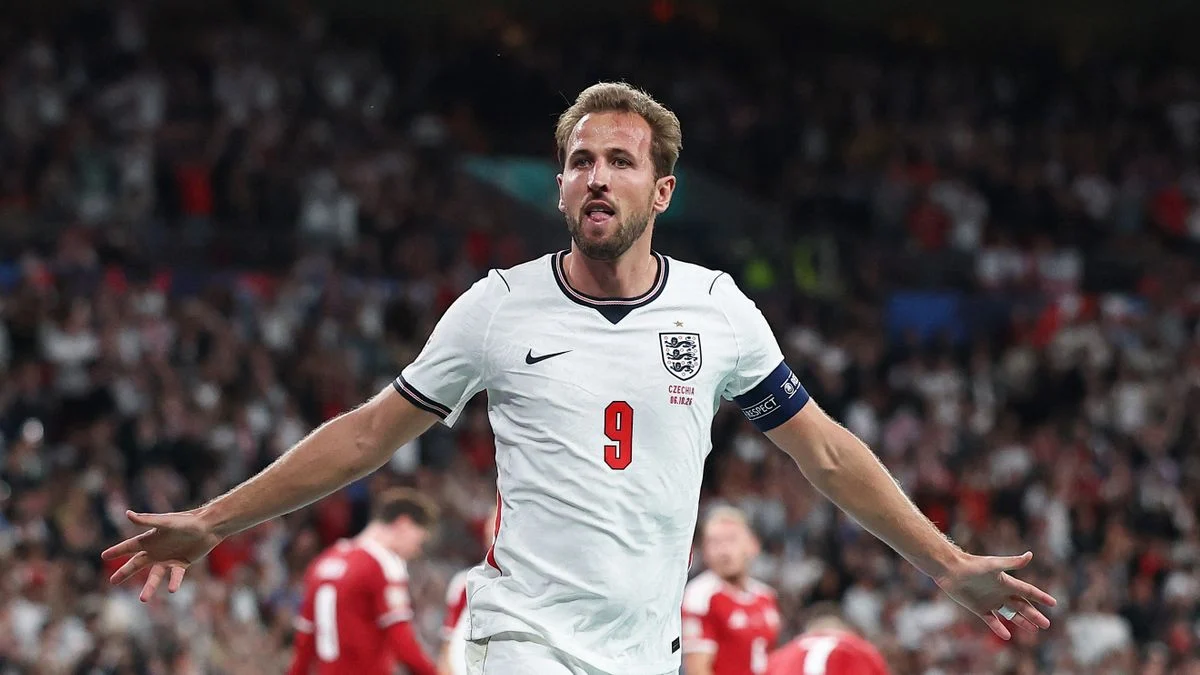
In the storied annals of English football, few evenings have shimmered with the magnitude of the 3-0 victory over the Czech Republic. It was a performance that transcended a mere result; it was a coronation of individual brilliance and a testament to tactical evolution. At the heart of the spectacle was Harry Kane, the captain who stood on the precipice of history and stepped firmly into the pantheon of the greatest players to ever pull on the Three Lions jersey.
As the final whistle blew, the atmosphere at Wembley was electric, not just because of the comprehensive victory, but because the fans had witnessed the convergence of two historic milestones: Harry Kane’s ascent to the record-breaking heights of international appearances and Thomas Tuchel’s swift, ruthless climb to the summit of managerial efficiency.
A Night of Milestones: The Facts Behind the Performance
The narrative of the match was scripted long before the first ball was kicked. All eyes were on Kane, who entered the fray with 124 caps to his name. With the starting whistle, he officially equaled the legendary goalkeeper Peter Shilton’s long-standing record of 125 international appearances—a mark that had stood as the ultimate barometer of longevity and dedication for decades.
Yet, Kane was not merely present to collect a milestone; he was there to dominate. The 33-year-old Bayern Munich talisman orchestrated a clinical dismantling of the Czech defense. He was the catalyst for the opening goal in the 27th minute, forcing an own goal through sheer predatory instinct, before adding his own signature to the score sheet with strikes in the 40th and 57th minutes. These goals, his 90th and 91st in international competition, served as a stark reminder of his enduring relevance in a sport that often discards its veterans prematurely.
The Chronology of Excellence: How the Three Lions Prevailed
The match unfolded with a surgical precision that has become the hallmark of Thomas Tuchel’s tenure. England began with a high-press intensity that immediately unsettled the Czech backline.
- The Opening Gambit (0’ – 25’): England controlled the midfield, with Jude Bellingham orchestrating play and providing the creative spark required to break down a low-block defense. The movement of the front three forced the Czech defenders into deep, uncomfortable positions.
- The Breakthrough (27’): The pressure told when Kane’s relentless pursuit of a cross forced a chaotic sequence in the penalty box, culminating in an own goal. It was a goal born of persistence—a trait that has defined Kane’s career.
- The Kane Show (40’ & 57’): Just before the interval, Kane displayed the composure of a master craftsman, slotting home his 90th goal to double the lead. The second half saw no respite for the visitors; Kane struck again in the 57th minute, effectively killing the contest and cementing his status as the primary protagonist of the evening.
- Closing the Book (60’ – 90’): With the result secured, the remainder of the match became a showcase of tactical discipline. Tuchel rotated his squad, ensuring the intensity remained high without risking the health of his key assets.
The Architect and the Icon: Tuchel’s Tactical Triumph
While Kane’s name dominated the headlines, the man in the technical area achieved a feat equally impressive. Thomas Tuchel, in his 26th match as the England manager, secured his 20th victory. In doing so, he surpassed the legendary Walter Winterbottom, who, according to BBC records, required 27 matches to achieve the same tally between 1946 and 1950.
Tuchel’s impact on this side has been transformative. Moving away from the rigid structures that often stifled English talent in previous years, the German coach has fostered an environment of fluid intelligence. "He is a legend of English football," Tuchel remarked in the post-match press conference. "Harry will inspire countless young people to play football and encourage others to pursue a career like his. He is a fantastic role model, not just for his goals, but for his character."
The Voice of the Dressing Room: Teammates on the Captain
The reverence for Kane within the squad is palpable. Jude Bellingham, the rising superstar of the English midfield, offered a glowing assessment of his captain, suggesting that Kane is evolving into something even greater than the sum of his statistics.
"He is, in the first instance, an incredible human being, both as a captain and as a man," Bellingham noted. "He is the best English player to ever wear the national shirt, and it is an honor to share the pitch with him. He is nearly unrivaled. He scores goals for fun, he makes the runs into the channels, and he does the dirty work in the challenges. The scariest part? He just keeps getting better."
This sentiment reflects a shift in the perception of Kane. He is no longer just the "goal machine" he was in his twenties; he has become a multifaceted leader, a pivot point for the entire team, and a tactical instrument that Tuchel uses to manipulate the opposition’s defensive shape.
Supporting Data: By the Numbers
To understand the scale of what transpired, one must look at the data:
- The Appearance Record: 125 caps. Kane now sits atop the list, tied with Peter Shilton, a figure who represented England for two decades. The consistency required to maintain that level of health, form, and international selection is unprecedented in the modern era.
- The Goal Tally: 91 goals. To put this in perspective, Kane’s international scoring rate has remained remarkably consistent despite changing tactical systems and aging.
- The Managerial Efficiency: Tuchel’s 20 wins in 26 games represents a win percentage of 76.9%. In the context of international football—where training time is limited and squad cohesion is difficult to build—this is an extraordinary rate of success.
The Implications: Where Do We Go From Here?
The implications of this performance extend far beyond a single victory in a qualifying campaign. England, under Tuchel, has solidified its status as a team that is not merely talented but deeply cohesive.
For Harry Kane, the question naturally shifts to "what’s next?" Having conquered the record books, he enters the twilight of his international career with a clear objective: to pair his individual brilliance with collective silverware. The chemistry he has developed with younger players like Bellingham suggests that the transition of leadership will be organic rather than forced.
For Thomas Tuchel, the challenge is to maintain this momentum. History shows that English managers often hit a ceiling after initial successes. By shattering Winterbottom’s record, Tuchel has proven he is operating on a different plane of efficiency. The focus will now shift to the upcoming major tournaments, where the pressure will be significantly higher than a standard qualification fixture.
Conclusion: A Legacy Cemented
As the floodlights dimmed at Wembley, the narrative was clear: the English national team is currently witnessing the peak of a specific generation. Harry Kane’s journey from a young, hungry prospect to the nation’s most capped and prolific player is a story of grit, tactical intelligence, and an unwavering commitment to the craft of goal-scoring.
When he looked back on his "perfect evening," Kane spoke of pride. It is a pride shared by a nation that, for once, feels that its best players and its manager are perfectly aligned in their pursuit of excellence. The records set against the Czech Republic will eventually be broken—as all records are—but the standard of professionalism and performance established by this group will serve as the benchmark for the next decade of English football.
The Three Lions are not just winning; they are setting a pace that the rest of the world will find increasingly difficult to match. As Tuchel continues to fine-tune his system and Kane continues to defy the aging process, England stands as a formidable force, looking toward the horizon with a confidence that has been absent for far too long. This was not just a night of statistics; it was the night England truly came of age.