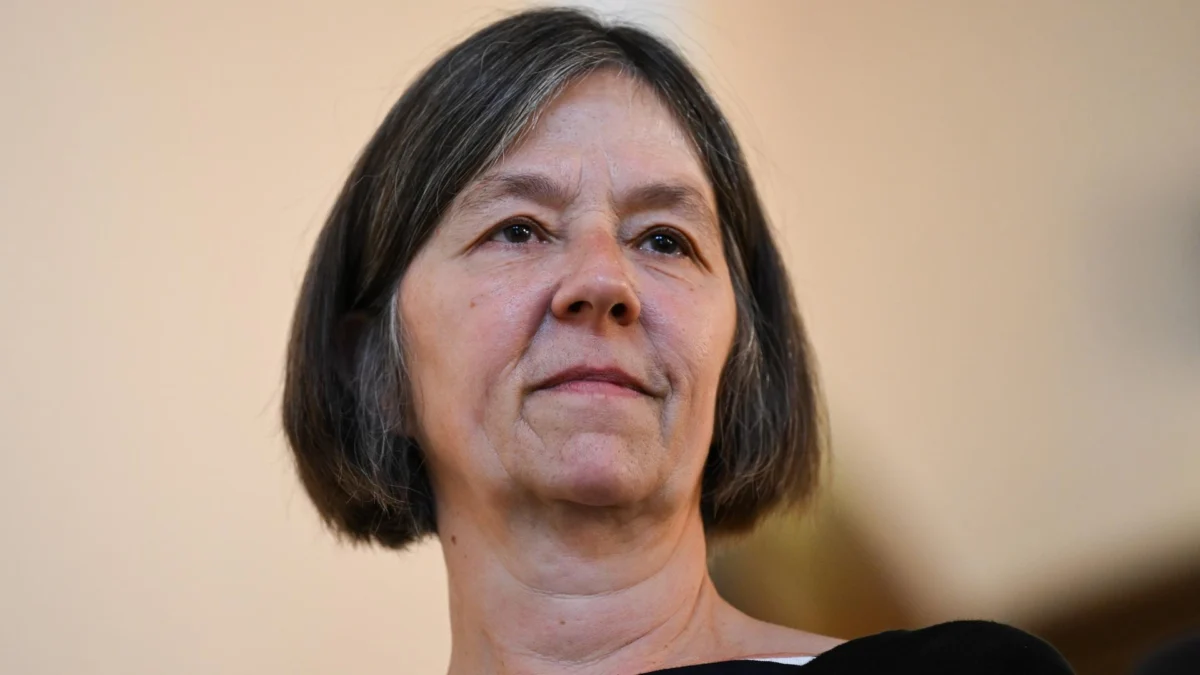
DARMSTADT, Germany – The German literary world turns its gaze toward Darmstadt this afternoon as the prestigious Georg Büchner Prize is formally bestowed upon the acclaimed novelist, biographer, and translator Christine Wunnicke. The ceremony, held at the historic Staatstheater, marks the culmination of a quarter-century of masterful storytelling, cementing Wunnicke’s position as one of the most significant voices in contemporary German-language literature.
The event, which is being broadcast via a live stream by hessenschau.de, serves as both a celebration of Wunnicke’s singular career and a reminder of the enduring importance of the Büchner Prize in shaping the cultural landscape of the German-speaking world.
The Weight of the Accolade: Why Wunnicke?
The Deutsche Akademie für Sprache und Dichtung (German Academy for Language and Literature), the body responsible for selecting the laureate, announced its decision to honor the 59-year-old author in July. In a formal statement, the jury praised Wunnicke for her "constantly surprising and sovereignly conceived narrative work."
For the academy, Wunnicke is a writer who refuses to be pigeonholed. Her prose is characterized by a "relentless work of a quarter-century," a dedication to craft that has seen her navigate the complexities of historical fiction with clinical precision and imaginative flair. The jury noted specifically that Wunnicke possesses the rare ability to "make the fictional visible within the supposedly historical." By blurring the lines between established historical fact and the imaginative possibilities of the past, she challenges her readers to question the nature of truth itself.
The prize, which carries a purse of 50,000 euros, is not merely a financial award; it is a seal of excellence, historically bestowed upon the titans of German literature. By joining the ranks of previous winners, Wunnicke enters a literary pantheon that includes giants like Max Frisch, Günter Grass, and Heinrich Böll.
A Career in Focus: From Translator to Literary Titan
Born in the vibrant cultural milieu of Germany, Christine Wunnicke has built an impressive body of work that spans multiple genres. Dividing her time between Munich and Berlin, she has cultivated a reputation as a meticulous researcher and a stylist of immense depth.
Her career is not limited to the novel; she is a prolific translator of both Italian and English literature, a role that has undoubtedly informed the rhythmic, precise nature of her own German prose. Her bibliography reflects a fascination with the margins of history—the figures who are often forgotten, the eccentricities of the past, and the psychological weight of intellectual pursuit.
Key Works and Recognition
Wunnicke’s trajectory toward the Büchner Prize has been marked by several significant milestones:

- "Der Fuchs und Dr. Shimamura" (2015): A seminal work that showcased her ability to weave disparate historical threads into a cohesive, philosophical narrative.
- "Die Dame mit der bemalten Hand" (2020): A novel that further cemented her reputation for narrative innovation.
- "Wachs" (2025): Her most recent major critical success, which earned her a place on the shortlist of the prestigious German Book Prize, proving that her creative output remains as vital and competitive as ever.
Her work has been consistently recognized by critics, receiving accolades such as the Wilhelm Raabe Literature Prize, the Jean-Paul Prize, and the Literature Prize of the Darmstadt Jury.
A Tradition of Excellence: The Georg Büchner Prize
To understand the magnitude of today’s ceremony, one must look at the history of the prize itself. Established in 1951 by the Darmstadt-based Academy for Language and Literature, the Georg Büchner Prize is the most coveted literary award in Germany.
Named after the revolutionary dramatist Georg Büchner—the man behind the hauntingly modern Woyzeck—the prize is intended to honor authors who have made a significant contribution to the development of contemporary German culture. The academy’s charter is specific: the recipient must be an individual whose work "exhibits a special level of merit" and who has had a "substantial impact on the shaping of contemporary German cultural life."
The funding structure of the prize reflects its national importance, as it is supported by a tripartite partnership between the Federal Government, the State of Hesse, and the City of Darmstadt. This ensures that the award transcends regional politics, acting as a symbol of the nation’s commitment to the arts.
Historical Context and Predecessors
The prize has often acted as a lightning rod for the state of the German intellectual consciousness. From the mid-century existentialism of Max Frisch to the political engagement of Heinrich Böll and Günter Grass, the list of laureates reads like a syllabus for 20th-century European thought.
Last year, the prize was awarded to the novelist and poet Ursula Krechel, whose work was lauded for its exploration of political memory and personal history. In selecting Wunnicke for 2026, the jury continues a trend of honoring writers who possess an intellectual rigor that matches their aesthetic ambition.
The Philosophy of the "Historical Fiction"
What sets Wunnicke apart, according to critics, is her approach to the "historical." In an era where historical fiction is often dominated by sweeping epics or populist retellings, Wunnicke’s work is intimate and cerebral.
She does not use history as a backdrop; she uses it as a laboratory. By placing characters in specific, often overlooked moments in history, she explores the limits of human knowledge and the fragility of identity. In The Fox and Dr. Shimamura, for instance, she explores the intersection of European science and Japanese culture, creating a narrative that is as much about the process of learning as it is about the story being told.

Her readers often find themselves confronted with the "fictional" nature of history—the idea that the past is a construct, and that the novelist’s role is to rearrange the shards of that construct to reveal new, often uncomfortable, truths. This is the "brilliant art" the jury identified—a sophisticated, multi-layered approach that demands an active, engaged reader.
Implications for Contemporary Literature
The awarding of this prize to Wunnicke signals a continued appreciation for literary fiction that is challenging and unconventional. In a market often saturated by lighter, more commercial fare, the Academy’s decision serves as a defiant assertion of the value of high art.
Furthermore, it highlights the vitality of the literary scene in Munich and Berlin, cities that remain the beating heart of German publishing. By honoring a writer who is also a translator, the Academy is also making a subtle point about the importance of cross-cultural exchange. Wunnicke’s work is deeply embedded in the European tradition, drawing upon the linguistic and cultural nuances of the countries whose works she translates.
As the ceremony concludes and the focus shifts to the celebration, the literary community will surely begin the inevitable process of analyzing Wunnicke’s next steps. For now, however, the day belongs to the author herself—a moment of recognition for a writer who has, for 25 years, quietly and effectively changed the way we look at the world, one sentence at a time.
How to Follow the Event
For those unable to attend the ceremony in person at the Staatstheater Darmstadt, the Academy has ensured accessibility through modern digital channels. The ceremony, which began at 4:00 PM CET, is currently available for viewing on the hessenschau.de platform.
This digital access reflects the academy’s broader goal: to bring high-level cultural discourse out of the ivory tower and into the public sphere, ensuring that the legacy of Georg Büchner—a man who was, in his own time, a radical champion of the people—remains accessible to all.