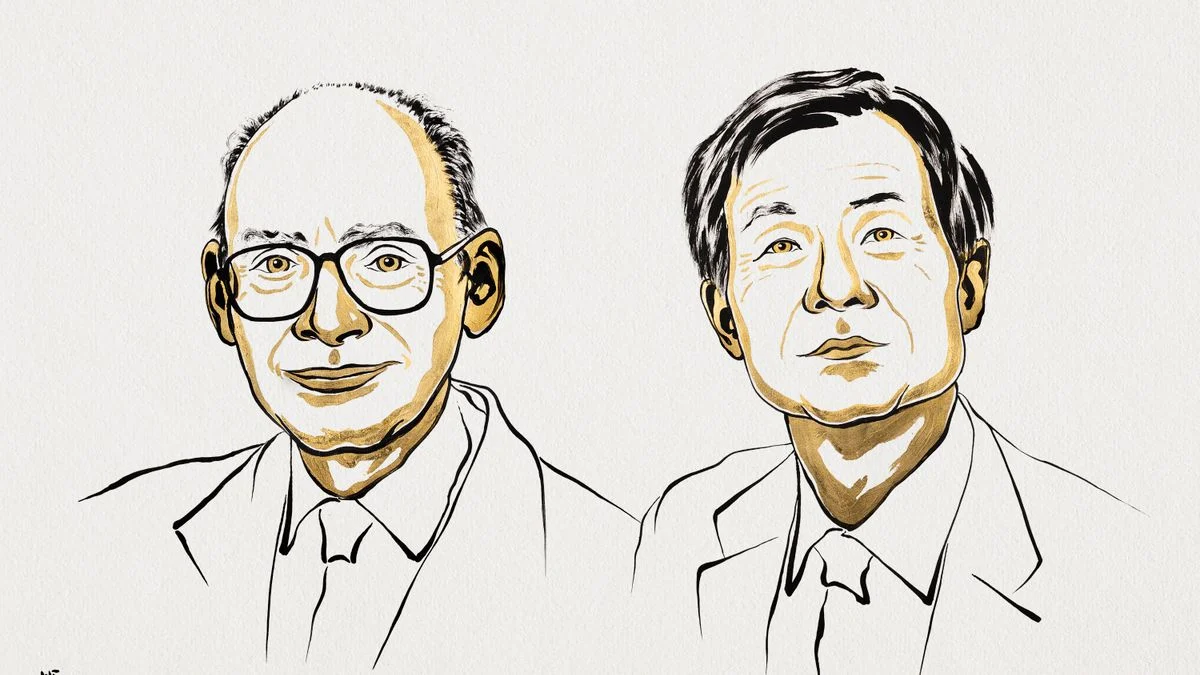
STOCKHOLM – The Royal Swedish Academy of Sciences has announced that the 2026 Nobel Prize in Chemistry has been awarded to French scientist Henri Kagan of the Université Paris-Sud and Japanese researcher Kenso Soai of the Tokyo University of Science. The duo receives the world’s most prestigious scientific honor for their groundbreaking contributions to the field of autocatalysis, specifically for solving the century-old mystery of how homochirality—the "handedness" of life—spontaneously emerges in chemical systems.
This year’s announcement marks a historic moment, not only for the advancement of synthetic chemistry but also for the governance of the Nobel Foundation itself. For the first time in the 287-year history of the Royal Swedish Academy of Sciences, the laureates were announced by the Academy’s new Secretary General, Ellen Moons, who assumed her post earlier this year as the first woman to lead the institution.
The Chiral Conundrum: Why Life Prefers One Hand
At the heart of the Nobel-winning research is the concept of "chirality," a term derived from the Greek word for hand. In chemistry, chiral molecules exist in two mirror-image forms, much like a human’s left and right hands. While these molecules are identical in their physical properties—boiling point, density, and chemical formula—they behave very differently when they interact with other chiral environments, such as those found inside living organisms.
"Henri Kagan and Kenso Soai have provided a solution to a chemical riddle that has persisted for over a century: How can homochirality spontaneously emerge?" said Heiner Linke, Chair of the Nobel Committee for Chemistry. "The chemical reactions they have developed are nothing short of spectacular."
The mystery of homochirality is one of the fundamental puzzles of biology. Proteins, the building blocks of life, are composed of amino acids that are exclusively "left-handed." If one were to synthesize these molecules in a standard laboratory setting, the result would typically be a 50/50 mixture of both "left" and "right" forms—a racemic mixture. Nature, however, exhibits a profound preference for one over the other.
This asymmetry is not merely an academic curiosity; it is a vital necessity for modern medicine. Because biological receptors in the human body are chiral, they often only recognize one specific "hand" of a drug molecule. If a pharmaceutical manufacturer produces a mixture of both, the "wrong" mirror image can be at best inactive and, at worst, toxic. By mastering the art of creating just one of these mirror images, Kagan and Soai have provided the fundamental tools that allow chemists to create safer, more efficient life-saving medicines.
A Chronology of Discovery: From Nonlinearity to Autocatalysis
The path to this year’s Nobel Prize was paved by decades of incremental but transformative breakthroughs.
The First Breakthrough: Henri Kagan (1986)
By the mid-1980s, the scientific community was struggling to bridge the gap between small, laboratory-scale enantiomeric excess (the bias toward one mirror image) and the pure substances required for industrial application. In 1986, Henri Kagan made the first decisive leap. His work on the amplification of optical activity introduced a new method for controlling chemical reactions.
Kagan demonstrated that it was possible to create a significantly higher excess of one mirror image than had previously been thought possible. His methodology allowed for the precise manipulation of catalytic systems, effectively "tilting the scales" in favor of one specific molecular orientation. This established the foundation for modern asymmetric synthesis, a technique that has since become the gold standard in pharmaceutical manufacturing.
The Soai Reaction: Kenso Soai (1995–2003)
While Kagan provided the mechanism for amplification, Kenso Soai provided the bridge to true homochirality. In a landmark 1995 publication, Soai described a chemical reaction that possessed the theoretical potential to become self-replicating—or "autocatalytic."
The "Soai Reaction" gained international fame in 2003 when he successfully demonstrated a reaction that produced only one of the two possible mirror images. Before this achievement, the only system known to produce pure homochirality was the living cell itself. Soai’s ability to force a non-living chemical system to mirror the selective nature of life represented a paradigm shift in chemistry. By showing that a reaction could "choose" a hand and then replicate that choice, Soai provided a compelling model for how life might have emerged from the chaotic, racemic soup of the primordial Earth.
Implications for Modern Science
The implications of the work conducted by Kagan and Soai extend far beyond the walls of the research laboratory. The pharmaceutical industry, in particular, owes a debt of gratitude to these two laureates.
In the mid-20th century, the medical community learned tragic lessons about the importance of chirality. The most infamous example remains Thalidomide, a drug marketed in the late 1950s that caused severe birth defects. While one mirror image of the drug was a sedative, the other was a potent teratogen. The ability to synthesize single-enantiomer drugs, which is now standard practice, relies heavily on the catalytic methods pioneered by this year’s Nobel winners.
Beyond medicine, their research has profound implications for:
- Material Science: The creation of chiral polymers and advanced materials that interact with polarized light.
- Origins of Life Research: Providing a plausible mechanism for how the first self-replicating, homochiral molecules might have arisen before the evolution of enzymes.
- Chemical Synthesis Efficiency: Reducing waste by ensuring that synthetic reactions produce 100% of the desired isomer, rather than a mixture that requires costly separation processes.
A Landmark Year for the Nobel Foundation
The 2026 prize comes with an increased purse. To mark the 125th anniversary of the Nobel Prize, the Foundation has raised the prize money to twelve million Swedish krona (approximately one million Euros).
"In this year, we celebrate the 125th anniversary of the Nobel Prize," stated Hanna Stjärne, CEO of the Nobel Foundation. "It is our pleasure to increase the prize money by one million to reflect the enduring significance of these contributions to humanity."
The formal ceremony will take place on December 10, the anniversary of Alfred Nobel’s death. The event is expected to draw global attention, not only to celebrate the laureates but to honor the historic shift in the Academy’s leadership. Secretary General Ellen Moons, who has been praised for her rigorous academic background and commitment to transparency, expressed her honor in announcing the winners: "It is a profound privilege to announce the work of Kagan and Soai. Their research embodies the very spirit of the Nobel Prize: the relentless pursuit of knowledge to solve the most enduring mysteries of our world."
Reflections and Corrections
The path to discovery is rarely linear, and the scientific community is the first to acknowledge that even our terminology evolves. In a note attached to the announcement, the Royal Swedish Academy clarified a historical distinction in their records, noting that earlier discussions regarding the "handedness" of molecules had conflated the terms "chiral" and "homochiral."
"We have corrected the record," the Academy stated. "Chirality refers to the existence of mirror-image pairs, while homochirality refers to the state of having only one of those pairs present. This distinction is vital to understanding the brilliance of the work recognized today."
As the scientific community celebrates this win, the legacy of Henri Kagan and Kenso Soai is already being felt in labs across the globe. From the design of complex cancer treatments to the fundamental understanding of our own biological makeup, the "symmetry breakers" have changed the way we view the building blocks of the universe. They have shown that while nature is inherently complex, it is also governed by elegant, discoverable rules—and with the right tools, those rules can be harnessed to improve the human condition.