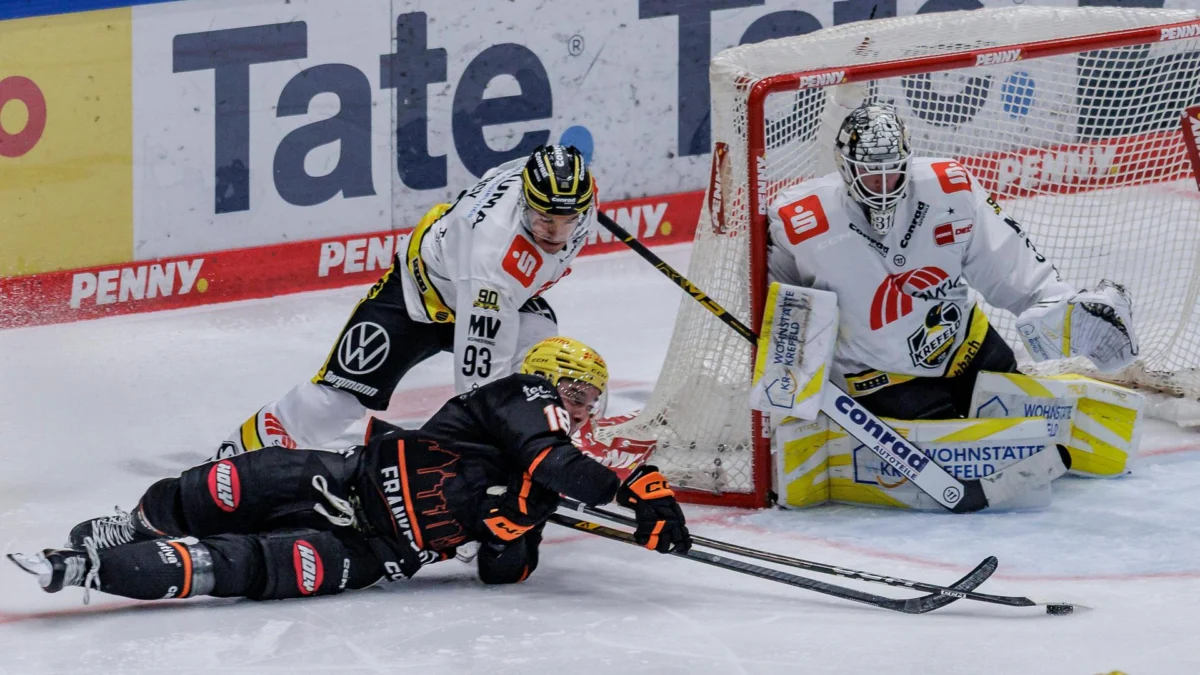
The ice hockey landscape in Hesse is currently facing a period of introspection. The Löwen Frankfurt, a team that has historically relied on the fervent support of their home crowd to grind out results, found themselves on the wrong side of a 2-5 scoreline against the Krefeld Pinguine this past Thursday evening. The result marks the third consecutive defeat for the Frankfurt side, a concerning trend that threatens to derail the momentum they had hoped to build early in the season.
Despite a promising start and an initial lead, the Löwen were unable to contain a clinical Krefeld offense, particularly in the final frame, where the visitors effectively dismantled Frankfurt’s defensive structure. With 6,477 spectators filling the arena, the atmosphere was electric, yet the final whistle brought only frustration for the home faithful.
Main Facts: A Breakdown of the Disappointment
The encounter, which served as a stark reminder of the unforgiving nature of professional ice hockey, saw the Löwen Frankfurt struggle to maintain consistency across all sixty minutes of play. While the opening period ended in a stalemate, the game exploded into life during the second and third stanzas.
The Löwen managed to strike first through Timo Kose, injecting energy into the building. However, the lead proved ephemeral. Mathew Santos, a constant threat for the Pinguine, acted as the primary catalyst for the visitors, scoring twice in the second period to flip the script before the intermission.
The most damaging sequence occurred early in the third period. Within a span of just under two minutes, Adam Payerl and Philip Gogulla pushed Krefeld’s lead to a margin that proved insurmountable for the Frankfurt squad. Although Austin Wagner briefly provided a flicker of hope for the hosts, Payerl’s second goal of the night in the final minutes put the result beyond doubt.
Chronology: The Narrative of the Match
The Standoff (1st Period)
The game began with a high-intensity, tactical battle. Both teams prioritized defensive stability, leading to a scoreless first period. Goaltenders were largely untroubled, with both sides cautious about conceding early mistakes. The 6,477 fans in attendance were treated to a showcase of defensive discipline, though the lack of offensive creativity was palpable.
The Shift (2nd Period)
The deadlock was finally broken at the 26:14 mark when Timo Kose found the back of the net, sending the home fans into a frenzy. For a brief moment, it appeared as though Frankfurt might control the tempo. However, the Pinguine responded with resilience. Mathew Santos leveled the game at 31:37, and just as the period seemed destined to end in a 1-1 tie, Santos struck again with less than thirty seconds remaining (39:38). That late goal was a psychological blow to the Löwen, who headed to the locker room trailing 1-2.

The Collapse (3rd Period)
The third period began with the Löwen needing an immediate response, but it was Krefeld that dictated terms. Adam Payerl scored at 42:46, followed quickly by a strike from veteran Philip Gogulla at 44:27. At 1-4, the match appeared effectively over. Austin Wagner’s goal at 45:39 provided a desperate, short-lived surge of energy for Frankfurt, but the team could not bridge the gap. Payerl added his second goal of the night at 58:39, sealing the 2-5 victory for the visitors and cementing a difficult night for the Frankfurt coaching staff.
Supporting Data and Statistical Analysis
To understand the magnitude of this defeat, one must look beyond the final scoreline. The statistics from the match highlight both the efficiency of Krefeld and the growing discipline issues—or lack thereof—within the Frankfurt squad.
- Final Score: Löwen Frankfurt 2, Krefeld Pinguine 5.
- Period Scores: 0-0, 1-2, 1-3.
- Penalty Minutes: Frankfurt: 2 | Krefeld: 4.
- Attendance: 6,477.
The disparity in penalty minutes suggests a game that was played with relative fairness, yet the lack of physicality from the Löwen may have contributed to their inability to disrupt Krefeld’s flow. When a team is trailing by multiple goals in the third period, one might expect an increase in intensity; however, the Löwen were unable to force the Pinguine into costly mistakes. Krefeld’s ability to convert their chances—scoring five goals on a focused offensive effort—stands in stark contrast to Frankfurt’s two-goal output, which relied more on individual moments of brilliance than sustained pressure.
Official Responses and Tactical Implications
While official post-match press conferences often focus on "learning lessons," the sentiment emanating from the Löwen Frankfurt camp is one of quiet concern. Coaching staff members have pointed to the "doppelschlag" (the double-strike) in the third period as the moment the match was lost.
"We had the lead, and we had the momentum," a team representative noted in the aftermath. "But in this league, you cannot switch off for even a moment. When you concede two quick goals, the entire tactical plan goes out the window. We need to look at our defensive transitions and ensure that we are not leaving our goaltenders exposed in those critical minutes."
Tactically, the Löwen appear to be struggling with "game management." The tendency to allow consecutive goals in short succession—a recurring theme in their last three outings—suggests a potential mental fatigue or a lack of composure under pressure. Whether this requires a shift in personnel, a change in the training regimen, or a tactical pivot remains the primary question for the coaching team heading into the next training session.
Implications for the Season Ahead
The broader implications of this 2-5 loss are significant. A three-game losing streak is a precarious position in professional ice hockey, where standings can tighten rapidly. For the Löwen, the immediate challenge is to halt this downward spiral before it becomes a season-defining slump.

1. Psychological Fragility
The primary concern for the coaching staff will be the mental state of the roster. Following a loss of this nature, players often second-guess their positioning. Restoring confidence is paramount. The team must look to their upcoming fixtures as an opportunity to reset rather than a chance to compound their mistakes.
2. The Home Advantage
The Löwen Frankfurt pride themselves on their home support. With 6,477 fans consistently turning out, the expectation is that the arena acts as a fortress. Losing to a competitor like Krefeld—especially in front of a capacity crowd—can erode the "fear factor" that opposing teams feel when visiting Frankfurt. Regaining the trust of the home crowd is now as important as the points themselves.
3. Defensive Accountability
The data clearly shows that while the offense is capable of finding the net, the defensive structure is prone to catastrophic lapses. The "double-strike" phenomenon that cost them the game against Krefeld indicates that the team is not effectively "resetting" after conceding. Defensive communication, especially during high-pressure segments of the game, will undoubtedly be the primary focus in the coming days.
4. The Path Forward
The season is long, and a three-game skid is far from fatal. However, the margin for error in the league is razor-thin. If the Löwen are to compete for a playoff spot, they must find a way to stabilize their defensive zone and eliminate the high-frequency mistakes that led to the third-period collapse against Krefeld.
The team returns to the drawing board with the knowledge that their performance against Krefeld was not representative of their full potential. Yet, as the old adage in sports goes: "You are what your record says you are." Right now, the record says the Löwen are a team in transition, struggling for form, and desperately in need of a breakthrough performance to turn the tide.
As the players pack their gear and look toward the next training cycle, the pressure will only mount. The supporters expect a reaction—not just in words, but in a display of resilience on the ice. The next game will not just be about points; it will be a test of character for a team that has hit its first major roadblock of the season.