By Editorial Staff
"God is a DJ." The iconic 1998 anthem by the British electronic project Faithless has long served as a shorthand for the quasi-religious fervor often found on the dance floor. For decades, club culture has been compared to spiritual communion—the collective ecstasy, the hypnotic repetition, and the search for transcendence through sound. Yet, few would have predicted that this metaphorical bridge would be crossed by a man in a priest’s collar.
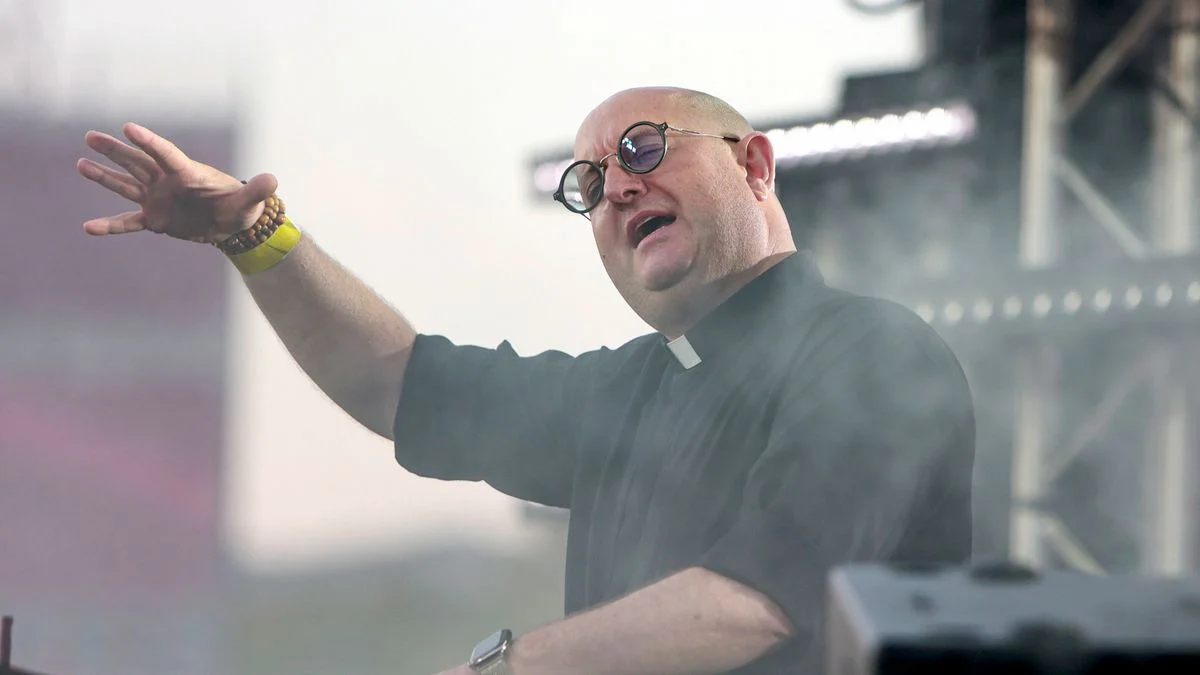
Guilherme Peixoto, a 52-year-old Catholic priest from the Portuguese diocese of Braga, has defied conventional expectations to become one of the most recognizable figures in the global electronic music scene. Recently, in a testament to his burgeoning influence, Peixoto secured the 79th spot in the prestigious DJ Mag Top 100 poll, a ranking determined by hundreds of thousands of votes from electronic music fans worldwide. His ascent marks not just a novelty act, but a profound shift in how religious institutions attempt to engage with the digital-age youth.
The Convergence of Faith and Frequency
The DJ Mag ranking, revealed in a high-profile ceremony on the island of Ibiza, solidified Peixoto’s position as a legitimate player in the international techno circuit. As "Padre Guilherme," he has transitioned from local parish duties to performing before millions. His sound—melodic techno infused with high-energy synths—serves as the backdrop for a message he describes as rooted in "cohesion, love, and spirituality."
For the veteran observer of dance music, Peixoto’s success is an anomaly. While many DJs rely on personas involving elaborate costumes or pyrotechnics, Peixoto’s "costume" is his clerical attire. He seamlessly integrates snippets of Papal addresses, liturgical prayers, and vocal samples of religious significance into his sets, creating a sonic tapestry that challenges the secular boundaries of the modern nightclub.
A Chronology of a Clerical Career
The path from the pulpit to the DJ booth was neither linear nor planned. Peixoto’s life has been defined by service, long before he ever touched a mixing console.
Early Service and the Catalyst of Crisis
Before he was a fixture on festival lineups, Peixoto served as a military chaplain, completing missions in conflict zones including Afghanistan and Kosovo. These experiences, he has noted in interviews, provided him with a unique perspective on the human condition and the need for hope in dire circumstances.
However, it was the global COVID-19 pandemic that served as the true catalyst for his musical career. As lockdowns forced churches across Portugal to shutter their doors, Peixoto looked for ways to maintain a connection with his community. He turned to the digital realm, streaming sets of electronic music to his parishioners. What began as a pastoral outreach program quickly gained traction beyond his local parish, eventually catching the attention of the wider public.
The World Youth Day Breakthrough
The defining moment of his career occurred in 2023 during World Youth Day in Lisbon. Tasked with entertaining the massive crowds waiting for the morning mass presided over by Pope Francis, Peixoto took to the stage before an estimated 1.5 million young people. His set, which saw him mixing electronic beats with the voices of the faithful, was broadcast globally, turning the priest into an overnight sensation.
Global Expansion
Since the Lisbon event, Peixoto’s schedule has mirrored that of a touring professional. He has performed at major international venues, including a high-profile set at the base of the Christ the Redeemer statue in Rio de Janeiro in January 2025. In April of the same year, he headlined a concert in Buenos Aires to honor the legacy of Pope Francis, further cementing his role as a musical ambassador for the Vatican’s modern face.
Supporting Data: The DJ Mag Poll and Industry Standing
The DJ Mag Top 100 list, which has been the industry standard for nearly three decades, serves as a barometer for the health and direction of the electronic music industry. This year’s list featured the French legend David Guetta at the number one spot for the sixth time, followed by Dutch powerhouse Martin Garrix and the rising star Anyma (Matteo Milleri).

Peixoto’s entry at 79 is significant. Industry analysts note that he is the most unconventional debutant in the list’s history. His inclusion is not merely a result of curiosity; it reflects the sheer volume of his online following. With approximately 3.5 million followers on Instagram, Peixoto commands a reach that many professional DJs would envy. This digital engagement is a crucial metric in modern music, and his ability to leverage this platform to bridge the gap between traditional Catholicism and the youth-driven EDM market is unprecedented.
Official Responses and Internal Resistance
The reception of "The Pope’s DJ" has been predictably polarized. Within the Catholic Church, his activities are viewed through two starkly different lenses.
The Institutional Strategy
To the Vatican and various diocesan leaders, Peixoto represents a successful strategy of "inculturation"—the process of embedding the gospel within the cultural context of a specific group. By meeting young people in the clubs and at festivals, the Church is attempting to shed its reputation for being out of touch, using the universal language of dance music to communicate values of peace and communal unity.
Traditionalist Backlash
However, this approach has met fierce resistance from conservative and traditionalist wings of the Church. Critics argue that the sacred and the profane should not be mixed, and that performing in venues associated with alcohol, hedonism, and late-night debauchery is beneath the dignity of the priesthood.
A notable instance occurred in Beirut, where plans for Peixoto to perform in a prominent nightclub drew sharp protests. Fearing that the backlash would overshadow his message, Peixoto made the tactical decision to perform without his clerical collar or visible crucifixes. This concession highlighted the ongoing tension: how much of the "priest" can be preserved in an environment explicitly built for "the party"?
Implications: The Future of Spiritual Expression
The debate extends beyond the Church; it is equally heated within the electronic music community.
The Critics’ Critique
In an article for the specialized industry publication Groove, critics took aim at the stylistic execution of these "techno-masses." The critique was biting: "It feels as if someone mixed the 1998 Taizé songbook with a Café del Mar playlist on YouTube." Critics within the scene argue that such performances are performative, lacking the genuine underground ethos that defines techno culture. They view the attempt to "Christianize" dance music as an aesthetic mismatch, questioning whether the spiritual energy of a club can ever be reconciled with institutional religious dogma.
A New Paradigm?
Despite these criticisms, Peixoto’s momentum shows no sign of slowing. He is currently working on further collaborations and festival appearances that promise to keep him at the forefront of the crossover conversation.
The implications of his success are twofold. First, it signals that the barriers between secular subcultures and traditional religious life are becoming increasingly porous. For a generation of young people who feel disconnected from traditional worship, the "vibe" of a techno set may be the only liturgy they find accessible.
Second, it forces a conversation about the nature of the DJ booth itself. If a priest can use the tools of the modern DJ to facilitate a sense of community, it challenges the industry to reflect on whether electronic music is inherently secular or if it possesses a latent, universal capacity for spiritual experience.
Whether Padre Guilherme is a genuine visionary or a temporary cultural curiosity remains to be seen. What is certain, however, is that he has successfully turned the volume up on the conversation about faith in the 21st century. As long as he continues to fill venues and curate soundscapes, the world will be watching—and listening—to see if the dance floor can truly become a sanctuary.