Executive Summary
In a development that has sent ripples through the PC hardware community, owners of AMD Radeon RX 7000 series graphics cards are being urged to monitor their manufacturers for critical vBIOS updates. What initially appeared to be a localized issue involving Sapphire Technology has rapidly evolved into a broader, platform-wide concern. New evidence confirms that Gigabyte has joined the effort to distribute mandatory firmware patches, explicitly citing a security vulnerability tracked under the identifier AMD-SN-6023.
This discovery marks a significant turning point in the understanding of the situation. It is now evident that the security flaw is not specific to any single board partner’s implementation, but rather resides within the foundational AMD firmware used across the entire RDNA 3 architecture. As users scramble to secure their systems, the lack of granular detail from AMD has created a climate of uncertainty, prompting questions about the nature of the exploit and the urgency of the deployment.
The Chronology of Discovery
The timeline of this security incident began over the past weekend, when initial reports suggested that Sapphire was issuing firmware updates for its Radeon RX 7000 series cards. At that stage, the communication from the manufacturer was notably vague, describing the necessary patches only as a response to a "security issue." Because the communication was isolated to Sapphire’s support channels, the industry assumed the defect might be related to a specific manufacturing process or a unique BIOS configuration specific to Sapphire’s PCB design.
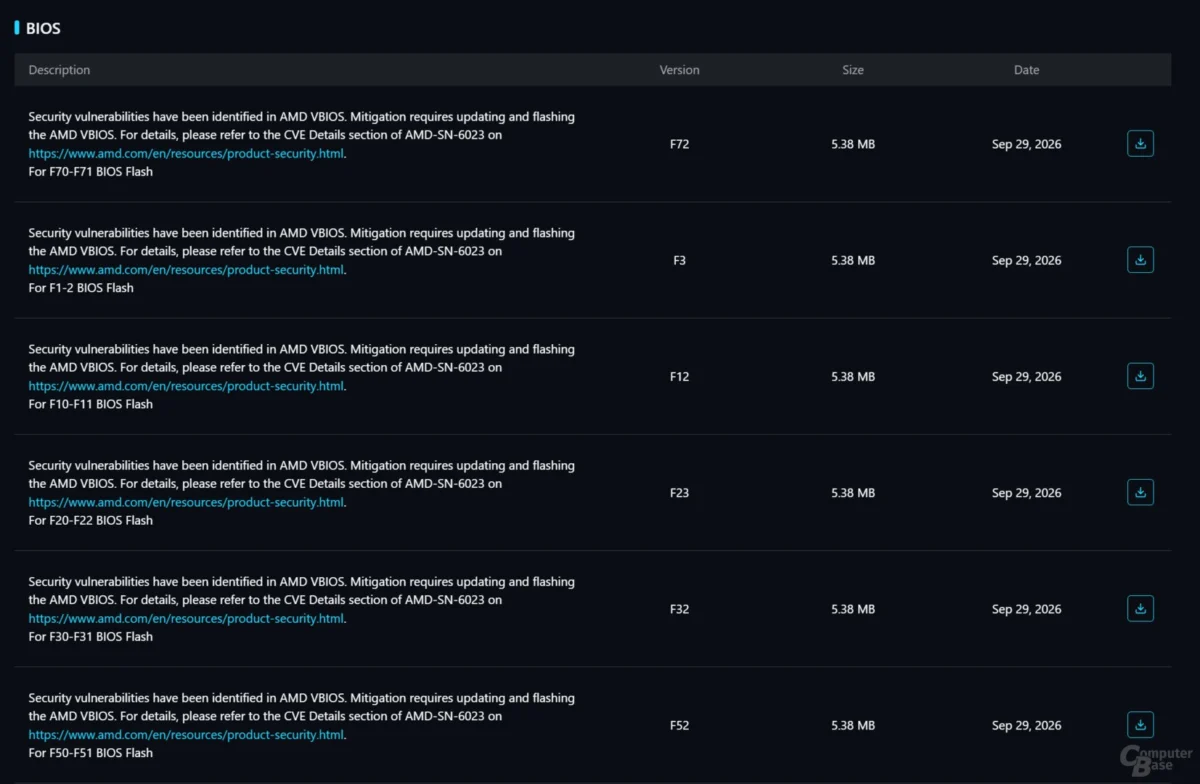
However, the narrative shifted dramatically when eagle-eyed community members, including users on enthusiast forums like ComputerBase, flagged that Gigabyte was also pushing similar updates. Gigabyte’s support pages provided significantly more transparency, specifically referencing the aforementioned "AMD-SN-6023" designation. This revelation fundamentally changed the scope of the problem: it moved the issue from a "vendor-specific quirk" to an "architectural vulnerability" affecting the entire RX 7000 series ecosystem.
As of this writing, other major board partners—including ASUS, ASRock, PowerColor, and XFX—have yet to publicly push equivalent firmware patches. This delay has sparked a debate among enthusiasts: is the vulnerability being rolled out in waves, or are other manufacturers still in the validation stage of their BIOS deployment?
Unpacking AMD-SN-6023: The Knowns and Unknowns
The core of this issue revolves around the mysterious identifier AMD-SN-6023. When users attempt to investigate this code via AMD’s official product security portal, they are met with a dead end. As of now, the AMD security resource page does not return a specific entry for this ID, leaving the public to rely solely on the brief descriptions provided by board partners like Gigabyte.
What Gigabyte has disclosed:
In the support documentation for their RX 7600 XT Gaming OC models, Gigabyte states:
"Security vulnerabilities have been detected in the AMD VBIOS. To resolve these vulnerabilities, an update and flash of the AMD VBIOS is required. For more information, please refer to the ‘CVE-Details’ section of the document AMD-SN-6023 at [AMD Security Portal]."
The reliance on a "VBIOS flash" is a critical detail. Unlike software-based driver updates that can be installed in seconds via the Adrenalin software suite, a vBIOS flash modifies the fundamental operating parameters of the graphics card itself. This process carries a non-zero risk; if power is interrupted or the flash fails, the card can become "bricked" and non-functional, requiring a BIOS recovery or RMA. This underscores the severity of the flaw: if a manufacturer is willing to risk user-led firmware flashing, the underlying threat must be substantial.

Technical Implications: Why Firmware Matters
The graphics card BIOS (or vBIOS) acts as the firmware bridge between the GPU hardware and the operating system. It initializes the hardware, manages power states, sets voltage limits, and dictates how the GPU interacts with the motherboard’s UEFI.
If an attacker were to exploit a vulnerability within the vBIOS, the implications could be severe. In the worst-case scenarios, such vulnerabilities can allow for:
- Privilege Escalation: Gaining higher-level access to the host system by exploiting the kernel-level communication between the GPU and the OS.
- Persistence: Because the vBIOS is stored in non-volatile memory on the card itself, a malicious exploit could theoretically survive a complete operating system reinstallation.
- Data Exfiltration: Manipulating the way the GPU handles memory access, potentially allowing unauthorized processes to read data intended for secure buffers.
While there is currently no evidence that these exploits are being used in the wild, the fact that a patch is being pushed suggests that the vulnerability is exploitable and potentially dangerous if left unaddressed.
Manufacturer Response and Market Fragmentation
The fragmented nature of the response has created a confusing landscape for the average consumer. Gigabyte and Sapphire have taken the lead, but the silence from other major players is notable.
Why the delay?
- Validation Testing: Each board partner must tailor the AMD-provided patch to their specific PCB layout and cooling solutions. A "one size fits all" BIOS could cause stability issues, thermal management failures, or fan-control bugs.
- Logistics: Pushing a firmware update to thousands of units sold over the last two years requires coordination and rigorous testing to ensure that the "cure" does not cause more problems than the "disease."
- Communication Strategy: Many manufacturers prefer to coordinate releases with AMD to ensure the messaging is consistent. The lack of an entry on AMD’s security page suggests that the public disclosure may have outpaced AMD’s own internal PR timeline.
Guidelines for Users: How to Protect Your System
If you own an AMD Radeon RX 7000 series card, you should treat this as a high-priority maintenance task. However, caution is advised.
- Check Manufacturer Sites Regularly: Visit the support page for your specific GPU model. Look for a "BIOS" or "Firmware" download section. Do not download BIOS files from third-party websites or forum attachments, as these are significant security risks in their own right.
- Identify Your Specific Model: Ensure you have the exact revision number of your card. Many manufacturers (including Gigabyte) have different BIOS versions for different hardware revisions of the same card. Flashing the wrong BIOS can permanently damage your hardware.
- Perform a Clean Flash: Follow the manufacturer’s instructions to the letter. This typically involves closing all background applications, ensuring stable power (a UPS is recommended if possible), and not disturbing the system until the process is complete.
- Monitor AMD’s Official Channels: Keep an eye on the official AMD Product Security page. Once the "AMD-SN-6023" entry goes live, it will provide the definitive technical details that will clarify whether this was a theoretical risk or a concrete threat that required immediate action.
Looking Ahead: The Need for Transparency
The tech industry is increasingly reliant on complex firmware architectures, and the Radeon RX 7000 series incident highlights the growing importance of hardware security. As GPUs become more tightly integrated into the compute stack—handling not just gaming, but AI workloads, video rendering, and cryptographic tasks—the security of the vBIOS is becoming as critical as the security of the CPU microcode or the motherboard BIOS.
The lack of clarity regarding AMD-SN-6023 serves as a cautionary tale. While the board partners are doing their part to distribute the patches, the silence from the primary vendor, AMD, leaves users in a state of unnecessary anxiety. As this story develops, it is imperative that AMD provides a comprehensive breakdown of the vulnerability. Transparency builds trust, and in the world of high-end PC hardware, trust is the most valuable currency.
For now, the advice remains clear: check your support pages, prepare for a firmware update, and ensure your system is secure. The industry is moving toward a more secure standard, but the transition, as evidenced by these staggered updates, is rarely seamless.
Disclaimer: This report is based on current information provided by hardware manufacturers and community reports. Users are encouraged to verify all information through official support channels before proceeding with any hardware modifications.